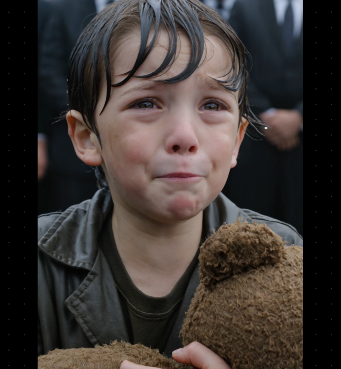
The rain had been falling since morning.
It was the kind of rain that a funeral deserves — steady, gray, the sort that soaks through wool coats and makes the flowers on the coffin go limp before the priest finishes speaking. The cemetery on Hillcrest Road had good drainage, which meant the mourners’ feet stayed mostly dry, which was the one mercy the day had offered.
There were sixty-three people gathered around the grave of Thomas Whitfield. He had been fifty-two years old. He had been, by most accounts, a successful man — founder of a regional construction company, owner of a house with four bedrooms that only ever used two, member of the kind of church where the stained glass gets cleaned professionally. His wife, Margaret, stood at the head of the gathering in a black coat that had been purchased for the occasion, her face doing what faces do when a long and complicated marriage produces genuine grief alongside the other things grief travels with.
The priest was at the third paragraph.
Nobody was expecting the boy.
He came from the direction of the access road — running, which nobody runs at a funeral, running in the specific way of someone who has been walking a very long time and has used up all their walking and gone past it into something more desperate.
He was nine years old. His clothes were wrong for a cemetery and wrong for the weather — a hoodie with the hood down despite the rain, jeans that had been through more than jeans are designed for, sneakers that had lost their color to mud and miles. His hair was plastered to his forehead.
He was clutching a teddy bear.
“Don’t bury my dad!”
The voice came out of him like something that had been building pressure for a long time and had finally found its exit. It cut through the rain and the priest’s reading and sixty-three whispered conversations about where they’d have the reception, and the gathering turned.
Two men near the grave moved toward him instinctively.
He dodged the first one. The second caught his arm.
“Hey—hey, hold on—”
“Let go of me!” He twisted, nearly got free, got pulled back. “That’s my dad! You can’t bury him, he promised he was coming back, he said—”
“Son, you can’t be here—”
“He’s my dad!” The boy’s voice broke completely on the last word — split in half by something too large for it. He stopped fighting, not because the man let go but because the fight ran out of him all at once, and he stood in the rain with the teddy bear against his chest and tears running down his face into the water already there, and he looked at the coffin.
He looked at it like he could stop it from going into the ground just by looking.
Margaret Whitfield had not moved.
This was noticed.
The women beside her had moved — hands reaching for her arm, her shoulder, the instinctive physical comfort that people extend toward new widows at dramatic moments. But Margaret had gone very still, with an expression that was not the expression of a woman witnessing an unexpected intrusion.
It was the expression of a woman recognizing something.
“Who is that child?” someone beside her said.
Margaret didn’t answer.
She was looking at the teddy bear.
Brown, worn, one ear slightly different from the other in the way of a repair. She had seen this bear before. She had not seen the child — she was certain of that, as certain as you can be about anything in a moment like this — but the bear. The bear she knew.
Thomas had kept one exactly like it in the drawer of his office desk. She had found it once, three years ago, while looking for the stapler. He had been strange about it when she asked — too casual, the specific over-casualness of a man managing his reaction — and she had let it go because there were things in a long marriage that you let go because the alternative required energy you’d decided not to spend.
She had let a great many things go.
The child was being held by a well-meaning man in a gray suit, crying quietly now, the fight finished but not the grief. His arms were wrapped around the teddy bear.
“Let him go,” Margaret said.
“Margaret—”
“Let the child go, please.” Her voice was even. Something underneath it was not even at all, but she had learned, over twenty-seven years of being Thomas Whitfield’s wife, how to keep the surface still while things moved below it.
The man in the gray suit released the boy.
The boy looked at Margaret.
She crossed the grass to him. The crowd parted, which crowds do when someone moves with enough certainty. She stopped three feet away and crouched down — slowly, because her knees were what they were — and looked at the boy’s face in the rain.
“What’s your name?” she asked.
“Caleb,” he said. He wiped his face with the arm that wasn’t holding the bear. “Caleb Moore.”
“How old are you, Caleb?”
“Nine.”
She looked at the bear.
“May I see that?” she asked. She kept her voice gentle. “Just for a moment. I’ll give it right back.”
Caleb looked at her.
He made a decision the way children make decisions — quickly, on instinct, based on something in her face rather than anything she’d said.
He held out the bear.
Margaret took it. She turned it over in her hands. She found the rip along the seam of the left side — recent, or at least not original — and she looked at it without touching it, because she already knew what was there.
She had seen Thomas sewing.
That had been three months ago and she had thought it strange — Thomas was not a man who sewed anything — and she had asked him what he was doing and he had said fixing something and she had let it go.
She let so many things go.
She pressed the bear gently along the seam.
The ring was hard through the fabric. A man’s ring — she didn’t need to open the seam further to know whose. She had seen it on Thomas’s finger for twenty-seven years. He had told her he’d lost it fourteen months ago and she had believed him because he had looked her in the eye and said it, and Thomas was many things but she had not known, until precisely this moment, that he was someone who could look her in the eye and say something that was not true.
Her hands were trembling.
Not with cold.
“He promised he’d come back for me,” Caleb said. His voice was small and absolute. “He said I had to stay with Mrs. Garrett until he sorted things out and then he was going to come get me and we were going to live somewhere better.” A pause. “He said we were going to have a real home.”
The rain fell on both of them.
Sixty-three people were silent in a way that had nothing to do with respect for the dead and everything to do with what was happening in front of the grave.
“How long have you known Thomas?” Margaret asked. She kept her voice level through what felt like a significant structural achievement.
“He’s my dad,” Caleb said. “I’ve known him my whole life.”
“Does your mother—”
“She died,” Caleb said. Simply. The way children report facts that have been facts long enough to lose their acute edge. “Two years ago. After that it was just me and Dad, but he said he had things to handle before I could live with him, and he gave me the bear so I’d know he was coming back.” His chin started shaking again. “The ring was in it. He said if anything ever happened, the ring would prove he was my dad.”
Margaret looked at the ring through the fabric.
Then at the boy.
At his face.
She looked for a long time.
Thomas had brown eyes. She had brown eyes. Their children — the two grown ones standing somewhere behind her in the crowd — had brown eyes.
Caleb had gray eyes.
His mother’s eyes, probably.
But the jaw. The set of the jaw, and the way he held his chin up even when it was shaking — she knew that jaw. She had kissed that jaw good morning for twenty-seven years.
“Mrs. Garrett,” she said. “Where is she? Is she here with you?”
“She dropped me at the road,” Caleb said. “She said she wasn’t sure I should come. I came anyway.”
“How did you know where to find us?”
“I heard Dad on the phone once. He said the name of this cemetery.” He looked at the coffin. “I didn’t know I’d have to run.”
Margaret stood up.
She turned and looked at the coffin. At the flowers going limp in the rain. At the polished wood surface that held a man she had shared her life with and apparently had not fully known.
She turned back.
She held out the bear to Caleb.
“This is yours,” she said.
He took it back immediately. Held it with both arms.
“What happens now?” he asked. “To me. What happens now?”
Margaret looked at him.
She was sixty-one years old. She was standing in the rain at her husband’s funeral in a coat bought for the occasion, and she was looking at a nine-year-old boy with a teddy bear and a gold ring sewn into its seam and gray eyes that were not her eyes and not Thomas’s eyes but were still, somehow, unambiguously part of everything she was trying to hold together.
“Now,” she said carefully, “we go somewhere warm and we talk.” She paused. “And then we figure out what comes after that.”
“Are you angry?” he asked.
She considered this with the seriousness it deserved.
“I don’t know yet,” she said. “Right now I’m just — I’m trying to understand.”
Caleb looked at the coffin one more time.
“He was going to come get me,” he said. “I need you to know that. He always came when he said he would.”
Margaret Whitfield looked at the grave of her husband of twenty-seven years, and at the child standing beside it in the rain, and she did the only thing available to her:
She told the truth.
“I believe you,” she said.
