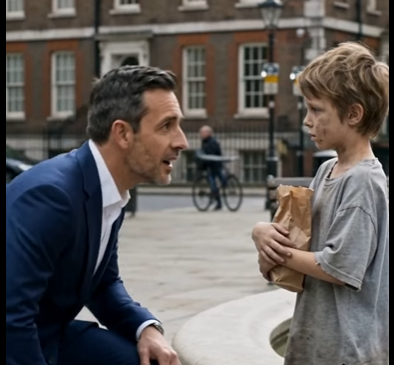
She saw him first.
Of course she did. Lily saw everything first — processed it, reported it, had already formed an opinion before her father had finished turning his head. She was seven years old and she had her father’s eyes and her mother’s complete disregard for the filters that adults spend decades constructing.
“Daddy.” She tugged his hand. Hard. The way she tugged when something was important. “That boy looks like me.”
It was a Thursday in October. The fountain plaza was moderately populated — lunch crowds thinning out, a few dog walkers, some office workers eating at the surrounding benches. The kind of ordinary urban afternoon that doesn’t expect to become anything.
The boy was on the far bench, nearest the fountain.
He was maybe eight years old, or small for nine. His clothes were the clothes of a child assembled by circumstance rather than care — a hoodie that had been through too many seasons, jeans with a tear that wasn’t fashion, sneakers wrapped at one toe with a strip of electrical tape. His hair was past the point where someone had last attended to it. He had a paper bag in his lap, the brown kind, worn soft at the handles.
He was watching the fountain with the focused attention of someone who has learned to find the interesting thing in whatever is available.
Lily was already pulling toward him.
Michael Rourke — forty-one years old, partner at a firm where navy suits were practically a uniform, divorced fourteen months ago in the specific way that leaves shared custody and a daughter every other week and a quiet apartment the other nights — followed his daughter because what else do you do.
He crouched down in front of the boy.
“Hey,” he said. The voice he used for Lily when she was upset — low, unhurried, no agenda.
The boy looked at him.
Then looked away.
“What’s your name?” Michael asked.
A pause. The calculation of whether to answer.
“Ethan,” he said.
“Ethan.” Michael nodded like this was important. “I’m Michael. This is Lily.”
Lily sat down beside the boy on the bench without being invited, because she had never understood the social convention of waiting to be invited.
“I’m Lily,” she said. “That’s my dad. He fixes legal things.”
Something moved in the corner of Ethan’s mouth. The echo of something that had been a smile once and recognized the invitation.
“Are you here with someone?” Michael asked.
Ethan looked at the fountain.
“I was waiting,” he said.
“For who?”
“I don’t know exactly.” He said it carefully. “I was told to wait here. By the fountain. Until—” He stopped.
“Until what?”
Ethan looked at him.
He had been looking at Michael with the peripheral attention of a child trying not to be caught staring, but now he looked directly. His eyes moved across Michael’s face with the focused deliberateness of someone doing a comparison they hadn’t expected to be doing.
Then he reached into the paper bag.
He had to work to get it out — the bag had been opened and closed many times and the contents had settled. He pulled out a photograph.
It was old in the way of photographs that have been handled rather than stored — soft at the edges, sepia-toned by age and contact rather than filtration. It had been folded once, carefully, and unfolded many more times than once.
He held it out.
His hand was trembling.
“Mom said,” he started. He stopped. He tried again. “Mom said if I was ever by myself and I ever met a man in a blue suit—”
He looked at Michael’s navy jacket.
“She said ask him if he’s my dad.”
Michael took the photograph.
He told himself, in the half-second before he looked at it, that this was a sad situation and the boy had clearly been through something and the photograph would show a stranger and they would handle the situation carefully and call someone appropriate.
He looked at the photograph.
The world went away.
The fountain sounds. The office workers on the nearby benches. Lily’s small commentary on the pigeons. The ambient noise of an ordinary Thursday in October.
All of it, gone.
The woman in the photograph was young — mid-twenties, dark hair, laughing at whoever held the camera in the specific way of someone who doesn’t know they’re being photographed and doesn’t mind when they realize they were. Behind her was a waterfront he recognized. The particular angle of the light on the water, the railing he remembered leaning against, the city skyline behind them that he had stopped looking at years ago because it existed only in a specific context he had learned to avoid thinking about.
He recognized the waterfront because he had been there.
He recognized it because he had been there with her.
Anna Reeves. Twenty-six years old the summer he’d known her. Four months that had ended with the particular abruptness of two people who weren’t ready for what they were, who were going different directions, who had said things at the end that he had spent the subsequent years revising in memory into something less sharp.
He had thought about her occasionally.
He had never thought about a consequence he hadn’t been told about.
He had never been told.
“Your hand is shaking,” Lily said.
She said it with the observational neutrality of a child who notes facts.
Michael looked up from the photograph.
He looked at Ethan.
He did the thing he had been doing for the past thirty seconds — the thing he had been doing from the moment Lily said that boy looks like me and he had actually looked — but he let himself do it fully now, without managing it.
The jaw. The hairline. The particular way Ethan held his head when he was thinking about something — that specific forward tilt that Michael had been told his whole life was a family thing, was the way his father had held his head, was the way his grandfather had held his head in photographs.
“How old are you?” Michael’s voice came out different from his normal voice.
“Eight,” Ethan said. “In November.”
Eight in November.
Michael counted backward with the helpless arithmetic of a person whose internal timeline has just been handed new information.
Nine years.
“Where is your mother?” His voice was very careful now. The voice of someone carrying something large and trying not to drop it. “Ethan. Where is she right now?”
Ethan’s face changed.
The careful composure — assembled over months, maybe years, of being the only person responsible for his own situation — moved at the edges.
“St. Catherine’s,” he said. “She’s been there for three weeks. They said she’s getting better.” A pause. “Better takes time. She said wait by this fountain and she’d send someone, and I’ve been—” He looked at the paper bag. “I’ve been waiting four days.”
“Four days,” Michael said.
“She always comes when she says she will,” Ethan said. “She always has before. But this time she said she might not be able to come herself and if a man in a blue suit stopped by the fountain—” He looked at Michael’s jacket again. “She said I’d know.”
Michael looked at the photograph in his hand.
At Anna’s face, laughing at the camera, in a summer nine years ago.
At the boy on the bench.
“She said you’d know,” Ethan repeated. More quietly. The question underneath the statement surfacing. “Do you?”
Michael closed his hand around the photograph.
He looked at Lily, who had been quiet for the past two minutes — which was unusual enough that he registered it. She was watching him with her father’s eyes, which meant she was watching him with the eyes currently visible on the bench to his left, and she was doing the same calculation she’d started when she’d grabbed his hand and said that boy looks like me.
“Daddy,” she said.
He looked at her.
She had nothing else to say. She just wanted him to see that she was there. That she’d been there for all of it.
He nodded at her.
He looked at Ethan.
“St. Catherine’s is six blocks from here,” he said. His voice was different now — decided, the way his voice got when a decision had been made and the next step was simply to move toward it. “I know where it is.”
“I can’t leave,” Ethan said. “She said wait by the fountain.”
“You won’t be alone,” Michael said. “And she won’t have to send anyone.” He stood. He held out his hand. “We’re going to her.”
Ethan looked at the hand.
He looked at the photograph, which Michael was still holding.
He looked at Michael’s face for a long time, running whatever final calculation needed running.
“She said I’d know,” he said again.
“I know,” Michael said. “So will you.”
Lily stood up from the bench and took Ethan’s other hand without asking.
Ethan looked at her.
“You really do look like me,” he said.
“I know,” she said, like this was already settled, like it had been settled from the moment she pulled her father toward the fountain. “Come on.”
They walked away from the fountain, the three of them, toward St. Catherine’s six blocks north, and the October afternoon went about its business around them, and the paper bag sat forgotten on the bench with the photograph no longer inside it because Michael had kept that, held it at his side as he walked, held it like something he was going to need to show to someone very soon.
