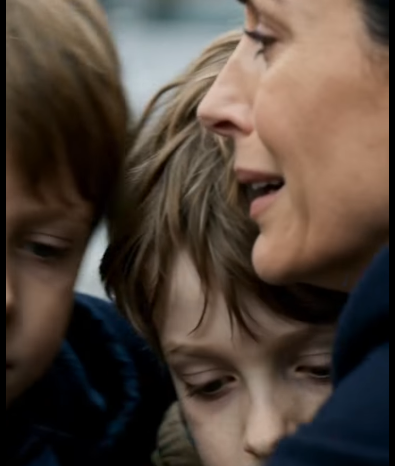
She heard them before she saw them.
Not their voices — they weren’t speaking. She heard the absence of something, the specific silence that falls on a city sidewalk when something happens that makes strangers slow down without knowing why. She had been walking from the grocery store on Clement, bag in both arms, thinking about whether she’d remembered the pasta, and then she came around the corner and the bag hit the pavement.
She didn’t feel it fall.
She didn’t hear the oranges rolling.
She was looking at the two boys on the bench.
They were identical.
That was the first thing — the blunt, impossible fact of it, delivered without warning on a Wednesday afternoon in February with her groceries on the ground and her breath making small clouds in the cold air. Two faces, exactly matched. Same jaw. Same eyes. Same hairline. Same particular way of holding the head slightly forward when paying attention to something.
She knew that posture.
She had watched it develop from six months old.
The boy on the left was wearing a blue winter coat, the good kind, with a hood and toggles and the name of a reliable brand on the chest. Clean sneakers. His cheeks were the pink of a child who is warm enough inside and outside. He was watching a pigeon with the serene attention of someone who has nowhere urgent to be and that’s fine.
The boy on the right was wearing a coat that had been, at some point, a man’s zip-up fleece — gray, two sizes too large, the hem hanging past his thighs. His jeans were wrong for the temperature. His shoes had the compressed look of shoes that have been walked in every day for many months. His hair needed cutting. His wrists were thin where the fleece cuffs fell back.
He was holding the other boy’s hand.
Just holding it, loosely, the way you hold the hand of someone you’ve just met and are still deciding about.
“No,” the woman said. She said it before she could stop herself, before she could decide whether to say anything at all. “That’s impossible.”
The oranges reached the curb. A man in a gray coat stopped walking.
Then two more people.
The thin boy looked up.
He looked at her the way children look at things that are very large and coming toward them — measuring, calculating, deciding.
Her name was Anna Morrow. She was thirty-four years old and she had been living for two years with a specific, categorical absence in her life that had been classified as a missing persons case, had been investigated, had been given a case number and assigned to a detective named Rivera who called her on the fourteenth of every month to say there was no new information.
Her twin sons had been four years old when it happened. She had been in the hospital for six days — a car accident, not her fault, the kind of accident that takes weeks to stop rewriting itself in your memory. When she came home, her mother-in-law, who had been watching the boys, met her at the door and said the words that Anna had spent two years unsuccessfully teaching herself to put down.
Thomas is gone. We don’t know where. We’ve called everyone.
Liam had been found in the park two blocks away, standing by the fountain, clutching his stuffed elephant. Thomas had not been found.
Had not been found.
Until now.
Until a Wednesday afternoon in February when she rounded a corner on Clement Street and found both of her sons sitting on a bench outside a pharmacy, one of them holding the other’s hand.
She sank to her knees on the sidewalk.
The cold concrete went through her jeans and she didn’t register it.
“Thomas,” she said. Barely a sound.
The thin boy on the right went very still.
“I thought I lost you,” she said. “I thought—” She couldn’t finish it. The sentence had no ending she could say out loud. “I looked for you every day. I have a room for you. It’s been there for two years, I couldn’t—I couldn’t change anything in it because I thought—”
The thin boy was looking at her with something in his face that was not quite recognition and was not quite the absence of it. Something in between. Something that had been waiting.
“What’s my name?” he asked.
“Thomas,” she said. “Thomas James Morrow. You’re six years old. Your brother’s name is Liam. You were born at Saint Catherine’s on March third and you weighed six pounds four ounces and you cried for forty minutes straight and then went completely quiet and it scared me half to death.”
Something moved across his face.
“I was here,” he said. Quietly. Simply. Like reporting a location.
And then she broke.
Not gradually. All at once — the way things break when they’ve been under sustained pressure for a very long time and the pressure suddenly releases. She pulled both boys into her arms on the cold sidewalk and held them with the specific completeness of someone who has been missing two pieces of themselves and has just found that both pieces are here, are real, are present.
Her hand gripped the worn collar of Thomas’s oversized fleece.
She did not let go.
Liam went rigid for a moment — the natural startle of a child suddenly embraced — and then relaxed. He put his arms around her.
Thomas was harder.
He stayed very still inside the embrace, not pulling away but not fully arriving either. She felt it. She held him anyway. Not tighter — just steadily, the way you hold someone when you want them to feel the constancy rather than the force.
“It’s okay,” she said. “I’ve got you. I’ve got both of you.”
A woman nearby had pressed her hand over her mouth. The man in the gray coat had his phone out but wasn’t filming — he was looking at the screen without pressing anything, the gesture of someone who has thought about recording something and then decided it belonged to the people inside it.
A minute passed. Maybe more.
Thomas’s arms moved.
Slowly. Incrementally. The way trust moves when it hasn’t been exercised in a long time — carefully, testing the structure before committing weight.
His arms went around her.
“I didn’t know where to go,” he said into her shoulder. His voice was muffled, small, six years old in the way that six is six regardless of what the six years have contained. “I couldn’t find it. I kept trying to remember the way but the streets were different and I couldn’t—”
“I know,” she said. “I know, baby. That’s done now.”
“I found Liam today,” he said. “I was just walking and I saw him. He looks like me.”
Liam, from the other side of her embrace, said: “I knew right away. I just knew.”
“You’ve always done that,” Anna said. Her voice was wrecked and warm. “From when you were small. You always just knew things about each other.” She held them tighter for a moment. “Some things don’t get lost.”
Thomas pulled back slightly to look at her face.
He looked for a long time.
“You’re our mom,” he said. Not a question. Confirming something that had been theoretical and had just become concrete.
“Yes,” she said.
“You looked for us,” he said.
“Every day.”
He looked at Liam.
Liam looked at him.
The twin language that exists below words, that Anna had watched them develop in the first weeks of their lives — the turns of the head, the small calibrations of expression that meant things she couldn’t always decode — moved between them.
Thomas looked back at her.
“Okay,” he said.
Just that.
One word that contained, in the way single words sometimes contain everything, all the weight of a six-year-old deciding to believe in something.
She pulled them both back in.
The pedestrians who had stopped were moving again now, quietly, one by one, giving the sidewalk back to its ordinary function. The man in the gray coat had put his phone all the way away. He walked past and didn’t look back, which was its own form of courtesy.
The oranges had reached the gutter.
The bag was on its side.
Anna Morrow stayed on her knees on the cold concrete with both her sons and did not think about any of it.
