The rain came down like it had a grudge.
Neon signs bled their colors across the wet asphalt — red, gold, blue — turning the sidewalk into something almost beautiful if you weren’t the one running through it. And the boy was running. Hard. Arms pumping, shoes hitting every puddle without care, breath coming in ragged white bursts in the cold night air.
He was eleven, maybe twelve. Thin in the way that means not enough, not just genetics. His jacket was soaked through — had been soaked through for the last four blocks — and his eyes were fixed on the black Mercedes idling at the curb ahead of him like it was the last lifeboat on a sinking ship.
He grabbed the rear door handle with both hands.
Yanked.
The door swung open into the rain.
The woman who stepped out was not expecting any of this.
Victoria Hale was forty-one years old, dressed for the Hartwell Foundation Gala in a floor-length silver gown that cost more than most people’s monthly rent. Her hair was pinned and perfect — or had been, before the rain found it. Her earrings caught the headlights and threw them back. She was the kind of woman who made other women feel underdressed just by existing in the same room.
She stepped into the rain and looked at the boy with an expression that started as fury and couldn’t quite decide where to go from there.
“Have you lost your mind?” she said.
The boy didn’t move. Didn’t back away. He stood in the headlight beams with rain streaming down his face, chest heaving from the run, hands balled into fists at his sides.
“Daniel.” Her driver appeared around the hood, hand raised. “Ma’am, should I call—”
“Don’t.” She kept her eyes on the boy. “Who are you? What do you think you’re doing with my car?”
“You left her,” the boy said. His voice cracked on the second word.
“I beg your—”
“You left my grandmother in the rain.” The words came out in pieces, broken up by the effort of breathing and crying at the same time. “She was standing on the corner of Fifth and Madison. She’d been waiting two hours. It was raining and she had — she had a plastic bag over her purse because she didn’t have an umbrella and she just stood there, getting soaked, waiting for you to come.”
Victoria blinked. Rain dripped from her lashes. “I don’t know what you’re talking about.”
“She called you fourteen times.” The boy pulled a cracked phone from his jacket pocket, screen spiderwebbed but still lit. “Look. Fourteen calls. No answer.”
Victoria’s jaw tightened. “I was at an event. I had my phone off—”
“You never looked back.” His voice went to pieces entirely on that sentence. “That’s what she said when I found her. She said, ‘She never looks back.’ She wasn’t even angry. She was just — sad. Like she already knew.”
The rain fell between them.
“Where is she now?” Victoria said, and something in her voice had shifted — the fury dimming, something else moving underneath.
“The hospital.” He met her eyes. “She collapsed on the corner. An ambulance came. I rode with her because there was nobody else.”
Victoria’s hand came up to her collarbone. “That’s not — my mother is fine. She was at home tonight, she—”
“Her name is Ruth,” the boy said. “Ruth Calloway. She’s seventy-three. She has a photograph of you on her nightstand and she calls it her favorite thing in the whole apartment.”
The name landed like a stone in still water.
Victoria didn’t speak.
The driver had gone very still beside the car.
“You need to come,” the boy said. “She’s asking for you. She keeps asking, ‘Did Victoria come yet?’ And the nurses look at me and I don’t know what to tell them.”
“Why are you—” Victoria’s voice had lost its certainty entirely. She was looking at him differently now. Had been for the last thirty seconds, though she hadn’t admitted it to herself yet. “Why are you there? Who are you to her?”
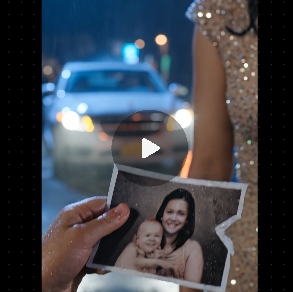
The boy reached into the inside pocket of his jacket — carefully, the way you handle something irreplaceable — and pulled out a photograph.
It was torn. Soaked through. The colors had blurred at the edges from the water, but the image was still clear enough: a young woman holding a newborn, both of them in what looked like a hospital room, the woman’s face tilted down toward the baby with an expression of complete and total love.
He held it out toward Victoria.
His hand was shaking.
“She gave me this,” he said. “Two months ago. She said to keep it safe. She said one day it would matter.” He swallowed hard. The photograph trembled in the rain. “She said you were my real mother.”
The sound Victoria made was not a word.
She took one step forward. Stopped. Looked at the photograph — the young woman’s face, younger by twenty years but unmistakably her own — and then looked at the boy standing in the headlights with rain and tears indistinguishable on his face.
“That’s not possible,” she whispered. “I never — I don’t have—”
“She said you were seventeen,” the boy said. “She said you were scared. She said she promised you she’d take care of me and that you could come back when you were ready.” His voice dropped to something barely there. “She said you just never came back.”
The silver gown was soaked through. Victoria didn’t seem to notice.
She was looking at his face. At the line of his jaw. At something in his eyes that she recognized the way you recognize music you haven’t heard in years — not consciously, not immediately, but somewhere deep and cellular and undeniable.
“What’s your name?” she breathed.
“Noah,” he said. “She named me Noah.”
The headlights blazed behind him. The rain fell without mercy.
Victoria Hale, who had spent twenty-three years not looking back, stood completely still on a wet city sidewalk and felt the past arrive like a train she had forgotten she was standing in front of.
The photograph shook in Noah’s hand.
She reached out — slowly, the way you move toward something you’re terrified of breaking — and covered it with both of her own.
Neither of them spoke.
The rain did enough.
