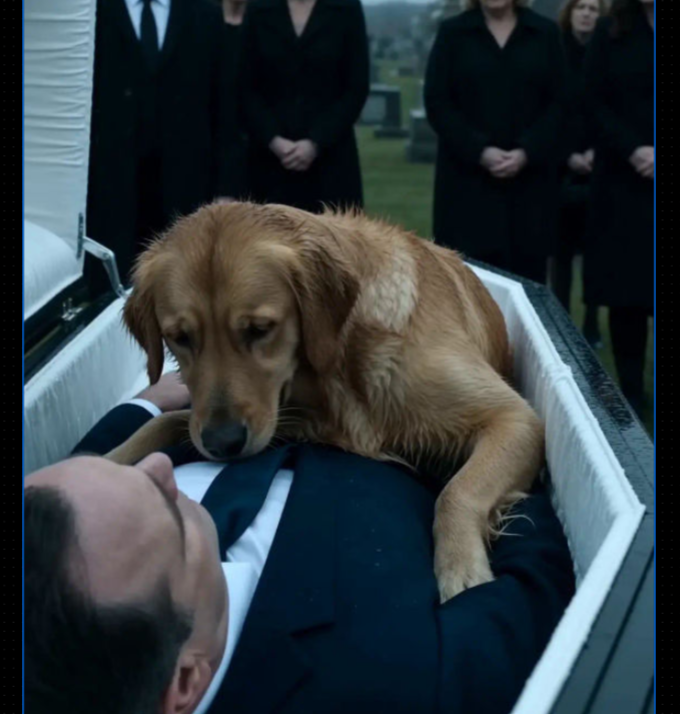
The dog arrived before the hearse.
Nobody saw him come through the cemetery gate. He was simply there when the procession turned up the gravel path — a golden retriever, fur damp from the morning rain, sitting beside the grave with the particular stillness of an animal that has decided where it needs to be and has no intention of moving.
Someone said it was touching.
Someone else said it was a sign.
Father Connelly, who had been doing this for thirty-one years and had catalogued the full range of behaviors that grief produces in both humans and animals, said nothing. He made a note of the dog the way he made notes of everything — as information to be processed and filed and managed in the service of keeping the ceremony moving at its appropriate pace.
He had not yet understood what the dog was telling him.
His name, according to the collar that nobody checked until later, was Buddy. He had belonged to Martin Ellison for nine years. He had slept at the foot of Martin’s bed, walked beside him every morning on the route that took them through the park and back, eaten the piece of cheese that Martin produced from his jacket pocket at the midpoint of every walk without fail.
He had been present two days ago when Martin Ellison sat down in his armchair and closed his eyes.
He had stayed beside the armchair for six hours before the neighbor came in and understood what had happened.
He had not been in the house since. He had gotten out through the back gate — nobody knew how — and he had made his way to this cemetery, which he had walked past with Martin on the longer route, and he had sat beside the grave, and he had waited.
The service began at ten.
The coffin was open, as Margaret Ellison had insisted — a traditional viewing, a last public presence for a man who had always been better in rooms full of people than alone. The family stood on the left. The neighbors on the right. Father Connelly at the head with his book and his practiced solemnity.
Buddy stood in the coffin.
He had positioned himself during the transport, when the pallbearers had set the coffin down, and he had not left. He was lying across Martin’s chest with his head against Martin’s shoulder, and he was whimpering in a register that was quiet enough to be private and constant enough to be impossible to ignore.
Father Connelly cleared his throat.
He began with the opening prayer.
Buddy’s whimpering continued under the words.
Margaret Ellison, standing at the front, pressed her lips together and said nothing. Her daughter reached for her hand.
The prayer continued.
Then Buddy stood up.
It happened fast and without warning — the retriever rising from his position, paws on either side of Martin’s body, back legs braced against the coffin’s interior walls. He was barking. Not the alert bark of a dog hearing something outside a window, not the play bark of an animal at a game. Something different. Something with urgency in it, with a quality that the people nearest the coffin felt in their chests before they processed it with their ears.
The ceremony stopped.
Father Connelly raised his hands — the practiced gesture of a man accustomed to managing interruptions.
“Somebody take the dog away,” he said.
Buddy turned.
He looked at the priest with the wet, focused eyes of an animal that has decided it is communicating and is frustrated that the communication is not being received. He barked once. Deep. The kind of sound that arrives at the bottom of the register where it becomes something you feel rather than hear.
Father Connelly, who had been surprised by very little for thirty-one years, felt something he later described, with characteristic understatement, as unease.
The mourners were whispering.
Margaret’s daughter — her name was Clara, she was thirty-two, she had driven four hours this morning — leaned toward her mother.
“Should we get him?” she said.
“No,” Margaret said. She said it with a certainty that surprised them both.
Buddy had turned back to the coffin.
He was scratching at Martin’s chest.
Not aggressively — with the controlled, deliberate motion of an animal doing something purposeful. His front paw moving in short strokes against the front of Martin’s jacket. Over and over. Barking between strokes, looking up at the assembled mourners, looking back down.
“What is he doing?” someone said.
“He’s grieving,” someone else said.
“That’s not what that looks like,” said a third person — a woman named Dr. Patricia Hayes, who had been Martin’s neighbor for six years and was also, in her non-neighbor life, a cardiologist. She had been watching Buddy for thirty seconds with a quality of attention that was different from everyone else’s.
She moved toward the coffin.
“Patricia—” Father Connelly started.
“One moment,” she said.
She reached into the coffin.
She pressed two fingers against Martin Ellison’s neck.
She held very still.
The graveyard went completely quiet.
“Call an ambulance,” she said.
Her voice was level with the specific levelness of a person who has trained for urgency and is applying that training right now.
“I’m sorry?” Father Connelly said.
“Call an ambulance.” She was already adjusting Martin’s collar, already repositioning herself. “Now. Please. Right now.”
Clara had her phone out.
Margaret Ellison took one step toward the coffin.
“Patricia.” Her voice was a structure barely holding. “What are you—”
“There’s a pulse,” Dr. Hayes said. “It’s very weak. It’s slow. But it is there.”
The words arrived in the graveyard and displaced everything else — the rain, the ceremony, the whispers, Father Connelly’s composure, the careful choreography of a proper funeral for a good man.
Martin Ellison had a pulse.
Buddy had known.
Had known, presumably, since the armchair — had stayed beside it for six hours not out of grief but out of the same thing that had made him stand up in the coffin and scratch at the chest and bark at a priest who was trying to bury someone who was not yet dead.
Dr. Hayes was performing what she could perform in a coffin in a graveyard in October while Clara said the address into her phone and Margaret stood with both hands pressed flat against her face and Father Connelly stood with his book closed and his thirty-one years of experience providing no guidance for this specific situation.
Buddy stood at the foot of the coffin.
He had stopped barking.
He watched Dr. Hayes work with the calm attention of an animal that has delivered its message and is waiting to see if the humans will do what needs to be done.
“He’s breathing,” Dr. Hayes said. “He’s — Martin. Martin, can you hear me?”
No response.
“Martin.” Louder. “Martin Ellison. Open your eyes.”
The graveyard waited.
Martin Ellison’s left hand, which had been resting at his side, moved.
It was a small movement — the fingers curling slightly, the hand turning a fraction, the reflexive reach of a man coming back from somewhere very far away.
Buddy moved the length of the coffin in one step.
He put his head against Martin’s hand.
Martin’s fingers closed around the dog’s ear.
“Oh God,” Margaret said. She said it with her hands still pressed to her face, muffled, barely audible. She said it as a prayer and a fact simultaneously.
“The ambulance will be here in four minutes,” Clara said. Her voice was the voice of someone holding everything together through the sheer force of function. “Four minutes, Mom.”
Father Connelly looked at his book.
He looked at the coffin.
He looked at the dog who had stood in that coffin and barked at him when he’d tried to have it removed, who had scratched at a chest that contained a beating heart nobody had checked, who had known something with the part of a dog’s brain that operates below language and protocol and the assumption that the professionals in the room have covered the necessary bases.
“In thirty-one years,” he said. Quietly. To no one in particular.
Dr. Hayes looked up.
“Don’t,” she said. “Keep it for the homily.” A pause. “Different homily.”
The ambulance arrived in four minutes and twenty seconds.
Martin Ellison arrived at Saint Catherine’s Hospital with a heart rate of twenty-eight beats per minute and a core temperature that answered several questions about why he had appeared, by every available measure, to be dead.
He was not dead.
He was in the ICU for eleven days.
On the twelfth day, Margaret brought Buddy.
She smuggled him in under a large coat, which fooled no one but which the nursing staff on that floor chose not to address, because some things are more important than the policy about animals in ICUs and they had heard the story of what happened at the cemetery and they had made a collective, unofficial, undocumented decision about where they stood on the matter.
Martin Ellison opened his eyes when the dog put his head on the bed.
“There you are,” he said.
His voice was barely anything.
But it was something.
Buddy’s tail moved.
