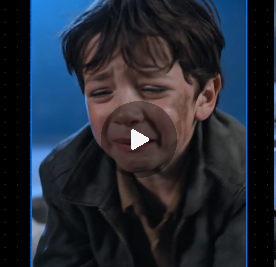
Winter in the city had no mercy.
It came in through every gap — collar, cuff, cracked sole — and stayed until it owned you. The sidewalk on Delaney Street was glazed with ice that caught the orange glow of the streetlights and gave nothing back. It was the kind of cold that made metal hurt to touch and made breathing feel like a small punishment.
The boy had been sitting there for two hours.
He was ten, maybe eleven — the kind of age that’s hard to guess when someone has been living rough long enough to look older in the eyes and younger everywhere else. His name was Max. He had a sleeping bag, a backpack with a broken zipper, and a puppy — small, white-and-tan, barely twelve weeks old — tucked inside his coat against his chest where the warmth was.
The puppy was the reason he stayed in one spot. She couldn’t walk far in the cold. Not yet.
He had almost enough for a night at the warming shelter. Almost.
He heard the SUV before he saw it — a black Range Rover moving too fast for an icy street, music audible even through the glass, headlights sweeping around the corner with the confidence of something that expected everything else to move out of its way.
It didn’t slow down.
The wall of gray slush hit Max like a wave hitting a rock. The world went sideways — icy water, gravel, the shock of cold so complete it stole his voice before he could use it — and he went down hard on his elbow and hip, the impact jarring through his whole body.
His only thought, even falling, was the puppy.
He curled around her as he hit the ground. Took the asphalt on his forearms. Felt something tear in his pocket — the lining giving way — and heard, in the terrible silence after impact, the small bright sound of metal hitting the grate of a storm drain.
Then nothing.
Then the driver’s window came down.
“Watch where you sit!” The man’s voice was warm with liquor and amusement. Fifty-something, heavy jaw, the kind of face that had never really learned to take itself seriously.
He laughed once. Rolled up the window.
And that was when Max looked down at the storm drain.
“No,” he breathed. “No. Please—”
He scrambled across the ice on his hands and knees, the puppy whimpering inside his coat, and pressed his face against the grate. Below, in the shallow collected water at the bottom of the drain, a silver ring caught the streetlight and winked at him like it had no idea what it had just done.
“Please,” Max said again, to no one. To the ring. To whatever version of the universe might still be listening to someone like him.
He thrust his fingers through the grate. Too small. He couldn’t reach.
He looked around desperately — for something thin, for a stick, for anything — and found nothing, and put his forehead against the cold iron of the drain cover and just breathed.
The ring had been his mother’s. She had pressed it into his hand the morning they took her to the hospital for the last time. Keep this safe, she’d said. It belongs to someone important. One day you’ll know who.
He had kept it safe for nine months. Through the shelter system. Through three evictions. Through everything.
“Hey.”
Max looked up.
The Range Rover had stopped half a block ahead. The driver’s door was open. The man was walking back toward him — but differently now. Not the loose, laughing walk from before. Something had seized up in him. He was moving the way people move when their legs are working but their brain hasn’t caught up yet.
His eyes were fixed on the drain.
He crouched down beside Max without a word. Without asking permission. He pressed his own face close to the grate and stared at the ring sitting in the shallow water below.
His breathing changed.
Max watched the man’s face go from pink to the color of old paper.
“Sir?” Max said.
The man didn’t answer immediately. He reached into his coat — the automatic gesture of someone who does everything through other people — and then stopped, because there was no one to call for this. No assistant to handle it. Just him and a drain and a ring that shouldn’t exist.
“That ring,” he said. His voice had lost every degree of warmth it had carried before. “Where did you get that?”
“It was my mom’s,” Max said carefully. “She gave it to me before she died.”
“What was your mother’s name?”
Max pulled the puppy tighter against his chest. “Why?”
The man looked at him then — really looked at him, for the first time. Took in his face, the line of it, the specific geography of his features.
“Because I buried that ring,” the man said, “with my son. Six years ago. I put it in his hand myself.”
The cold settled around them like a third presence.
“That’s not possible,” Max said.
“I know it’s not possible.” The man’s jaw was working. “And yet.”
“My mom said—” Max stopped. Started over. “She said the ring belonged to someone important. She said his name. She made me memorize it in case I ever needed—” He swallowed. “She said his name was Daniel Pearce.”
The sound the man made was almost inaudible.
“I’m James Pearce,” he said. The words came out hollow, like something had been removed from inside them. “Daniel was my son.”
Max stared at him.
“He was nineteen,” James continued, and his voice was barely a voice anymore. “Car accident. He was alone on Route 9 in January. The roads were iced.” He pressed his fist against his mouth briefly. “We never found out if anyone stopped. If anyone tried to help him. If he was alone at the end or if—” He couldn’t finish.
“My mom was a nurse,” Max said slowly. “She worked emergency response. She used to drive Route 9.”
James Pearce went completely still.
“She never talked about it,” Max continued, each word arriving carefully, like he was carrying something breakable. “But she had nights where she’d just sit at the kitchen table and stare at nothing. And once — just once — she said, ‘I did everything I could, but everything wasn’t enough, and I’ve never stopped being sorry.’“
The wind moved through the street and found every gap it was looking for.
James looked at the drain. At the ring catching light at the bottom of it. At this boy — this cold, soaked, puppy-clutching boy — who had appeared out of the dark carrying the last thread of the worst night of James Pearce’s life.
“She stayed with him,” James said. It wasn’t a question. He was assembling something, piece by piece, that he hadn’t known he needed assembled. “She stayed until—”
“She always stayed,” Max said quietly. “She said that was the job. You stay.”
James Pearce, who had laughed from a warm car window twelve minutes ago, sat down on the frozen sidewalk next to a homeless boy and a shivering puppy and did not care at all about his coat.
He looked at the drain for a long time.
Then he looked at Max.
“We need to get that ring out,” he said. His voice was different now — stripped of the liquor warmth, stripped of the entitlement, stripped down to something older and more essential. “And then I think you need to tell me everything you know about your mother.”
Max looked at him for a long moment. The puppy poked her nose out from the coat and sniffed the cold air.
“Okay,” Max said. “But can we do it somewhere warm?”
For the first time since he’d walked back from that car, James Pearce almost smiled.
“Yeah,” he said. “We can do it somewhere warm.”
He stood up. Extended his hand — not the gesture of a man accustomed to apology, but the gesture of one attempting it for the first time in a long time.
Max took it.
The ring stayed in the drain for now. But it wasn’t going anywhere. Some things wait exactly as long as they need to.
