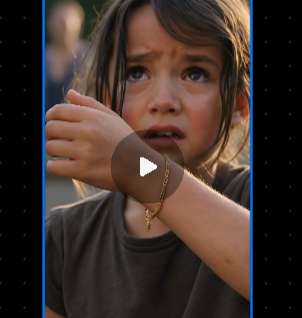
The screaming started at eleven forty-three.
One moment the Millbrook Zoo’s wolf habitat was the ordinary destination of a Tuesday morning crowd — parents with strollers, school groups with clipboards, couples eating pretzels from paper bags. The next moment a small girl was over the barrier and dropping four feet to the enclosure path below, and the crowd that had been watching wolves was watching something else entirely.
She had seen the cub before anyone else did.
That was the thing nobody understood until later — that she hadn’t jumped on impulse, hadn’t panicked, hadn’t acted out of childish recklessness. She had been watching the enclosure for seven minutes, standing at the viewing fence with both hands on the rail, watching the space between the habitat’s outer service path and the main enclosure, where the maintenance fencing ran along the rock face.
She had seen the small shape caught in the wire.
She had watched it struggle.
She had looked around for an adult who was looking at the same thing.
Nobody was.
The cub was maybe three months old. It had gotten through a gap in the service fencing — the kind of gap that maintenance was supposed to check and hadn’t, the kind of gap that becomes a crisis on a Tuesday morning when a wolf cub finds it at the wrong angle and gets a leg caught in the twist of old wire that was supposed to have been replaced last spring.
The cub had been struggling for twenty minutes by the time she got there.
The girl went over the barrier.
Her name was Rose. She was seven years old. She had been at the zoo since the gates opened because the zoo was free on Tuesdays with the county access card, which meant it was one of the places you could go and be inside something warm and full of living things without having to account for your presence.
She had been there before.
She knew where the wolves were.
She landed on the service path below the barrier and moved fast — not running, because running would startle the cub and startle the adult wolves watching from the habitat above. She moved the way she’d seen people move around animals, low and quiet, her approach direct and non-threatening.
The cub heard her and tried to pull back. The wire tightened.
“Stop,” she said. Quietly. The way you talk to something that is afraid. “Stop. I’m going to help. Stop moving.”
She knelt.
The wire was twisted around the cub’s left foreleg — not deeply, but enough. She had no tools. She had her hands.
She started working the wire.
“Stop hurting him!” she called up at the barrier, because the security guards were arriving and the crowd was pressing forward and the noise was exactly the wrong kind for a frightened animal. “Stop making noise!”
Above the barrier, the crowd had rearranged itself in the particular pattern of a crowd watching a crisis — the front row pressed against the railing, the rows behind standing on tiptoe, phones raised, a steady current of alarm moving through the group.
Two security guards were on radios. A third was running for the service gate that would let them access the path.
A woman near the back of the crowd had not moved toward the barrier.
Her name was Sylvia Hartwell. She was forty-three years old. She was at the zoo with her nephew, who had wandered toward the adjacent habitat and would need to be retrieved shortly. She had been half-present in the way of adults accompanying children to things, which is to say present physically but mentally elsewhere.
She had heard the screaming. She had moved forward with the crowd.
She was looking at the girl on the service path below — this small, dirty, courageous child working at a wire trap with her bare hands — and she was seeing the bracelet.
Gold chain. Thin. The kind sized for a child’s wrist. With a single charm, small enough to be easy to miss but visible in this light, in this moment, at this angle: a flower. Daisy. Petals detailed in the small specific way of something made to last.
Sylvia Hartwell had not breathed in the last thirty seconds.
“That bracelet,” she said.
No one near her was paying attention to her.
“That bracelet,” she said again, louder.
The woman beside her glanced over.
“Was on my daughter,” Sylvia said.
The security gate opened and two guards came through.
The girl looked up when she heard them.
“Don’t scare him,” she said immediately. “He’s almost free. Don’t come fast.”
The guards stopped.
One of them — younger, with the good instincts of someone who hadn’t yet been trained out of them — crouched down.
“Okay,” he said. “Okay. We’re not coming fast. You’re doing great. What do you need?”
“Something to cut the wire,” she said. “Or gloves. If you have gloves you can do it. My hands aren’t strong enough for the last piece.”
He had gloves.
He crossed to her slowly, crouched beside her, and took over the last section of wire with hands that had the strength she didn’t.
The cub came free.
It scrambled backward, three-legged for a moment, testing the weight on the freed leg. Then it moved. Not away — it stood ten feet back and looked at the girl with the yellow wolf eyes that don’t operate on human schedules of gratitude and understanding but that looked, to everyone watching, like something.
The girl looked back.
Then she sat down on the service path and started crying.
Not from fear. She hadn’t been afraid, or hadn’t let herself be afraid while the thing needed doing. But the thing was done now, and the adrenaline was leaving, and she was seven years old and she had just been kneeling in a wolf enclosure with her hands on wire, and her body had opinions about that.
The young guard sat beside her.
“Hey,” he said. “You did really well.”
She nodded, wiping her face with the back of her wrist.
“Is he going to be okay?” she said.
“Yeah. He’s going to be okay.” The guard looked at the cub, already moving toward the habitat. “Because of you.”
Sylvia Hartwell had found the service gate.
She didn’t know the protocol. She knew the bracelet, and she knew the small girl wearing it, and she walked through the gate with the complete disregard for proper procedure of a person who has identified something more important than proper procedure.
“Ma’am—” A guard moved toward her.
“That child,” she said. “The girl who went over the barrier.” She kept walking. “I need to see her. Right now.”
“Ma’am, this is a restricted—”
“Now, please.”
Something in her voice cleared the path.
She reached the service path.
The girl looked up.
Sylvia crouched down.
She was looking at the bracelet. At the daisy charm. At the particular way the clasp sat, slightly to the left of center, because the bracelet had been sized for a smaller wrist and the clasp migrated.
She knew the clasp.
She had fastened it herself.
“Hi,” she said. Her voice was barely functional. “Hi. I’m sorry to— I just need to — that bracelet.” She pointed. “Can you tell me where you got it?”
The girl looked at her bracelet.
“A lady,” she said. “An old lady who lived by the park. She said it was for someone brave.”
“When?” Sylvia’s voice broke on the word.
“Last winter. She said she’d been keeping it for a long time and she couldn’t keep it anymore.” The girl looked at the woman crouching in front of her. “Did I do something wrong?”
“No.” Sylvia pressed her lips together. “No, you didn’t do anything wrong.” She looked at the daisy charm. “My daughter had a bracelet exactly like this. I bought it for her when she was about your age.” A pause. “I haven’t seen it in four years.”
The girl was quiet.
“Where’s your daughter now?” she asked.
Sylvia looked at her — at this small brave girl who had jumped a fence to save a wolf cub, who was sitting on a service path in a zoo with tear tracks through the dirt on her face, who was wearing a bracelet that had traveled through four years and several pairs of hands to arrive here.
“I don’t know,” she said. “She got lost. We’ve been looking.”
The girl’s eyes moved over Sylvia’s face with the focused reading of someone who does this constantly, who has learned to extract information from expressions.
“How old was she?” she said. “When she got lost?”
Sylvia looked at her.
“Three,” she said.
The girl looked at her bracelet.
Then back at the woman.
“I was three when they found me,” she said carefully. “I don’t remember before that.”
The zoo kept going around them — the distant sounds of animals and families and an ordinary Tuesday morning, none of which knew what was happening in the wolf habitat’s service corridor.
Sylvia Hartwell reached out very slowly and touched the daisy charm.
One finger. Just the flower.
“She had a birthmark,” she said. “On her left wrist. Below the bracelet.”
The girl looked down at her left wrist.
She pushed the bracelet up.
The service path went very quiet.
