The Necklace
The rain had been falling since dawn.
It came down in sheets over Riverside Memorial Cemetery, soaking the black umbrellas, darkening the expensive wool coats, plastering the white roses flat against the lid of the mahogany coffin. It was the kind of rain that felt deliberate — like the sky itself was in mourning.
But no one seemed to notice the boy.
He stood at the edge of the burial canopy, maybe eight years old, maybe nine. His sneakers were soaked through. His thin jacket — gray, unzipped — clung to his bony shoulders. He had no umbrella. He had no one. He simply stood there, staring at the coffin with enormous, reddened eyes, his small hands pressed together in front of him like he was praying or begging or both.
The mourners around him were wealthy. That much was obvious. Designer black. Catered grief. The kind of people who hired a string quartet even for a burial.
No one had spoken to the boy.
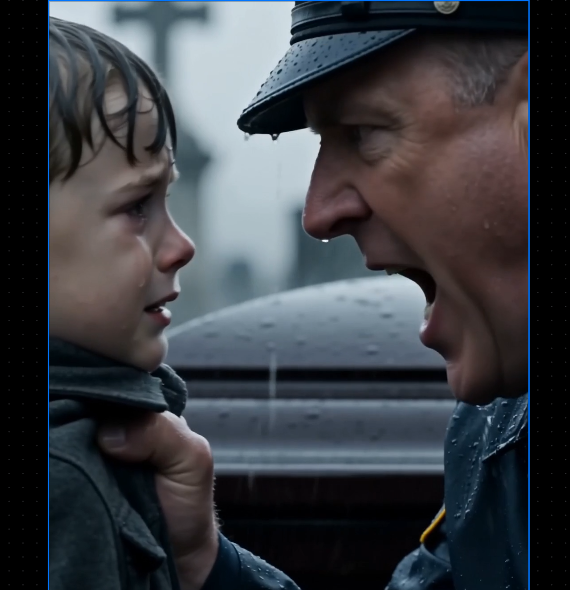
No one, until the security guard noticed him stepping closer to the coffin.
“Hey.” The guard’s hand shot out and grabbed the boy’s shoulder, yanking him backward. His voice was loud — too loud for a funeral. “I told you to stay away from there.”
The boy stumbled. His eyes went wide with shock, then crumpled.
“I just want to see my mom,” he sobbed. His voice broke on the last word. Mom. Like the word itself was a wound.
The crying was immediate and complete — the kind of crying that comes from somewhere deep, the kind children can’t perform or fake. It silenced the string quartet. It turned every head.
A woman near the front row lowered her umbrella.
Her name was Margaret Hale. Sixty-three. Silver hair pinned immaculately beneath a black fascinator. She had the look of a woman who decided things — who had always decided things. She studied the boy for a long moment, the way a person studies an insect that has crawled onto their dinner table.
“Who let this child in?” she asked. Her voice was calm. That was worse than anger.
No one answered.
“He was just standing at the gate,” the guard offered. “Said he knew the deceased.”
Margaret’s jaw tightened almost imperceptibly. “He doesn’t belong here.” She lifted one gloved hand and pointed — a single, elegant motion — toward the iron cemetery gate at the end of the gravel path. “Throw him out.”
“Please—” the boy started.
“Now,” Margaret said, not unkindly, which made it worse.
The guard’s hand tightened on the boy’s shoulder. The boy didn’t fight it. He didn’t run. He simply reached up — slowly, deliberately, like he’d rehearsed this — and pulled something from beneath his soaked shirt.
A necklace.
A thin gold chain, and on it, a small pendant: a pressed flower encased in glass. A forget-me-not. Tiny. Faded. Unmistakable.
The boy held it up with both hands, tears streaming freely down his face.
“Mom told me to keep this,” he said. “She said if anyone ever tried to send me away, I should show them this.”
The guard froze.
The mourners froze.
And Margaret Hale — the woman who had not flinched at a coffin, who had not shed a single tear throughout the entire service, who had organized and commanded and controlled every element of this funeral with the precision of a general — went completely, utterly still.
Her umbrella tilted.
Rain touched her silver hair. She didn’t seem to feel it.
“Where,” she said, and her voice had changed entirely — cracked open at the center like old wood — “where did you get that?”
“My mom gave it to me,” the boy said. He wiped his face with the back of his wrist. “Before she got really sick. She said it was the most important thing she had.”
Margaret took one step forward. Then another. The crowd parted without being asked.
She knelt — slowly, painfully, a woman her age kneeling in the wet grass — until she was at eye level with the boy. Up close, her composure was gone. Something raw had replaced it.
Her voice dropped to barely a whisper.
“That necklace,” she said, “belonged to my daughter.”
The boy blinked. “Your daughter?”
“Her name was Claire.” Margaret’s voice broke on the name. “She disappeared nineteen years ago. We never—” She stopped. Pressed her lips together. Tried again. “We never found her.”
The boy stared at her.
“My mom’s name was Claire,” he said quietly.
The silence that fell over Riverside Memorial Cemetery was different from the silence before. The rain kept falling. The roses lay flat against the coffin. But every person standing beneath those black umbrellas felt the world shift — a quiet, seismic thing — as an old woman reached out with a trembling gloved hand and touched the cheek of a boy she had nearly thrown out into the street.
“Tell me your name,” Margaret whispered.
The boy looked at her steadily, with the dignity that only the very young and the very innocent ever manage to hold onto.
“My name is Daniel,” he said. “Daniel Hale.”
Margaret closed her eyes.
The guard released the boy’s shoulder.
And the rain — finally, slowly — began to stop.
