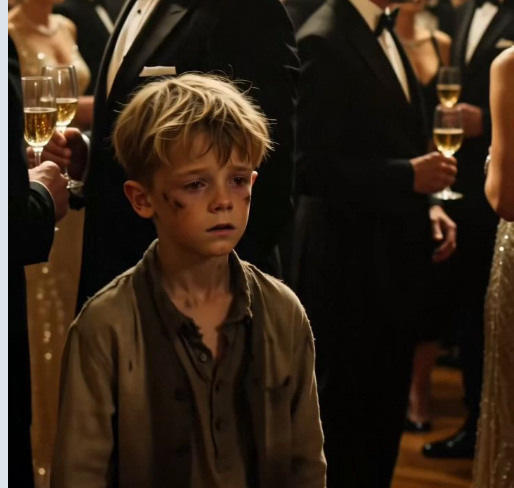
The Lady in Gold
The Whitmore Gala was the kind of event where everything gleamed.
Crystal chandeliers. Champagne flutes. The soft laughter of people who had never once worried about money — not truly, not the bone-deep way that keeps you awake at 3 a.m. The golden ballroom of the Harrington Hotel had hosted governors, ambassadors, and once, allegedly, a European prince. Tonight it held four hundred of the city’s finest, dressed in silk and diamonds, moving through the warm light like beautiful, unhurried planets.
No one noticed the boy until he was already inside.
He was maybe seven. Maybe eight. His blond hair was uncombed, pushed to one side by the wind he’d carried in with him. His clothes — dark jeans, a plaid shirt, sneakers with a split sole — stood out in that room the way a candle stands out in a cathedral. The maître d’ was already moving toward him, one hand raised, when the boy stopped walking.
He had spotted someone.
He reached into his shirt pocket and pulled out a pocket watch on a gold chain. Old. Worn smooth at the edges. He held it up, and the light from a thousand crystal prisms caught it, and for one suspended second the entire ballroom seemed to hold its breath.
The boy walked straight toward Vivienne Alcott.
Vivienne was fifty-one, and she wore it like armor. Gold gown. Perfect posture. She was mid-sentence — something about a charitable endowment — when the boy appeared at her elbow and held the watch up to her face with both hands.
“I think this belongs to you,” he said.
Vivienne stopped talking.
The people around her stopped talking.
She looked down at the watch the way you look at something you buried — something you were certain was gone forever. Her hands came up slowly, trembling, and she took it from him.
“Where,” she said, and had to stop. “Where did you get this?”
The boy reached up and carefully opened the watch himself — gently, practiced, like he’d done it a thousand times in a small room somewhere far from here. Inside the lid, protected behind scratched glass, was a portrait. Tiny. Faded at the edges. A young woman with dark hair and laughing eyes.
The boy looked at it for a moment. Then he looked up at Vivienne, and his own eyes were full.
“My mommy kept it,” he said. “She told me to find the lady in gold.” He paused, swallowed hard. “She said the lady in gold would know what it meant.”
The ballroom was silent now. Four hundred people, not one of them breathing.
Vivienne Alcott — who had chaired boards, buried a husband, rebuilt a company from nothing — made a sound she had not made in public in thirty years. A sound she had not made since the night everything fell apart. She pressed her free hand over her mouth, and tears began to move through her makeup, and she said, very quietly:
“No.”
Just that. One word. Like a door slamming on twenty years of carefully constructed composure.
“No,” she said again, softer. She clutched the watch against her chest with both hands, her knuckles white.
The boy stood his ground. He was small, and he was alone, and the crowd around him was enormous and bewildered and still — but he stood there with a steadiness that had no business existing in someone that young.
“My mommy said you’d know,” he repeated. His voice didn’t waver. “She made me promise. She made me say it exactly right. She said: Find the lady in gold. Give her the watch. Tell her Eleanor kept her promise.“
Something broke open on Vivienne’s face.
Not grief — or not only grief. Something older. Something that had been sealed behind glass for two decades and now shattered all at once, and every shard of it was visible in her expression as she looked at this boy, this impossible boy, standing in the ruins of her composure in the middle of the most elegant room in the city.
“Eleanor,” she whispered.
The word landed like a stone in still water.
Vivienne lowered herself — slowly, forgetting entirely about the gown, the guests, the cameras someone was surely pointing at her — until she was crouched in front of the boy, eye level, close enough to see the exact shade of his eyes.
They were dark. Dark and familiar in a way that made her chest seize.
“What was your mother’s name?” she asked. Her voice was barely sound. “Her full name. Please.”
The boy looked at her steadily.
Around them, four hundred people leaned in as one, and the chandeliers blazed, and the pocket watch pressed against Vivienne Alcott’s heart like a key against a lock — and the boy opened his mouth to answer.
