THE BOY WHO CALLED IT IN
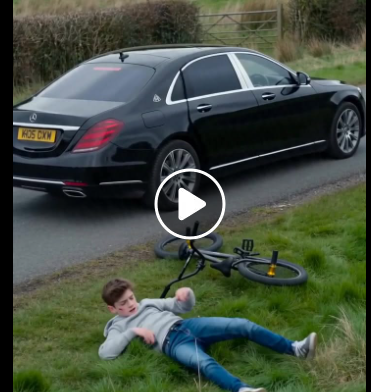
The road outside Ashford Hollow curved through farmland in long, lazy bends, the kind of rural two-lane that existed mostly for tractors and the occasional commuter cutting through to avoid the highway. Overcast sky. Gray light flattening everything into the same dull color. The kind of morning nothing was supposed to happen on.
Eli Granger was riding his BMX too fast, the way eleven-year-olds ride bikes when there’s nowhere they actually need to be and the bike is the whole point. He passed a black sedan idling near the shoulder — windows tinted, engine running, going nowhere in particular — without giving it a second look.
Then his front tire caught a pothole he didn’t see.
The bike went sideways. Eli went with it, hitting the grassy shoulder hard, the BMX clattering down beside him in a tangle of spokes and pedal.
The sedan’s passenger door opened almost immediately.
“Hey — hey, kid, are you alright?”
The man leaning out of the car was maybe forty, dressed like he’d been somewhere important before this stretch of road interrupted him. He started to step out, then stopped — the particular hesitation of someone whose instincts say help and whose training says wait.
Eli sat up slowly. Grass-stained, scraped along one forearm, but moving okay. He wasn’t looking at the man.
He was already reaching for his phone.
“I’m fine,” Eli said, not entirely steady. He pressed the phone to his ear. “Dad. Dad, it’s me.”
The man in the car went still.
“I’m okay,” Eli said into the phone, his voice climbing with urgency despite his own assurance. “I crashed my bike. I’m okay, I’m just — there’s a car here. A black car. I don’t know whose it is.”
“Kid.” The man had stepped fully out now. “It’s alright, I’m not going to—”
“Dad, send someone,” Eli said, talking over him. “Please. Now.”
The man froze with his hand half-extended.
What happened next took ninety seconds and felt like it happened in three.
The first black SUV came around the bend going far too fast for a country road, tires correcting hard as it slid to a stop. Then a second. Then a third, fanning out across both lanes with the practiced choreography of people who had drilled this exact maneuver more times than any of them wanted to admit. Doors opened before the vehicles had fully stopped. Men in dark suits spilled out, forming a loose perimeter around the boy, the fallen bike, and the now thoroughly confused man from the sedan.
A bald man in black — broad, calm, clearly the one in charge — walked straight toward the sedan with the unhurried pace of someone who has already decided how this ends.
“Sir.” He addressed the man from the sedan directly, no preamble. “Step back from the boy.”
“I didn’t do anything,” the man said, hands rising instinctively. “He crashed his bike, I was trying to help—”
“Who is this kid?” the bald man asked. Not hostile. Just precise. The question of someone gathering facts before deciding what came next.
The man in the suit — visibly rattled now, recalculating an ordinary Tuesday in real time — looked past the security agent to where Eli was sitting on the grass, phone still pressed to his ear, watching all of it unfold with the strange calm of a child who has clearly seen this exact response before.
“I don’t know,” the man said. “He just — he fell off his bike right next to my car.”
The bald agent didn’t answer him directly. He turned his head slightly, speaking into the radio clipped to his collar.
“Confirm asset secure. Visual on the principal’s son.”
“The principal’s son?” The man from the sedan said it like the words didn’t fit together. “Whose son?”
The bald agent looked at him for a long moment — the look of someone deciding how much a stranger needs to know, and concluding it’s very little.
“The chairman’s son,” he said.
The man’s face did several things in quick succession: confusion, then a kind of dawning unease, then something closer to alarm, as he ran back through the last two minutes and realized how it might have looked from another angle — a strange man stepping toward an injured child on an empty road, security cameras almost certainly already reviewing footage of his car.
“I wasn’t — I was just trying to help him,” he said, louder now, the particular fear of someone realizing they’ve accidentally wandered into a story much bigger than the one they thought they were in.
Eli, still sitting on the grass, finally lowered the phone.
“He’s fine,” Eli said to the bald agent. “He didn’t do anything. He was actually being nice. I just—” He glanced at the wreckage of his bike. “I called my dad because I was scared, and that’s just what happens now when I’m scared.”
The bald agent crouched down in front of him, his entire posture shifting from operational to something gentler.
“You did the right thing,” he said. “That’s exactly the protocol. We’d rather roll out for nothing than not roll out for something.”
“Is my dad coming?”
“He’s three minutes out.” The agent looked at the scraped forearm. “We’ll get that cleaned up before he gets here. He’s going to want to see for himself that you’re okay.”
Eli nodded, some of the tension finally leaving his shoulders.
The man from the sedan stood at the edge of the cordon, surrounded by security he hadn’t asked for, slowly understanding that he had simply been a stranger on a rural road who happened to stop near the right child at the wrong moment — and that nothing about the rest of his day was going to feel ordinary again.
When the chairman’s car finally arrived — unmarked, deliberately plain, the actual armor hidden in details most people would never notice — Eli was already standing, bike picked up off the ground, forearm bandaged by someone with a first aid kit that had clearly been used before.
His father came around the car at something just short of a run. Didn’t say anything important at first. Just put both hands on Eli’s shoulders and looked at him — checking, the way parents check, cataloguing every visible inch before believing the words I’m fine.
“You scared me,” his father said finally.
“I scared myself first,” Eli said.
His father almost laughed. Almost.
“Who’s that?” His father nodded toward the man from the sedan, still standing near his car, watching the reunion with the slightly stunned expression of a man whose Tuesday had gone somewhere he hadn’t planned for.
“He was just being nice,” Eli said. “He didn’t do anything wrong. He just stopped.”
The chairman studied the man for a moment. Then he crossed the distance between them and extended his hand — not the gesture of suspicion, but the gesture of genuine, deliberate gratitude.
“Thank you for stopping,” he said. “Most people don’t.”
The man shook his hand, still slightly disoriented by the scale of what “stopping” had apparently triggered.
“He’s a good kid,” the man managed. “He was more worried about explaining himself than he was about the scrape.”
The chairman looked back at his son — at the bike, at the bandaged arm, at the boy who had handled the scariest version of an ordinary accident exactly the way he’d been taught to.
“Yeah,” he said quietly. “He usually is.”
