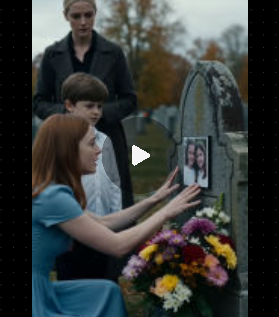
They Sit Together Every Day
The cemetery was the kind of quiet that had weight to it.
Not peaceful — heavy. The overcast sky pressed down low over the rows of headstones, and the only color in the whole gray landscape was the bouquet of yellow sunflowers that Dana Mercer carried against her chest. She came every Sunday. She had come every Sunday for three years.
Her sister, Renee, had come today too — which was unusual. Renee brought her son, Marcus, which was more unusual still. Dana hadn’t asked for company. She never did. But Renee had called that morning and said I just feel like we should all go together today, and Dana hadn’t had the strength to argue.
Marcus was six. He had his mother’s dark eyes and his father’s stubborn jaw, and he spent the walk from the parking lot asking questions about why the stones had pictures on them and whether the people inside could hear you talking.
“Some people believe they can,” Dana told him, because it was true and because she needed it to be true.
She knelt in front of the headstone and began arranging the sunflowers in the stone vase. The headstone was pale gray granite, and centered on it was an oval ceramic portrait — two girls, maybe eight and ten, laughing at something just off-camera. Forever laughing. Forever eight and ten.
“Hi, babies,” Dana said softly. “I brought flowers.”
Her voice was steady. She had practiced steady for three years.
Marcus stood beside her, hands in his pockets, studying the portrait with the focused intensity only small children bring to things adults have learned to look away from.
Renee stood a few feet back, watching.
The silence lasted maybe thirty seconds.
Then Marcus pointed.
He extended one small finger directly at the oval portrait, at the two laughing girls frozen in ceramic, and he said it the way children say things — without preamble, without awareness of consequence, with the absolute confidence of someone reporting observable fact:
“Mom. Those girls are in my class.”
Dana’s hands stopped moving.
Renee made a sound — not quite a word. Something involuntary.
The air changed.
Dana turned slowly and looked at Marcus. He wasn’t performing. He wasn’t seeking attention. He was simply looking at the photograph with mild puzzlement, the way you look at something you recognize in the wrong context — a teacher spotted at the grocery store, a friend seen across a crowded room.
Renee stepped forward. Dana watched her sister’s face arrange itself into something careful — a smile that didn’t reach anywhere near her eyes.
“I’m sorry,” Renee said, with a little laugh that came out wrong. “He must be mistaken.”
She put her hand on Marcus’s shoulder.
Marcus looked up at his mother, confused. “But Mom—”
“You’re thinking of someone else, bug.” Her grip tightened slightly. “Come on, let’s give Aunt Dana some space.”
Dana stood up.
She hadn’t planned to. Her legs simply brought her upright, and she was suddenly aware of her own breathing — too fast, too shallow — and of the way Renee was not meeting her eyes.
“Renee.”
“Dana, he’s six. He saw a picture of two little girls and—”
“Please.” Dana’s voice cracked on the word. She pressed her hand flat against her sternum, feeling her own heartbeat. “Please. Can I ask him what he meant?”
A long silence.
Renee’s jaw tightened. Something moved behind her eyes — something Dana couldn’t read and had never seen before on her sister’s face in forty-one years of knowing it.
“He didn’t mean anything,” Renee said. “You know how kids are.”
“Renee.” Dana’s voice dropped. “Those are my daughters on that stone.”
“I know who they are.”
“Then let me ask him.”
Another silence — longer, stranger, with more inside it than Dana could name.
Finally, Renee stepped back.
Dana knelt again, this time in front of Marcus rather than the headstone. She brought herself to his level, the way you do when you need a child to understand that you are serious, that what they say next matters.
“Marcus,” she said gently. “Sweetheart. Can you tell me about the girls in the picture?”
Marcus looked at the headstone. He looked back at Dana. There was no hesitation in him — none of the uncertainty that comes from being caught in a lie. Only the patient expression of a child who has been asked to explain something obvious.
“They’re in my class at school,” he said again, simply.
“What are their names?”
He thought for a moment. “Lily and June.”
Dana’s hands flew to her mouth.
She had not spoken her daughters’ names out loud to anyone in this cemetery. Not once. Not in three years. The headstone showed only Lillian and June Mercer, Beloved Daughters — and from where Marcus stood, it was impossible to read the engraving. The portrait showed only two laughing faces.
“Marcus.” Dana’s voice was barely air now. “Where do they sit?”
The boy looked at the photograph one more time, tilting his head slightly, as if making sure he had the right girls. Then he looked back at Dana, and his expression was so calm, so certain, so utterly devoid of any understanding of what he was doing to the woman in front of him.
He opened his mouth.
“They sit together,” he said. “Every day. They always save a seat.” He paused, and something shifted in his small face — a flicker of something he couldn’t name. “They told me to tell someone. They’ve been waiting.”
