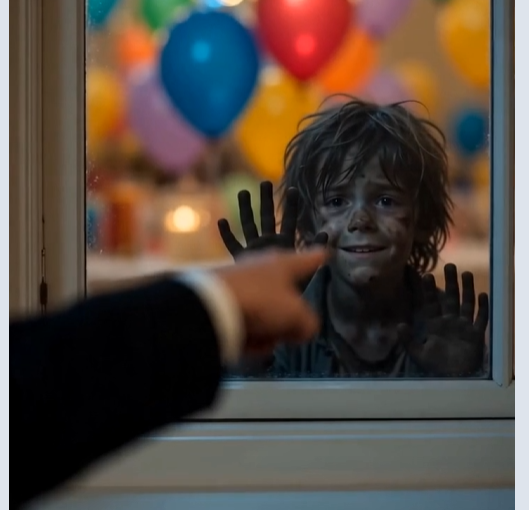
The Boy at the Window
The party was everything money could manufacture.
Three-tiered cake. Helium balloons in gold and white climbing to a twelve-foot ceiling. A hired magician. A photo booth with props. Forty children in their best clothes running through the Hargrove estate’s grand reception room, trailing streamers and shrieking with the particular joy of children who have never been told no.
Outside, it was cold and getting colder.
The boy at the window had been there for almost ten minutes before anyone noticed him.
He was small — undersized for what looked like seven or eight years — with dark circles under his eyes and clothes that had been washed so many times they’d gone colorless. His hair needed cutting. His shoes needed replacing. He stood on the stone ledge that ran along the base of the mansion’s great bay window, fingers hooked over the sill, face pressed close to the glass, and he watched the party the way starving people watch other people eat — with a hunger that went beyond the physical.
He wasn’t asking for anything.
He was just looking at the balloons.
It was Tyler Hargrove — the birthday boy, eleven years old and already fluent in cruelty — who spotted him first. Tyler stopped mid-bite of cake, pointed at the window with his plastic fork, and shouted across the room with the confidence of a child who had never once faced consequences:
“Look! The beggar came to watch us!”
The laughter was immediate. The way laughter always is when one child gives others permission.
Kids swarmed to the window. Someone pressed their cake plate against the glass. Someone else waved a fistful of balloons mockingly. A girl cupped her hands around her mouth and said something that made the group around her dissolve into giggles.
Outside, the boy at the window lowered his eyes.
His fingers stayed on the sill for a moment. Then they slipped off.
He pressed his back against the stone wall of the mansion, and the cold came off it like something alive, and he stood there with his head down while his face did something he clearly didn’t want it to do. His chin pulled inward. His shoulders came up around his ears.
A tear ran down his left cheek. Then his right.
He didn’t wipe them.
“I just wanted to see the balloons,” he said.
He said it to no one. He said it to the dark and the cold and the sound of laughter coming muffled through the glass, because there was no one else there to say it to.
Except that someone heard him.
Caroline Hargrove had been standing near the hallway entrance, phone in hand, halfway through a text to the caterer, when something made her look up. Maybe it was the shift in the room — the gravitational pull of children massing at one window. Maybe it was a mother’s instinct, the internal alarm that fires when something is wrong even if you can’t yet name it.
She crossed the room. She looked past the cluster of laughing children at the window, past the smeared cake and the fogged glass, and she saw the boy on the other side — no longer looking in, now facing away, shoulders curved, head down.
She heard what he said.
“Enough,” she said, sharply, to the children at the window. “Go back to your tables. Now.”
The laughter stopped. Tyler started to say something. Caroline looked at him once, and he didn’t finish it.
She walked to the front door.
The boy heard it open and turned, startled, ready to run — she could see it in him, that animal readiness, the flinch-and-flee that comes from being chased away too many times.
“Wait,” Caroline said. “Please. I’m not going to yell at you.”
He hesitated. His feet were pointed toward the dark driveway, toward escape, but he didn’t move.
“Are you cold?” she asked.
A pause. A small nod.
“Come onto the porch at least. Out of the wind.”
He came, reluctantly, keeping a careful distance. Up close, she could see how thin he was — the way his collar hung too wide on his neck, the sharp jut of his collarbone above it.
Above it.
Caroline’s eyes landed on the pendant.
It hung on a simple cord around his neck — a small silver disc, no larger than a thumbnail, engraved with a pattern she would have recognized anywhere, in any light, in any state of mind. A tiny tree. Roots at the bottom, branches at the top, and initials worked into the design so small you had to know to look for them.
L.H.
Liam Hargrove.
Her hand came up slowly. She pressed it flat against her own sternum, feeling her heartbeat accelerate beneath her palm.
“Where did you get that?” Her voice had gone very quiet.
The boy looked down at the pendant. “A lady gave it to me. A long time ago. She said to keep it safe.”
“What lady?”
“I don’t know her name. She found me at the station. She said—” He stopped. Seemed to be deciding something. “She said it would help someone find me someday.”
Caroline took one step closer. She couldn’t help it. Her eyes hadn’t left the pendant.
“That pendant,” she said, and her voice broke cleanly in half, “disappeared with my son.” She looked up at him. “Four years ago. He was four years old. He had that pendant on when they—when he—”
She couldn’t finish.
The boy stared at her. In the light spilling from the open door, his face was all angles and shadows, and his eyes — she hadn’t let herself look directly at his eyes until this moment — were the precise, unmistakable gray-green of her husband’s eyes.
Of her own son’s eyes.
“What’s your name?” she whispered.
The boy opened his mouth.
Behind them, from inside the mansion, Tyler’s voice drifted out: “Mom? Who are you talking to?”
Caroline didn’t turn around.
She was looking at the boy.
She was waiting.
