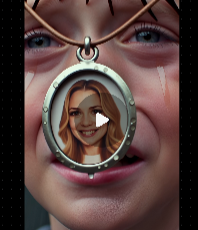
Mom Said You’d Recognize Me
The rain came down like punishment.
It had been freezing since dawn — not the clean, soft kind of winter rain that washes things away, but the hard, sideways kind that finds the gap between your collar and your neck, that turns cemetery gravel into black mud, that makes grief feel even more physical than it already is. The mourners at Greenfield Cemetery stood beneath a constellation of black umbrellas, pressed together in their wool coats and designer black, trying to hold onto their dignity in weather that didn’t care about dignity at all.
The funeral of Richard Calloway had drawn the right people. That was how his widow, Sylvia, would have phrased it. The right people. His business partners, his golf companions, his club members, the mayor’s deputy chief of staff. Sylvia Calloway stood at the center of all of them, rigid and pale and perfectly dressed, a woman holding herself together through sheer force of social architecture.
She did not notice the boy until he was already at the coffin.
He had come from the far side of the cemetery, through the service gate, slipping between the iron bars with the practiced ease of someone who moved through gaps in things — in fences, in crowds, in the notice of people who didn’t want to see him. He was small, maybe eight years old, with dark wet hair plastered to his forehead and rain-streaked cheeks that couldn’t fully hide older marks of hardship. His coat was two sizes too large and missing its bottom buttons. His shoes left muddy prints in the gravel.
He stood at the foot of the coffin with his hands pressed together, lips moving.
Saying goodbye.
He made it almost thirty seconds before Sylvia saw him.
She crossed the distance between them in seven steps, and when she grabbed the back of his hood and pulled, she was already screaming.
“Get away from here!” Her voice cut through the rain, through the low organ music from the portable speaker, through every hushed conversation. Heads turned. “You don’t belong at this funeral! Get away from that coffin right now!”
The boy stumbled but didn’t fall. He turned to face her, and his face was a wreck — rain and tears and the particular devastation of a child being denied the one thing they came for.
“I need to say goodbye to Mommy,” he sobbed.
The word landed like a stone through glass.
Mommy.
A ripple moved through the assembled mourners. Sylvia felt it — felt them looking between her and the boy, recalibrating, asking questions with their eyes that she did not want asked. Her grip on his hood tightened.
“Your mother is not here,” she said, each word measured and precise and cold. “You have the wrong funeral. Now leave, or I will have you removed.”
“Please—”
“Security.” Sylvia raised her free hand without looking away from the boy. “I need him removed. Now.”
That was when the old man broke.
He had been standing at the tree line, twenty feet back, half-hidden in the shadow of an oak — a small, weathered man in a coat as threadbare as the boy’s, with white stubble and eyes that had seen too many hard winters. At Sylvia’s signal to security, something gave way in him. He lurched forward, his knees hit the wet gravel before anyone could process what was happening, and he lifted both hands toward the assembled mourners the way people lift their hands in old paintings — in supplication, in desperation, in the last resort of someone with nothing left to lose.
“Please!” His voice was raw. Wrecked. “Let him see her. Let the boy see his mother. Please. He has walked since yesterday morning. He has walked in the rain. He is eight years old and he just wants to say goodbye. Please.”
Silence.
Even the rain seemed to hesitate.
Sylvia stared at the old man on his knees in the mud. Something moved through her — not softness, not yet, but a crack in the certainty she’d arrived with.
She looked back at the boy.
And that was when she saw it.
A pendant. Small, silver, hanging on a thin cord around his neck, half-tucked inside his oversized collar, jostled loose by her grabbing him. She wouldn’t have seen it at all except the security guard’s flashlight caught it as he approached — a brief sweep of light across the boy’s chest, illuminating the pendant for just a second.
A locket. Round, the size of a thumbnail.
Open.
Inside it — a photograph, tiny and precise — a woman’s face, laughing, caught in some bright afternoon moment, her dark hair loose around her shoulders.
Sylvia’s hand released the boy’s hood.
She knew that face.
She had spent the last nine months trying to understand that face — finding it in her husband’s phone, in his email history, in the receipts she wasn’t supposed to find. A face that had lived in the worst corner of her marriage for nearly a year and now lay, she had believed, cold and finished in the coffin six feet from where she stood.
She had died three weeks ago. Richard had grieved in private. Sylvia had noticed and said nothing.
Her voice, when it came, had lost all its force.
“Where did you get that?”
The boy looked down at the pendant, then back up at her. The rain kept falling. His eyes were red, his face was shaking, but underneath all of it there was something steady — the steadiness of a child carrying a message too large for him, carrying it carefully, the way you carry something breakable across a long and difficult distance.
He reached up with both hands and held the locket toward her.
“Mom said you’d recognize me,” he whispered.
Sylvia Calloway looked at the boy.
She looked at the locket.
She looked at his face — really looked, for the first time, the way she had been refusing to look since the moment she spotted him — and she saw it. In the jaw. In the set of the eyes. In something ineffable and biological and devastating.
Her umbrella slipped from her fingers.
The rain hit her face and she did not move.
Behind her, someone said her name. She didn’t hear it.
She was looking at her husband’s son.
