The night my father tried to turn my rent into a leash, my sister smiled.
That smile was what I remembered most.
Not Dad’s spreadsheet.
Not Mom’s crossed arms.
Not even the threat itself.
Just Martha sitting across the dinner table, thirty-two years old and seven months pregnant, looking at me as though the decision had already been made.
“If you’re not willing to help with the baby,” Dad said, tapping one finger against the paper in front of him, “then we’ll have to raise your rent.”
For a few seconds, all I could hear was the refrigerator humming behind me.
I was twenty-five, four months into my first full-time job as an elementary school teacher, and still living in the suburban house where I’d grown up.
I paid rent.
I bought my own groceries.
I paid my student loans.
I cleaned, cooked, mowed the lawn, and handled whatever repairs Dad’s bad back prevented him from doing.
I wasn’t living there because I wanted someone to take care of me.
I was living there because rent in our area was brutal, and I was trying to save enough to get out without drowning financially.
My parents knew that.
Which was exactly why Dad’s threat landed so precisely.
I put down my fork.
“You’re going to charge me more because I don’t want to be Martha’s unpaid nanny?”
“It isn’t punishment,” Dad said.
Mom nodded quickly. “It’s about family.”
Martha’s smile widened.
That was when I stopped trying to win the argument.
Because Martha had always been the person everyone rescued.
She dropped out of college twice.
Lost jobs.
Missed rent.
Needed car repairs.
Borrowed money she never repaid.
Every disaster came with a reason, and every reason ended with Mom and Dad cleaning it up.
Meanwhile, I worked.
During college, I took out loans and cleaned bathrooms at a diner until midnight.
After graduation, I accepted the first teaching job I could get.
I never asked my parents to pay my bills.
I never expected anyone to rearrange their lives for me.
Then Martha announced she was pregnant.
The father, according to her, had “freaked out and disappeared.”
Within a week, Mom and Dad decided Martha would move into our basement.
Contractors appeared.
A kitchenette was installed.
New flooring went down.
Furniture arrived in boxes.
I even overheard Mom talking about dipping into their retirement savings.
I kept my mouth shut.
Their house. Their money. Their choice.
Or so I thought.
Then one evening, while I was making tea, I heard Mom and Dad talking in the living room.
“She’ll need a lot of help after the baby comes,” Mom said.
“Of course,” Dad answered. “We’ll all pitch in.”
Mom hesitated.
“All?”
“You, me…and Abby.”
My hand froze around my mug.
Nobody had asked me.
Nobody had discussed a schedule.
Nobody had wondered whether I wanted to spend my afternoons caring for a newborn after teaching twenty-four second-graders all day.
They had simply volunteered me.
At dinner two nights later, Mom finally brought it up.
“You’re so good with children, Abby,” she said brightly. “You’re a teacher. It makes perfect sense.”
Dad added, “You’re home by three most days anyway.”
Anyway.
I stared at him.
As if three o’clock meant my job disappeared.
As if lesson plans, grading, meetings, errands, friends, sleep, and an actual personal life didn’t count.
“I can help occasionally,” I said. “But I’m not becoming the default babysitter.”
Martha scoffed.
“Wow. I didn’t realize helping your pregnant sister was such a burden.”
I looked at her.
She was unemployed, moving into a renovated apartment for free, and already acting as if my evenings belonged to her.
“I said I’ll help sometimes.”
“That’s not enough,” she replied.
And apparently, my parents agreed.
Within days, the pressure became constant.
Then Martha started eating my groceries.
One evening I came home exhausted, opened the refrigerator, and discovered my bread, yogurt, fruit, and the leftovers I had planned for dinner were gone.
“Did you eat my food?” I asked.
Martha barely looked away from the television.
“Mom said I could.”
“She didn’t buy it.”
Martha rolled her eyes.
“Oh my God, Abby. It’s just food.”
The following morning, Mom cornered me beside the coffee maker.
“You owe Martha an apology.”
I actually laughed because I assumed she was joking.
She wasn’t.
“For what?”
“For making your sister feel unwelcome.”
Something inside me changed then.
Not dramatically.
I didn’t shout.
I didn’t slam anything.
I simply understood that there was no combination of words that would make these people see me as anything except the responsible daughter who could absorb whatever the irresponsible daughter needed.
Then came Dad’s spreadsheet.
Household costs were rising, he explained.
Utilities would increase.
There would be another person in the house.
Then the baby.
“So how much more rent?” I asked.
“We’re still calculating it.”
“And if I babysit?”
Dad leaned back.
“Then we could probably keep things where they are.”
There it was.
Plain and simple.
My rent had become a punishment for saying no.
I looked at Mom.
She wouldn’t meet my eyes.
I looked at Martha.
She was smiling.
And suddenly I realized something they hadn’t.
They thought because moving out would be difficult, I couldn’t move out.
I went upstairs without another argument.
Locked my door.
Opened my laptop.
And started calculating.
Savings.
Gas.
Groceries.
Student loans.
Insurance.
Every number hurt.
Then I remembered Jenna, another teacher at my school.
Three weeks earlier, she’d mentioned her roommate was moving in with her boyfriend.
I sent her a text.
Is your spare room still available?
Her answer arrived less than a minute later.
YES. Please tell me you’re interested.
I stared at the screen.
Then typed:
Very.
By Friday, I had toured the apartment.
It was small.
The bedroom barely fit a bed and dresser.
The kitchen cabinets were older than I was.
But when Jenna handed me a key and said, “You can come and go whenever you want,” I nearly cried.
I signed the agreement.
That night, I began packing.
Quietly.
Documents first.
Clothes.
Books.
Electronics.
The little wooden jewelry box my grandmother had given me.
I carried everything to my car in small loads and covered it with a blanket.
Then I photographed every valuable thing still in my bedroom.
My family mistook my silence for surrender.
Dad became friendlier.
Mom started discussing “baby schedules.”
Martha asked whether I preferred weekdays or weekends.
I gave vague answers.
They thought they had won.
I had simply stopped negotiating.
A few nights later, I sat at my desk and wrote a letter.
I explained that I was moving out.
That my rent was paid through the end of the month.
That I would not be providing regular childcare.
That anything belonging to me was not to be given to Martha.
And that I wanted all further discussions about money documented in writing.
I printed it.
Folded it.
Slipped it into an envelope.
At six the next morning, I pushed it under my parents’ bedroom door.
Then I went to work.
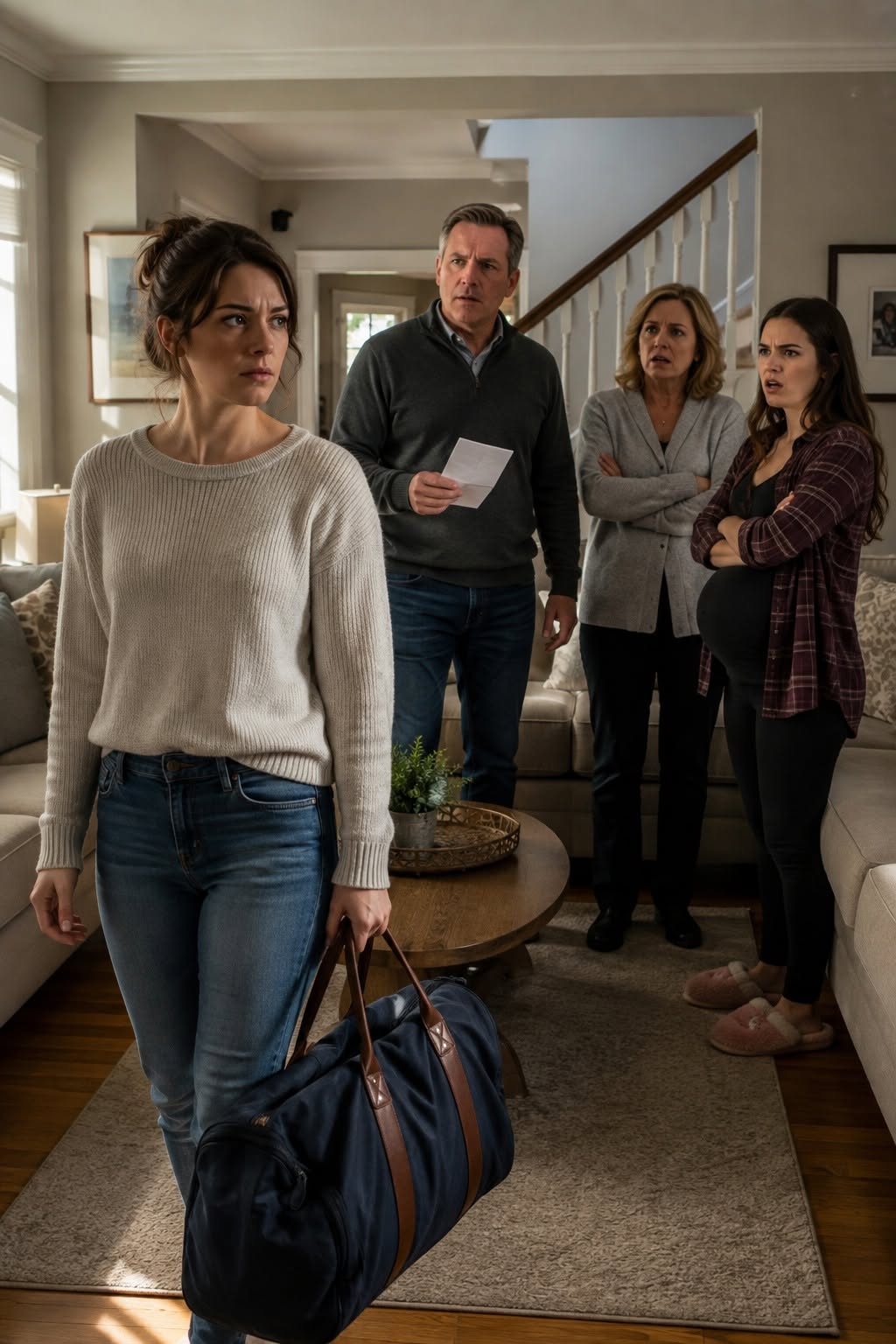
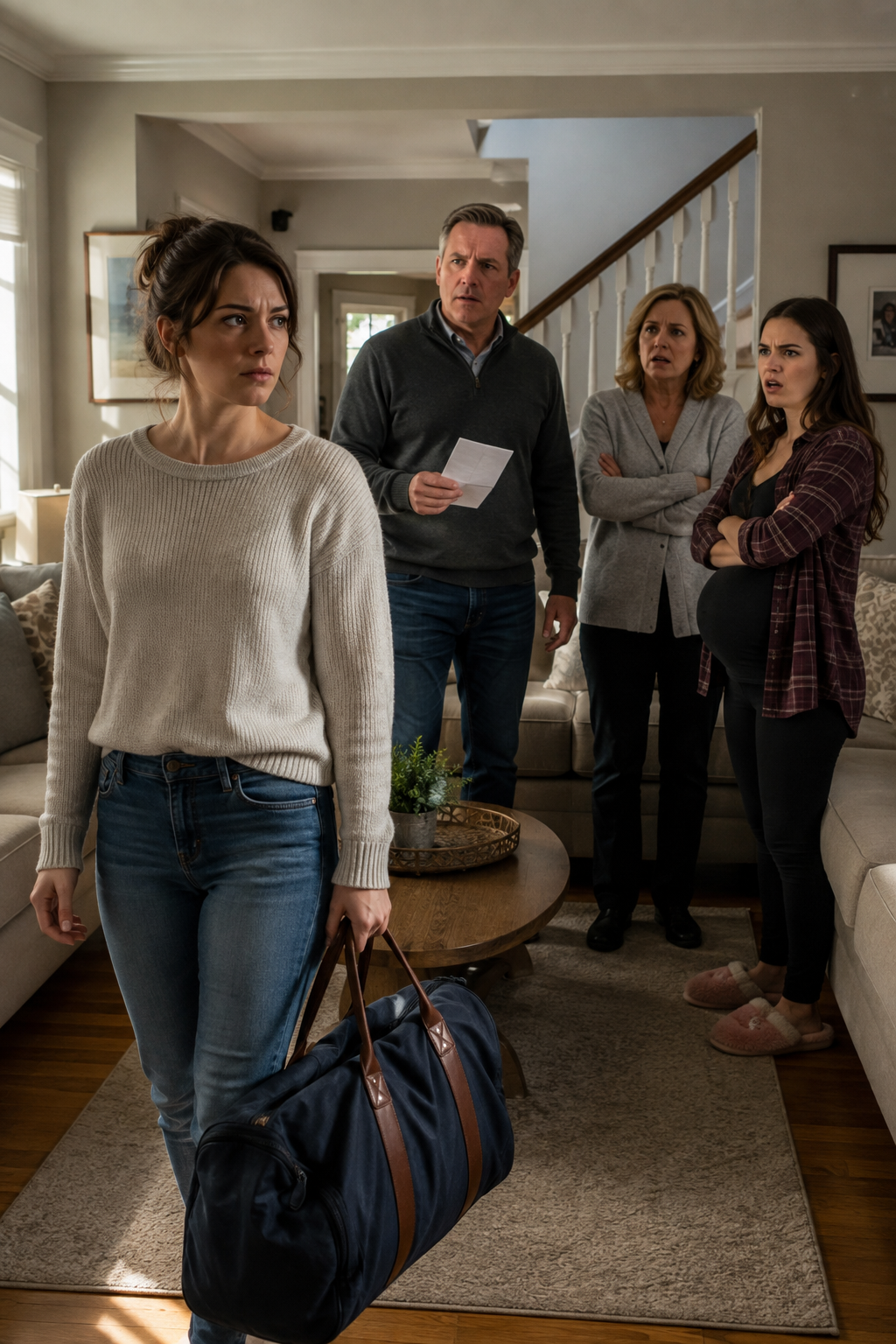
When I returned that afternoon, the entire family was waiting.
Mom sat rigidly on the sofa.
Martha stood beside her.
Dad held my letter.
“What is this?” he demanded.
“I think it’s pretty clear.”
“You’re moving out?”
“Yes.”
“When?”
“Tonight.”
Mom stood.
“Abby, don’t be ridiculous. You cannot just storm out because we asked you to help your sister.”
“I’m not storming anywhere.”
Martha folded her arms over her stomach.
“So you’re abandoning us right before the baby comes?”
“I was never part of your childcare plan,” I said. “You just decided I was.”
Dad’s face darkened.
“And what about the rent you owe?”
“I’ve paid through the end of the month.”
Silence.
Mom’s expression changed.
“Where are you even going?”
“With a coworker.”
“You can’t afford that.”
“I can.”
“You haven’t packed.”
For the first time in days, I smiled.
“Actually, I have.”
Martha’s face fell.
That moment alone was nearly worth everything.
I went upstairs, collected the last suitcase and two boxes, loaded them into Jenna’s SUV, and left.
Mom cried.
Dad called me immature.
Martha said I would “regret choosing strangers over family.”
But when I closed Jenna’s apartment door that night, I sat on the edge of my new bed and listened.
No footsteps outside.
No one calling my name.
No one demanding anything.
For the first time in years, silence felt like freedom.
It lasted three days.
Then the phone calls began.
Dad wanted to know when I was “coming to my senses.”
Mom sent photographs of unfinished basement furniture.
Martha texted:
Hope you’re proud of yourself. Mom has been crying all day.
I didn’t respond.
A week later, Dad sent me a photo of his spreadsheet.
Without my rent, they were apparently short every month.
He had highlighted one number.
$650.
My old rent.
Underneath, he wrote:
This is what your decision is costing your family.
I stared at the message.
Then deleted it.
Two weeks later, Martha went into labor early.
Mom called from the hospital.
I almost didn’t answer.
“Abby,” she said breathlessly, “the baby’s coming. Please come.”
I went.
Not because I had surrendered.
Because Martha was still my sister.
And when I saw my niece for the first time—a tiny red-faced baby named Lily—something inside me softened.
Martha looked exhausted.
For once, there was no smirk.
“Do you want to hold her?” she whispered.
I did.
Lily’s fingers curled around mine.
For one dangerous moment, I understood exactly how my parents planned to use her.
Love makes boundaries difficult.
But difficult didn’t mean impossible.
“I’ll be her aunt,” I told Martha softly. “I’ll love her. But I’m still not your nanny.”
Martha’s eyes went cold again.
“You really know how to ruin a moment.”
I handed Lily back.
Three weeks later, everything changed.
I was in my classroom during lunch when the school secretary called.
“Abby, there’s an attorney on line two asking for you.”
My stomach dropped.
An attorney?
I picked up.
“Ms. Bennett?”
“Yes?”
“My name is Daniel Levin. I represent the Evelyn Bennett Family Trust.”
Evelyn Bennett was my grandmother.
She had been dead for thirteen years.
“I think you have the wrong person.”
“No,” he said. “I don’t.”
Then he asked a question that made my skin go cold.
“Did your parents inform you that the residential trust matured on your twenty-fifth birthday?”
I couldn’t speak.
“What trust?”
There was a long pause.
Mr. Levin’s voice changed.
“You truly don’t know.”
I gripped the phone.
“Know what?”
“Ms. Bennett, I think we need to meet.”
The next afternoon, I sat across from him in a downtown office while he placed a thick folder in front of me.
My grandmother had owned the house where I grew up.
Not my parents.
Years earlier, Dad’s business had failed and my parents nearly lost everything.
Grandma bought the property outright.
But instead of giving it to my father, she placed it in a trust.
My parents received the legal right to live there while my sister and I were minors.
Martha had received a separate education trust when she turned twenty-one.
She had spent nearly all of it within two years.
Mine was different.
Grandma had placed the house itself into a protected trust.
At twenty-five, full ownership would transfer to me.
I stared at Mr. Levin.
“That’s impossible.”
He slid the deed across the desk.
There was my name.
Abigail Rose Bennett.
My birthday.
The transfer date.
Four months earlier.
My hands started shaking.
“But my parents charge me rent.”
Mr. Levin frowned.
“How long?”
“Almost four years.”
He became very still.
“They were specifically prohibited from collecting rent from the beneficiary.”
The room seemed to tilt.
I thought about every month I had transferred $650 to Dad.
Every lecture about household costs.
Every reminder that I was “living under their roof.”
Every threat.
“They knew?” I whispered.
Mr. Levin hesitated.
“Yes.”
I laughed once, but there was no humor in it.
“They threatened to raise my rent.”
His expression hardened.
“In a property you legally own.”
I covered my mouth.
Then he showed me something worse.
Trust notices had been mailed to the house.
Three of them.
One six months before my birthday.
One thirty days before.
One on the day the transfer became effective.
All required signatures.
All signed for.
By my father.
“I changed my mailing address after I moved,” I said.
“That’s why we finally reached you directly.”
My heart pounded.
Then Mr. Levin turned another page.
“There is another issue.”
Of course there was.
A maintenance account had been attached to the trust.
Grandma had left money specifically for taxes, major repairs, and preservation of the property.
Over several years, withdrawals had been made.
Roof.
Water heater.
Plumbing.
Those were legitimate.
Then the transactions changed.
$4,800.
$7,200.
$11,600.
“What are those?”
“We were hoping you could tell us.”
I knew before I finished reading.
Basement renovation.
Furniture.
Kitchenette.
Appliances.
My parents hadn’t drained their retirement savings to build Martha an apartment.
They had used money from my trust.
I felt sick.
Mr. Levin quietly slid one final document toward me.
“This withdrawal request was submitted last month.”
Amount:
$18,000.
Purpose:
Additional residential improvements for dependent family member.
It had been rejected.
Why?
Because the trust had already transferred to me.
My signature was required.
Suddenly, everything made sense.
The pressure.
The urgency.
Dad’s spreadsheet.
Their sudden obsession with my “contribution.”
They weren’t merely losing a babysitter.
They were losing access to the money and the house they had treated as their own.
I drove home to Jenna’s apartment in silence.
That evening, I texted Dad.
We need to talk.
He replied instantly.
Finally.
We agreed to meet Saturday at the house.
I brought Mr. Levin.
Dad opened the door, saw him standing behind me, and turned white.
Mom appeared from the kitchen.
Her hand flew to her mouth.
Martha was on the couch holding Lily.
“What’s going on?” she asked.
I walked into the living room.
The same living room where Dad had threatened to raise my rent.
The same couch where Mom had told me to apologize because Martha ate my groceries.
Mr. Levin placed the folder on the coffee table.
Dad didn’t sit down.
“Abby,” he said quietly, “whatever you think—”
“I know about Grandma’s trust.”
Mom began crying immediately.
Not surprise.
Not confusion.
Recognition.
That hurt more than anything.
“How long were you planning to keep it from me?”
Dad rubbed his face.
“We were going to tell you.”
“When?”
No answer.
“After you raised my rent?”
“Abby—”
“After I became Martha’s babysitter?”
Mom whispered, “We were trying to keep the family together.”
I laughed bitterly.
“You charged me rent to live in my own house.”
Martha stared between us.
“What is she talking about?”
And that was when I realized something.
Martha genuinely didn’t know.
Dad snapped, “This is complicated.”
“No,” Mr. Levin said calmly. “Legally, it is quite straightforward.”
He explained the trust.
The ownership.
The prohibited rent collection.
The maintenance funds.
Martha’s face slowly transformed.
Then Mr. Levin mentioned the basement renovation.
She looked at Mom.
“You told me you were paying for that.”
Mom started crying harder.
Dad finally exploded.
“What were we supposed to do? Let Martha and the baby live on the street?”
I stared at him.
“You could have asked me.”
“You would have said no.”
“That doesn’t make stealing a yes.”
Nobody spoke.
Then Lily began crying.
Martha bounced her gently.
For the first time, she looked frightened rather than smug.
“What happens now?” Mom whispered.
That was the question they had never imagined they would need to ask me.
I had thought about it all week.
“I’m not throwing you onto the street tomorrow.”
Mom sagged with relief.
“But I am ending this.”
Dad’s relief disappeared.
“The house is being sold.”
Mom gasped.
Martha stood so quickly Lily startled.
“You can’t!”
“I can.”
“This is our home!”
I looked directly at her.
“So was my time. So was my money. So were my groceries. Funny how ownership suddenly matters when it belongs to you.”
Dad slammed his hand against the table.
“You’d sell your childhood home just to punish us?”
“No. I’m selling it because none of us will ever be healthy while this house remains the place where everyone expects me to pay for Martha’s life.”
They had ninety days.
Mr. Levin had already arranged everything.
My parents would receive no proceeds from the house because they had never owned it.
But I offered them something anyway.
I agreed not to pursue repayment of every dollar of rent they had charged me if they cooperated with the sale and repaid the improperly used trust funds over time.
Dad looked defeated.
Mom looked heartbroken.
Then Martha suddenly laughed.
A strange, sharp sound.
“You’re all unbelievable.”
She grabbed Lily’s carrier.
“This whole family is insane.”
She marched toward the basement.
Her phone lit up on the coffee table.
A message appeared on the screen.
Mom glanced at it.
Then froze.
“Martha.”
My sister stopped.
Mom picked up the phone.
“Who is Eric?”
Every bit of color drained from Martha’s face.
I remembered the name instantly.
Eric was Lily’s father.
The man who had supposedly disappeared.
Martha lunged for the phone.
“Give me that.”
Mom stepped back.
The screen lit again.
Please stop ignoring me. I’ve transferred this month’s $1,200 like we agreed. I want to see my daughter.
The room became completely silent.
Dad stared at Martha.
“What?”
Martha said nothing.
Another notification appeared.
My attorney says we need to finalize the custody schedule.
Mom looked as if someone had slapped her.
“He’s been sending you money?”
Martha’s eyes filled with tears.
“It’s not what you think.”
I almost laughed.
That sentence apparently ran in the family.
Dad’s voice dropped.
“You said he vanished.”
“He did! At first.”
“How long has he been paying you?”
Martha looked away.
“Five months.”
Mom sank onto the couch.
Five months.
While my parents renovated the basement.
While they dipped into my trust.
While Dad threatened my rent.
While everyone told me I needed to sacrifice because Martha had no one.
She had been receiving $1,200 every month from the baby’s father—and hiding it.
“Why?” I asked.
Martha turned toward me.
And finally, the truth came out.
Because if Mom and Dad knew Eric wanted shared custody and was helping financially, they might not let her move in.
Because if they knew she had money, they might expect her to contribute.
Because if Eric took Lily several days a week, she wouldn’t need nearly as much help.
And because—
Martha’s voice broke.
“I knew if I looked helpless enough, they’d fix everything.”
Dad sat down.
Slowly.
As though his legs had stopped working.
Martha looked at our parents.
“You always do.”
Nobody argued.
Because she was right.
For years, they had taught her that disaster was a currency.
The bigger the crisis, the more she received.
And they had taught me the opposite.
Competence was a tax.
The more responsible I became, the more they expected me to carry.
Three months later, the house sold.
My parents moved into a small townhouse.
Dad took a part-time consulting job.
Mom stopped answering every one of Martha’s emergencies.
Martha moved into an apartment of her own and, after a difficult custody battle, began sharing parenting time with Eric.
For the first time in her adult life, she had to make a budget.
She hated it.
Then, slowly, she got better at it.
Our relationship didn’t magically heal.
Real life rarely works that way.
But six months later, she called me.
“I owe you an apology.”
I waited.
“For the groceries?”
She laughed weakly.
“For everything.”
That was a start.
As for me, the sale of the house paid off my student loans and left me enough for a down payment on a modest little place ten minutes from my school.
Two bedrooms.
A tiny patio.
No basement.
I loved it immediately.
On the day I closed, Mr. Levin handed me one last envelope.
It had been stored with my grandmother’s trust documents.
My name was written across the front in her handwriting.
I opened it sitting alone in my new living room.
Inside was a single page.
Grandma had written it thirteen years earlier.
Most of the letter was ordinary—how much she loved me, how proud she was, how she hoped I would grow into a kind woman.
Then I reached the final paragraph.
And started crying.
She wrote that she had watched our family carefully.
That Martha was loved loudly because she demanded loudly.
That I had learned too young to be easy, helpful, and undemanding.
And then came the sentence that explained everything.
“One day, Abby, they may mistake your strength for permission to take from you. I am leaving you this house so you will always have one place in this world where no one can tell you that you owe them the right to stay.”
I read it three times.
My grandmother hadn’t predicted a baby.
She hadn’t predicted Martha’s lies.
She hadn’t predicted Dad’s spreadsheet or Mom’s guilt or the exact night my family would try to use housing as leverage.
But somehow, thirteen years earlier, she had understood the pattern.
That was the real secret my parents had hidden.
The house had never merely been an inheritance.
It had been an escape route.
And the strangest part was that my parents’ threat had accomplished the exact opposite of what they intended.
They tried to make me afraid of losing my home.
Instead, they pushed me out the door just far enough to discover that the home had been mine all along.
I folded Grandma’s letter and placed it inside the wooden jewelry box she had given me.
Then I walked onto my little patio.
My phone buzzed.
It was a photo from Martha.
Lily was smiling.
Underneath it, Martha had written:
No babysitting request. Promise. Just thought Aunt Abby would want to see this.
I smiled.
Then another message appeared.
From Mom.
Dinner Sunday? No guilt if you’re busy.
That part made me laugh.
I typed back:
I’ll let you know.
Not yes.
Not no.
Not an explanation.
Just my decision, made in my own time.
I set the phone down and looked through the glass doors at the little home I had bought with a future I almost didn’t know belonged to me.
For years, I thought being a good daughter meant never becoming inconvenient.
Never saying no too loudly.
Never making anyone struggle if I could prevent it.
But sometimes people need to struggle.
Sometimes consequences are the only thing strong enough to break a family pattern.
And sometimes the most loving thing you can do—for them and for yourself—is stop volunteering to be the solution to problems you didn’t create.
My parents had once looked across a dinner table and believed they had found the perfect threat.
Babysit, or pay more to stay.
They never imagined I would leave.
They never imagined I would discover the trust.
They certainly never imagined Martha’s biggest lie would unravel in the same room.
But the part none of us could have predicted was what happened afterward.
Without me absorbing every consequence, everyone else finally had to change.
Including me.
Especially me.
Because Grandma had left me a house.
But it took losing the place I thought was home for me to understand what she had really given me.
The right to walk away.
