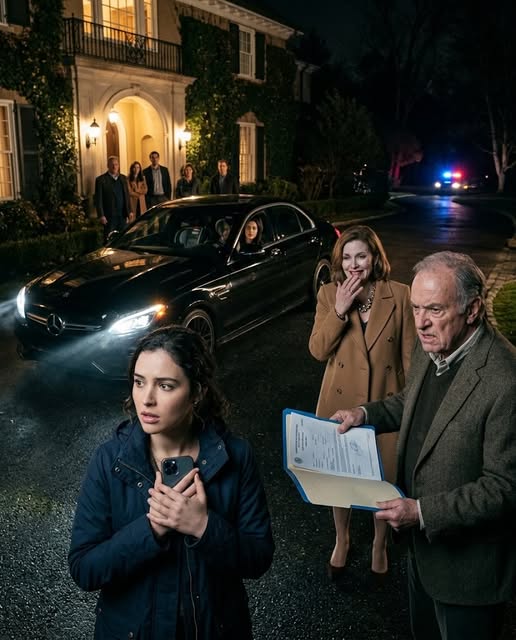
The officer’s question hung over the driveway.
“Who has the keys?”
Brooke stood beside the black Mercedes with one hand gripping the open rear door.
The child seat was half unfastened, one strap dangling toward the pavement.
My mother, Patricia, remained near the porch steps, pale but rigid, as though enough confidence might still turn the facts in her favor.
Grandpa came outside carrying the blue folder against his chest.
“I own the vehicle,” he said.
“My daughter was instructed to deliver it to my granddaughter, Hannah.
Instead, she gave it to her other daughter without my permission.”
The officer glanced at me.
I still had the dispatcher on the phone, though she had already confirmed that an officer was at the scene.
I ended the call and slipped the phone into my coat pocket.
Brooke finally held out the key fob.
“I didn’t steal it,” she said quickly.
“Mom gave it to me.”
“That may explain how you got it,” Grandpa replied.
“It does not explain why you kept it.”
The officer asked everyone to remain calm.
He took the title, compared the vehicle identification number with the number visible through the windshield, and requested identification from Grandpa, Brooke, and Mom.
Mom hesitated before opening her purse.
“This is a family misunderstanding,” she said.
“My father is elderly and emotional.
Nobody needs to make this official.”
Grandpa’s face changed.
Until that moment, he had been furious.
Now he looked wounded.
“Patricia, I asked you for help because I was recovering from heart surgery.
Do not use my age to erase what you did.”
The officer looked from Mom to the title.
“Sir, did you ever sign ownership of this vehicle over to either daughter?”
“No.”
“Did you authorize Patricia to give it to Brooke?”
“No.”
“Did you give Brooke permission to drive it?”
“No.”
Brooke pressed both palms against the roof of the car.
Her expression had lost its practiced glamour.
“Mom told me it had been bought for Hannah, but Hannah didn’t want it,” she admitted.
“She said Grandpa agreed that I needed it more.”
Every relative standing in the doorway heard her.
I felt the old instinct to make things easier for everyone.
I could have said Brooke had been misled.
I could have softened the truth, protected Mom from the consequences, and accepted another family apology that changed nothing.
Instead, I asked Brooke one question.
“Why did you post online that your husband bought it for you?”
Her eyes moved toward the Mercedes.
“People knew he had lost his job,” she said.
“I didn’t want them thinking we needed help.”
“So you knew the story Mom gave you would not survive questions.”
Brooke did not answer.
Mom stepped between us.
“Enough.
Brooke has a child.
She has been under tremendous pressure.”
“And Hannah hasn’t?” Grandpa asked.
Mom turned on him.
“Hannah is independent.
She always manages.”
There it was—the family sentence that had followed me since childhood.
Hannah manages.
Hannah understands.
Hannah can wait.
It sounded like praise, but it had always been permission to take from me.
Grandpa opened the blue folder and handed the officer the purchase agreement.
The buyer’s name was his.
A second document showed that the dealership had been instructed to release the car only after Hannah signed the registration forms.
She never had.
The officer examined another page.
“Whose signature is this?”
He held up a form with my full name printed beneath a looping signature.
I stared at it.
“It isn’t mine.”
Mom moved forward.
“That was just paperwork.
I signed because Hannah was working.”
The officer’s expression sharpened.
“Did she give you permission to sign her name?”
Mom said nothing.
I took the page and looked more closely.
The imitation was almost insulting.
My real signature was small and plain.
This one had dramatic curves, as though Mom had copied the version of my name I used in middle school.
Grandpa removed a bank statement from the folder.
“Three days before the car was collected, I transferred Patricia forty-eight hundred dollars,” he said.
“Registration, insurance, delivery costs, and a maintenance plan for Hannah.
I want to know where that money went.”
Mom’s shoulders dropped slightly.
“It paid family expenses.”
“Whose expenses?”
“Brooke’s mortgage was overdue.”
Brooke looked at her.
“You told me that money came from your savings.”
Mom snapped, “I was trying to keep your house from going into foreclosure.”
“We were one payment late,” Brooke said.
“Not in foreclosure.”
For the first time, the anger in the driveway shifted away from me.
Mom had spent years controlling the family by separating us, telling each person a different version of events.
She told me Brooke was helpless.
She told Brooke I was selfish.
She told Grandpa everything was handled.
As long as nobody compared stories, she remained indispensable.
Now everyone was comparing them at once.
The officer returned the title to Grandpa but kept notes about the forged signature and the transferred funds.
He explained that the immediate issue was recovering the vehicle for its legal owner.
The questions involving the paperwork and money would require a formal report and further review.
Mom seized on that distinction.
“See? Nobody stole anything.
Brooke is giving it back.”
The officer looked at her evenly.
“Returning property after the owner discovers it does not make the underlying facts disappear.”
Brooke removed the child seat and placed it beside the garage.
Her husband had arrived in their aging sedan after she called him.
He stood beside her, stunned.
“You said your grandfather gave us the car,” he told her.
“That’s what Mom told me.”
“You also told me to say I bought it.”
Brooke’s face reddened.
“I panicked.”
He looked toward me.
“Hannah, I’m sorry.
I didn’t know it was yours.”
“It was supposed to be mine,” I said.
“I didn’t know that either.”
That sentence silenced everyone more effectively than shouting could have.
Grandpa instructed the officer to document the vehicle’s mileage and visible condition.
Brooke had added nearly six thousand miles in three months.
There was a scrape along the passenger-side wheel and a coffee stain on the cream leather.
The maintenance warning light was glowing because she had ignored two dealership messages.
Grandpa watched the inspection without speaking.
When the officer finished, he asked whether Grandpa wanted the Mercedes left at the house or towed elsewhere.
“It stays here,” Grandpa said.
“Nobody drives it until the dealership inspects it.”
Brooke handed him the key fob.
Mom caught my arm as I turned toward the house.
“You can stop this,” she whispered.
“Tell the officer you gave Brooke permission.
Your grandfather will calm down, and we can resolve everything privately.”
I pulled my arm free.
“You already resolved it privately.
You decided I would lose.”
Her eyes narrowed.
“After everything I have done for you?”
I almost laughed.
That question had ended every disagreement of my life.
It turned food, shelter, and basic parenting into debts I could never repay.
Grandpa had heard her.
“Patricia, go home,” he said.
“This is my father’s birthday dinner.”
“It was.
You turned it into an investigation.”
She looked toward the relatives in the doorway, expecting someone to defend her.
My aunt Linda stepped outside instead.
“Dad is right,” she said.
“You should leave.”
Mom stared at her sister.
“You’re choosing Hannah over your own family?”
Linda shook her head.
“Hannah is our family.
That is the part you keep forgetting.”
Mom left without another word.
She drove away so quickly that her tires scattered gravel across the road.
The police officer completed the report at the dining-room table.
He photographed the disputed registration form and gave Grandpa instructions for providing bank records and dealership correspondence.
He also took a statement from me confirming that I had never seen the paperwork, received the car, or given anyone permission to use my identity.
When he asked how I had been commuting, I told him about the buses and late-night rideshares.
I mentioned the night I spent more than ninety dollars getting home during a transit shutdown because Mom had told me Grandpa could no longer afford the promised car.
Grandpa closed his eyes.
“I could afford it,” he said.
“I bought it.”
The officer left shortly after midnight.
The birthday guests had long since abandoned the cake and presents.
Brooke remained because her husband had taken their child home, and Grandpa wanted answers while the truth was still fresh.
She sat across from me at the kitchen table, twisting a tissue between her fingers.
“I should have called you,” she said.
“Yes.”
“Mom said you thought the car was too flashy.”
“You know I have never turned down reliable transportation.”
“I wanted to believe her.”
That was the closest she came to naming her part in it.
She had wanted the car.
Mom had provided a story that allowed her to take it without feeling like a thief.
Brooke never checked because checking might have cost her the Mercedes.
“I was jealous of you,” she admitted.
“Grandpa talked about how hard you worked.
When Mom said he bought the car for you, I felt like everyone was finally noticing what you did and not what I needed.”
“So you decided I should disappear again.”
Brooke’s eyes filled, but I did not rush to comfort her.
“I’m sorry,” she said.
“I believe you’re sorry this happened.
I don’t know yet whether you’re sorry you accepted it.”
She nodded as though the distinction hurt because it was accurate.
The next morning, Grandpa called his attorney.
I was in the living room when he revoked the limited financial authority he had granted Mom during his recovery.
He also removed her as successor trustee and replaced her with a professional fiduciary and Aunt Linda acting jointly.
“This is not revenge,” he told the attorney.
“It is risk management.”
Mom arrived before noon, furious that he had acted without consulting her.
“You’re destroying my reputation over a car,” she said.
Grandpa placed the forged form on the table.
“No.
You risked your reputation over a car.”
She turned to me.
“Are you happy now?”
I was not happy.
I was exhausted, embarrassed, and grieving the mother I had spent years pretending I had.
But beneath all of that was a small, unfamiliar steadiness.
“I’m relieved,” I said.
“Nobody is asking me to lie for you anymore.”
Grandpa’s attorney sent a formal demand for the return of the $4,800 and requested an accounting of every transaction Mom had handled during Grandpa’s recovery.
That review uncovered two smaller transfers she had described as medical expenses but used to pay Brooke’s credit-card bills.
Brooke claimed she had not known where the money came from.
Her bank records showed that Mom had sent it directly, and there was no evidence Brooke had seen Grandpa’s statements.
Even so, she agreed to repay what had benefited her.
Mom’s explanation changed repeatedly.
First, she said Grandpa had authorized everything verbally.
Then she said she had intended to replace the money.
Finally, she said families should not keep accounts against one another.
Grandpa answered with the sentence that ended the argument.
“Sharing is when the owner agrees.
Taking is not sharing because you call the victim family.”
The investigation lasted several weeks.
The authorities focused on the false signature and the unauthorized paperwork rather than treating the dispute as a dramatic roadside theft.
Mom eventually accepted responsibility through the legal process, repaid the missing funds, and was prohibited from managing Grandpa’s finances.
The exact consequences mattered less to me than the official record stating something our family had denied for years: she had not made a harmless parental decision.
She had used another person’s name and property without permission.
Brooke sold several expensive items to repay her portion.
She and her husband bought an older minivan within their budget.
For once, she did not turn the downgrade into a family emergency for someone else to solve.
Our relationship did not heal instantly.
Apologies could not erase years of being chosen at my expense.
But Brooke began doing something new: she stopped asking Mom to translate between us.
She called me directly.
She answered difficult questions without changing the subject.
Sometimes I ended the conversation early.
She accepted that too.
Mom refused to speak to me for nearly two months.
Her silence was supposed to punish me.
Instead, it revealed how much of my energy had been spent anticipating her demands.
Without that pressure, my life became quieter.
The Mercedes remained at the dealership for ten days.
Brooke paid for the damaged wheel and interior cleaning.
Grandpa paid for the overdue service because, as he put it, the car had already caused enough arguments about money.
When it was ready, he did not simply hand me the keys.
He took me to the dealership and placed a new title application on the desk.
“This time,” he said, “nobody signs your name but you.”
I read every page before signing.
The manager slid the key fob across the desk.
I looked at it but did not pick it up immediately.
Grandpa noticed.
“You do not have to accept it because I bought it.”
“I know.”
That was why I finally took it.
The car was beautiful, but the first drive did not feel triumphant.
I kept thinking about the nights I had stood alone beneath fluorescent bus-stop lights while Mom watched Brooke post photographs from behind my steering wheel.
I thought about how easily my family had mistaken endurance for consent.
Grandpa sat beside me as I drove away from the dealership.
“I should have called you directly,” he said.
“I trusted Patricia to handle it, and you paid the price.”
“You believed your daughter.”
“I failed to verify what affected my granddaughter.”
He did not make excuses.
That mattered more than a perfect apology.
We drove to the small diner where he used to take me after school.
The Mercedes drew attention in the parking lot, but inside we sat in a cracked vinyl booth and ordered coffee and pie.
Grandpa lifted his cup.
“To asking questions sooner.”
I touched my cup to his.
“To answering them honestly.”
Months later, the car became ordinary.
It carried groceries, work bags, and Grandpa’s folding cane.
