PART 2
” How long have you known?”
Gabriel’s voice was quiet.
That frightened me more than if he had raised it.
For years, I had remembered him as a man who seemed built from certainty. Gabriel Cross did not hesitate when he entered a room. He did not search other people’s faces for instructions. He was the person everyone else watched.
But now his attention was fixed on Serena.
And Serena looked as though the floor beneath her had shifted.
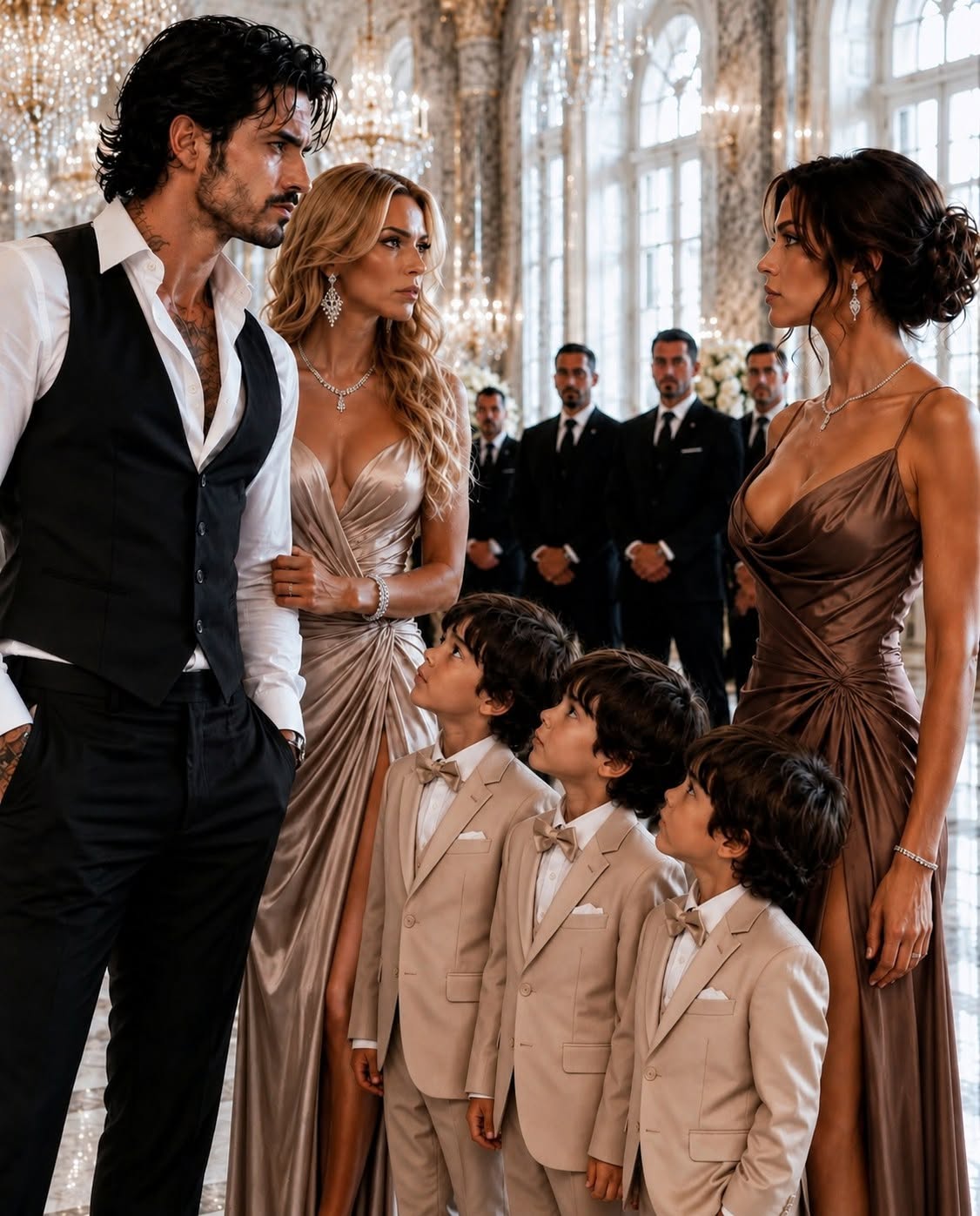
My youngest son, Ben, pressed closer to my side.
That tiny movement brought me back to what mattered.
Not Serena.
Not Gabriel.
Not five years of unanswered questions.
My children.
“Not here,” I said.
Gabriel looked at me.
“There are three little boys standing in the middle of a ballroom.”
His expression changed immediately.
The terrible stillness left his face.
He glanced around as if only now remembering the hundreds of people surrounding us—the polished marble, the glittering chandeliers, the orchestra playing near the stage, waiters moving between tables with silver trays.
A few guests had noticed us.
Not enough to know what was happening.
Enough to know something was.
Gabriel straightened.
“You’re right.”
There was no argument.
That surprised me.
The Gabriel I had been married to had sometimes treated disagreement as something to be solved through sheer force of will. He had not been cruel to me, but he had been accustomed to being obeyed.
This Gabriel simply nodded.
Then my oldest, Henry, looked up at him.
“Are you our dad?”
The question returned us to the only truth in the room that could not be delayed.
Gabriel lowered himself again.
Slowly.
Carefully.
He left several feet between himself and the boys.
“I think,” he said, and his voice became gentler than I remembered it ever being, “that your mother and I need to talk about that.”
Henry frowned.
He was the serious one.
At five years old, he approached mysteries as though the universe had personally assigned them to him.
“But she said you are.”
Gabriel looked at me.
I nodded.
His throat moved.
“Then yes,” he said. “I’m your father.”
Theo, standing beside Henry, considered this.
Theo was our collector of facts.
Dinosaurs, planets, fire engines, obscure information about whales—if there was something to learn, he wanted to know it.
“Where have you been?”
I closed my eyes for half a second.
Of all the questions I had anticipated someday, that one had been the hardest.
Gabriel did not look away.
“I didn’t know about you.”
Theo’s eyebrows pulled together.
“All three of us?”
“All three.”
“That’s a lot of people not to know about.”
Despite everything, a startled laugh escaped me.
Gabriel looked at Theo.
For one second, something almost like amusement touched his face.
“You’re right,” he said. “It is.”
Ben peeked from behind me again.
“So you didn’t forget us?”
Gabriel went very still.
“No.”
One word.
But I heard everything underneath it.
“No,” he repeated. “I never knew you were here.”
Ben appeared to accept that.
Five-year-olds sometimes understood simple truths better than adults understood complicated ones.
A woman approached from behind me.
“Claire?”
I turned.
Laura Chen, the program director for the Hudson Children’s Foundation, was also one of the few close friends I had made after rebuilding my life in the city.
She looked from me to Gabriel and immediately understood that she had walked into something enormous.
“Everything okay?”
Before I could answer, Theo pointed at Gabriel.
“That’s our dad.”
Laura’s eyes widened.
Then, to her credit, she recovered in less than two seconds.
“Oh,” she said.
Henry nodded gravely.
“He didn’t know.”
“I see.”
Laura looked at me.
Years of friendship passed silently between us.
Need help?
I nodded.
She crouched beside the boys.
“There is an emergency situation involving chocolate cupcakes in the children’s activity room.”
Theo became suspicious.
“What emergency?”
“Too many cupcakes.”
“That’s not an emergency.”
“It is if nobody eats them.”
Theo looked at his brothers.
Ben was already convinced.
Henry turned to me.
“Can we go?”
“Yes.”
“You’re coming?”
“In a few minutes.”
Ben studied Gabriel once more.
Then he waved.
“Bye, Dad.”
Gabriel’s face changed.
It happened so quickly that anyone who did not know him would have missed it.
I did not.
His eyes closed for the briefest moment.
When he opened them, Ben had already taken Laura’s hand.
The boys followed her toward the adjoining room.
Gabriel watched until all three disappeared through the doorway.
Only then did he stand.
Serena had not moved.
“We need somewhere private,” I said.
Gabriel led us through a side corridor into a small library used by the foundation’s trustees during board meetings.
He closed the door but did not lock it.
It was a tiny detail.
Five years ago, I would not have noticed it.
Tonight, I did.
I stood near the window.
Serena remained beside a leather chair.
Gabriel stayed in the middle of the room.
For several seconds, none of us spoke.
Then Gabriel looked at Serena.
“How long?”
Serena exhaled.
“I didn’t know she was having triplets.”
“That wasn’t my question.”
“I know.”
She folded her arms, then seemed to realize how defensive the gesture looked and dropped them again.
“I knew Claire was pregnant.”
My heart beat harder.
“When?”
“About two months after your divorce.”
I stared at her.
“How?”
She looked at me.
“I saw you.”
I shook my head.
“No, you didn’t.”
“At Lenox Hill.”
The room seemed to tilt slightly.
I remembered.
A gray afternoon.
My first appointment after finding out there were three babies instead of one.
I had left the hospital carrying a folder against my chest, terrified and exhilarated in equal measure.
“I was there with my cousin,” Serena continued. “She was having a procedure. I saw you come out of the obstetrics department.”
“That doesn’t mean you knew I was pregnant.”
“No. But then you stopped near the elevator.”
A memory returned.
I had opened my folder.
Inside had been three ultrasound images.
I had stood there staring at them because I still could not believe they were real.
Serena swallowed.
“I saw the pictures.”
Gabriel turned away.
He placed both hands on the back of a chair.
“Did you know they were mine?”
“I suspected.”
“You knew the dates.”
“Yes.”
“And you said nothing.”
Serena looked down.
“Yes.”
There was no excuse in the word.
No attempt to soften it.
I should have felt vindicated.
Instead, I felt tired.
Deeply, unexpectedly tired.
“Why?” I asked.
Serena looked at me.
For the first time that evening, the polished model disappeared.
The woman underneath looked older than the version I remembered.
Not physically.
Emotionally.
“Because I was selfish.”
Gabriel looked at her.
Serena continued before he could speak.
“I could tell you that it wasn’t my information to share. I could tell you I didn’t know for certain. Both things are true.”
She paused.
“But neither is the whole truth.”
I waited.
“You had left him,” she said to me.
“He divorced me.”
“I know.”
Something in her voice made me listen.
“And three weeks after the divorce,” Serena said, “Gabriel ended things with me.”
I stared at him.
Gabriel did not move.
“What?”
Serena gave a small, humorless smile.
“There was never a grand romance, Claire.”
The words landed strangely.
“For five years,” I said, “I thought—”
“That he left you for me.”
“Yes.”
Serena looked toward Gabriel.
“He might have believed that too for a while.”
Gabriel finally spoke.
“No.”
Serena raised an eyebrow.
“You were very good at lying to yourself back then.”
He accepted that without protest.
I looked between them.
“You were together.”
“For a few weeks,” Serena said. “Depending on how generously you define together.”
My hands went cold.
Gabriel looked at me.
“What you saw in my office was real.”
I appreciated that he did not insult me by denying it.
“I kissed her.”
“I know.”
“I betrayed you.”
“Yes.”
His jaw tightened.
“But I did not file for divorce because Serena and I were building a life together.”
“Then why?”
The question came out more quietly than I intended.
For five years, I had believed I knew.
There had been a younger woman.
A beautiful woman.
A glamorous woman.
There had been me.
And Gabriel had chosen.
Simple.
Painful.
Final.
Now he looked at me as though there had never been anything simple about it.
“Because I was a coward,” he said.
Serena glanced away.
Gabriel continued.
“Our marriage had been failing for a long time.”
I almost objected.
Then I stopped.
Because that part was true.
The last year of our marriage had been full of silences.
Gabriel disappearing into work.
Me pretending I did not mind.
Dinners postponed.
Weekends canceled.
Conversations that became arguments about conversations we were not having.
“You stopped asking me to come home,” he said.
“Because you never came when I asked.”
“I know.”
“You stopped telling me anything.”
“I know.”
“I was lonely in a house full of people who worked for you.”
His eyes lowered.
“I know.”
I had never heard Gabriel Cross say those words so many times.
“And instead of admitting that I was failing you,” he said, “I convinced myself you would be better without me.”
“So you kissed Serena.”
“No.”
His gaze met mine.
“I kissed Serena because I wanted, for one selfish moment, to be someone who had no history and no obligations and no marriage I was disappointing.”
The truth was not flattering.
That made me believe it more.
“Then I used that mistake as proof that I had already destroyed us.”
Serena spoke softly.
“He told me the kiss was a mistake the next morning.”
I stared at her.
“I didn’t know.”
“Of course you didn’t.”
Serena looked ashamed.
“He didn’t know you had seen us.”
Neither had I told him.
Gabriel rubbed a hand over his face.
“I filed for divorce because I thought ending things cleanly would hurt you less than spending another year making you miserable.”
A bitter laugh escaped me.
“That worked beautifully.”
“I know.”
Silence.
Then I remembered why we were here.
“You saw me pregnant.”
Serena nodded.
“And you didn’t tell him.”
“No.”
“Even after he ended things with you?”
She hesitated.
“That was part of why I didn’t.”
I stared.
Serena held my gaze.
“I was embarrassed. Angry. I had convinced myself Gabriel had chosen me. Then he told me there was never going to be an us.”
Her voice became softer.
“When I saw you at the hospital, I thought if I told him you were pregnant, he would run back to you.”
“You were worried he would choose me.”
“Yes.”
“And you decided for him.”
“Yes.”
Gabriel said nothing.
His silence carried more disappointment than anger could have.
Serena looked at him.
“I almost told you.”
“When?”
“The same night.”
“But you didn’t.”
“No.”
She drew a slow breath.
“I told your mother.”
Gabriel’s head lifted.
I felt a second jolt of disbelief.
“Eleanor knew?”
Serena nodded.
Gabriel looked genuinely stunned.
“When?”
“A week after I saw Claire.”
His mother had known.
The elegant, reserved Eleanor Cross, who had once taught me how to survive formal dinners without accidentally insulting three generations of Manhattan society.
She had known I was pregnant.
Gabriel took a step backward.
“Why would she not tell me?”
Serena shook her head.
“You need to ask her.”
For the first time that night, I felt something close to fear—not danger, but the unsettling sensation of discovering that a memory I had lived inside for five years had doors I had never opened.
“I’m going to get my children,” I said.
Gabriel turned to me.
“Claire.”
“Not tonight.”
He stopped.
I had expected him to insist.
He didn’t.
“I want a paternity test,” I said.
Something flickered across his face.
Not offense.
Understanding.
“Okay.”
“Not because I have doubts.”
“I know.”
“Because we need facts. Legal facts. Medical facts. Something uncomplicated.”
“Whatever you need.”
“And you don’t come to my apartment without asking.”
“I won’t.”
“You don’t send people to watch us.”
His expression tightened.
“I won’t.”
“You don’t change their schools, security, routines or anything else without discussing it with me.”
“I understand.”
“They are happy children, Gabriel.”
His eyes softened.
“I could see that.”
“They have a home. Friends. A life.”
“I’m not trying to take any of that away.”
“Tonight you’re shocked.”
“Yes.”
“Tomorrow you might feel differently.”
“No.”
“You don’t know that yet.”
He was silent.
Then he nodded.
“You’re right.”
That answer surprised me most of all.
I left the library before I could discover what else had changed.
The boys were eating cupcakes when I found them.
Ben had frosting on his nose.
Theo had somehow obtained two juice boxes.
Henry sat beside Laura, quietly drawing something on a piece of construction paper.
When he saw me, he held it up.
There were five stick figures.
Three small.
Two large.
I could not breathe for a second.
“Who’s that?” I asked.
Henry pointed.
“Me. Theo. Ben. You.”
He hesitated at the fifth.
“And maybe Gabriel.”
Maybe.
It was the most accurate word anyone had spoken all night.
The paternity test happened three days later.
Gabriel suggested a private clinic.
I refused.
Not because there was anything wrong with his clinic.
Because I needed one decision to belong entirely to me.
We used a laboratory recommended by my attorney.
Gabriel arrived alone.
No driver waiting at the curb.
No assistants.
No Serena.
He wore a navy sweater instead of a suit.
It made him look less like the man from business magazines and more like someone I might once have met at a coffee shop.
The boys thought the cheek swabs were funny.
Theo asked whether the test could also determine which of them was best at math.
The nurse told him unfortunately not.
Ben asked whether it could determine who liked pancakes most.
Gabriel said, “That one might be me.”
Ben looked delighted.
It was the first thing they had in common.
Afterward, we went outside.
Gabriel stood on the sidewalk as the boys chased one another around a planter.
“Can I see them again?”
I had known the question was coming.
“Yes.”
His shoulders loosened almost imperceptibly.
“With me there,” I added.
“Of course.”
“And somewhere ordinary.”
He glanced around.
“Define ordinary.”
“Central Park.”
“That I can manage.”
“No security team walking ten feet behind us.”
His mouth almost smiled.
“I’ll compromise at fifty.”
“Gabriel.”
“I’m joking.”
I stared at him.
He actually smiled.
It transformed his face in a way that made something old and dangerous move inside my chest.
I hated that.
Five years was supposed to be enough time to stop noticing his smile.
Apparently it wasn’t.
The first afternoon in Central Park was awkward.
The boys called him Gabriel.
He did not correct them.
Henry wanted to know what he did for work.
Gabriel looked at me.
I almost laughed.
There was no child-friendly way to explain the Cross family.
“I run companies,” he said.
“What kind?”
“Real estate. Shipping. Restaurants.”
That was technically true.
Theo narrowed his eyes.
“Mom says people who say ‘I run companies’ usually don’t explain what they actually do.”
I covered my mouth.
Gabriel looked at me.
“I’m beginning to understand the source of some of these questions.”
“You’re welcome.”
Theo continued.
“Do you have a boss?”
“No.”
“That sounds suspicious.”
Gabriel laughed.
Really laughed.
People nearby turned.
I realized I had not heard that sound in years.
Ben wanted to ride the carousel.
Gabriel bought five tickets.
I stayed beside Ben.
Henry chose his own horse.
Theo changed horses twice before the ride began because he was conducting what he called a “speed assessment.”
Gabriel ended up standing beside Henry.
When the carousel started moving, I watched him place one hand near Henry’s back without touching him.
Ready.
Not controlling.
Just there.
My throat tightened.
I had spent five years imagining everything that could go wrong if Gabriel entered their lives.
I had never let myself imagine something going right.
That was more frightening.
The results arrived eleven days later.
99.99 percent.
Biologically, legally, scientifically undeniable.
Gabriel Cross was the father of Henry, Theodore and Benjamin Hart.
I had given the boys my maiden name.
Gabriel never mentioned changing it.
Instead, he asked whether I would meet him for coffee.
Without the children.
I nearly said no.
Then I said yes.
We met in a small café in Tribeca.
He arrived before me.
Another difference.
Gabriel had once been chronically late to anything that did not involve business.
There were two coffees on the table.
Mine was exactly right.
Oat milk.
One packet of sugar.
I stared at it.
“You remember.”
“I remember everything about you.”
The words were too intimate.
I sat down.
“We’re here to talk about the boys.”
“Yes.”
He slid a folder toward me.
I stiffened.
“What is that?”
“Nothing you have to sign.”
I opened it carefully.
There were no custody demands.
No legal petitions.
It was a proposed schedule.
One afternoon each weekend.
For now.
All visits with me present unless I decided otherwise.
No overnights.
No travel.
No press.
No changes to school or medical arrangements without both parents agreeing.
At the bottom was a handwritten note.
Claire has final say if the boys are uncomfortable.
I looked up.
“You wrote this?”
“With my family attorney.”
“It’s unusually reasonable.”
“I told him you’d say that.”
“You told your attorney I think you’re unreasonable?”
“I told him you have extensive historical evidence.”
I nearly smiled.
Nearly.
Then I reached the final page.
A financial proposal.
I closed the folder.
“No.”
“Claire.”
“I don’t want your money.”
“It isn’t for you.”
“I have supported them for five years.”
“And I should have been supporting them too.”
“You didn’t know.”
“That changes the explanation. It doesn’t change the responsibility now.”
I looked at him.
His voice remained calm.
“No gifts meant to impress them,” he continued. “No absurd houses or cars or anything else you’re imagining.”
“I was imagining a pony.”
“Ben likes horses.”
“Gabriel.”
“Fine. No pony.”
I shook my head.
He leaned forward.
“Education accounts. Health insurance as a secondary policy. Their ordinary expenses divided in a way our attorneys agree is fair.”
I studied him.
He seemed to understand that this was not generosity.
It was participation.
That distinction mattered.
“I’ll have my attorney review it.”
“Good.”
We sat quietly.
Then he said, “My mother wants to see you.”
My fingers tightened around the coffee cup.
“Did you ask her?”
“Yes.”
“And?”
“She said she’ll explain to you herself.”
“That isn’t an answer.”
“No.”
Something in his expression told me the conversation with Eleanor had hurt him.
“Are you angry with her?”
He stared out the window.
“I don’t know.”
That was another sentence the old Gabriel would never have admitted.
“I’m angry that so many people had pieces of the truth and none of us managed to put them in the same room.”
I looked at him.
“You’re including me in that.”
“I’m including myself first.”
That ended my instinct to defend myself.
Because he was right.
The tragedy of the last five years had not been created by one person.
Gabriel betrayed our marriage.
I left.
I discovered I was pregnant.
I stayed silent.
Serena saw me.
She stayed silent.
Eleanor learned.
She stayed silent.
A chain of private decisions.
Each one understandable to the person making it.
Together, they had cost three boys five years with their father.
Eleanor Cross came to my apartment the following Sunday.
She brought no gifts.
That told me immediately she had thought about what would make me comfortable.
She was seventy now, silver-haired and still elegant enough to make my modest living room look underdressed.
When I opened the door, she simply looked at me.
“Oh, Claire.”
Her eyes filled.
I had not expected that.
Neither had she, apparently.
She pressed her lips together.
“May I hug you?”
I nodded.
She held me gently.
Not like a former mother-in-law.
Like someone who had missed me.
The boys were building a railway across the living-room floor.
Eleanor did not rush toward them.
She waited until I introduced her.
“This is Eleanor,” I said. “Gabriel’s mother.”
Theo looked up.
“So you’re our grandma.”
Her composure nearly failed.
“If you would like me to be.”
Ben handed her a wooden train.
“You can be the blue one.”
Eleanor sat on my rug in a cashmere skirt that probably cost more than my first car and spent forty minutes pushing a blue wooden train through a tunnel made from sofa cushions.
Only after the boys left with Laura for an afternoon at the Natural History Museum did we talk.
Eleanor sat across from me at the kitchen table.
“Serena told me you know.”
“Yes.”
“I should have told Gabriel.”
I had prepared myself for explanations.
Defenses.
Instead, she began there.
“I thought I was respecting you.”
“You never contacted me.”
“I did.”
I stared at her.
“When?”
“Twice.”
“No, you didn’t.”
She reached into her handbag.
“I wrote to your old address. The apartment in Brooklyn.”
“I moved before the boys were born.”
“I know that now.”
She removed two envelopes.
Returned mail.
My name was written in her handwriting.
Both were stamped undeliverable.
“I had no phone number for you. Gabriel had instructed everyone around him not to seek information about you after the divorce.”
“Why?”
“Because he knew the reach of his name had frightened you.”
I looked away.
That was true.
During our marriage, privacy had sometimes felt impossible.
If I went somewhere alone, somebody knew.
Not always because Gabriel asked.
Simply because people around him believed it was their job to know.
“He told his staff that you were to be left entirely alone,” Eleanor said. “No inquiries. No reports. No photographs. Nothing.”
“And you followed that.”
“I did.”
“Even when Serena said I was pregnant.”
Eleanor closed her eyes.
“That was my mistake.”
“Why not simply tell him?”
“Because Serena was not certain. She had seen you with ultrasound images. She had not spoken to you. I believed that if the child was Gabriel’s, you would tell him when you were ready.”
“Children.”
“Yes.”
A sad smile appeared.
“I did not know there were three.”
I folded my hands.
“You could have told him I might be pregnant.”
“I could have.”
“But you didn’t.”
“No.”
“Why?”
She thought for a long moment.
“Because my son had spent most of his adult life believing information gave him the right to act.”
I said nothing.
“I was afraid that if I told him you might be carrying his child, he would appear at your door before understanding that wanting an answer did not entitle him to one.”
I could imagine it.
The old Gabriel.
Five years younger.
Guilty.
Impulsive.
Accustomed to solving problems.
“He was not ready to be the man you needed him to be,” Eleanor said.
“And you thought that was your decision?”
Her eyes lowered.
“No.”
The simplicity of the answer unsettled me.
“I thought I was giving both of you time.”
“You gave us five years.”
“I know.”
Her voice broke slightly.
“I have regretted it every year.”
Then she reached into her handbag again.
“There is something else.”
She placed a cream envelope on the table.
Unlike the others, this one had never been mailed.
My name was written across the front.
Not in Eleanor’s handwriting.
In Gabriel’s.
I stared at it.
“What is this?”
“He wrote it four months after your divorce.”
My heartbeat changed.
“How do you have it?”
“He came to my house late one evening. He had been carrying it for three days.”
Eleanor gave a faint smile.
“He asked me whether sending it would be selfish.”
“What did you tell him?”
“That apologies are only meaningful when they ask nothing from the person receiving them.”
“And?”
“He took the letter home.”
“Then why is it here?”
“He gave it back to me the next week and told me not to let him send it.”
I looked at the envelope.
“Why?”
“Because he said you had earned the right to live without him appearing in your life whenever his regret became uncomfortable.”
My throat tightened.
Eleanor pushed the envelope toward me.
“I asked him yesterday whether I could give it to you now.”
“And he said yes?”
“He said it was yours if you wanted it.”
I stared at my name.
For five years, I had believed Gabriel had moved effortlessly from our marriage into another life.
That while I learned to assemble three cribs by myself, he had been celebrating his freedom.
That while I lay awake listening to three newborns breathe, he had forgotten the sound of my voice.
I opened the envelope.
The letter was short.
Claire,
I have rewritten this too many times because every version tries to explain what cannot be excused.
I failed you before I betrayed you, and I betrayed you before I ended our marriage. I told myself divorce was the cleanest thing I could give you. The truth is that I was too ashamed to ask whether we could repair what I had damaged.
I do not expect forgiveness.
I am not asking you to come back.
I only need you to know that Serena was not the life I chose after you. There has been no life after you yet. There has only been the one I am learning to build after understanding what I destroyed.
I hope wherever you are, you feel free.
Gabriel.
I read it twice.
Then a third time.
Eleanor sat silently.
“He never sent this.”
“No.”
“And four months after the divorce, he and Serena were already over.”
“Yes.”
I pressed the letter flat against the table.
Everything I had done still made sense.
I had been pregnant.
Heartbroken.
Afraid.
I had made the best decision I could with what I knew.
But for the first time, I understood that Gabriel had been making decisions with incomplete information too.
Not innocent decisions.
Not blameless ones.
Incomplete ones.
My phone rang.
Gabriel.
I stared at his name.
Eleanor stood.
“I think you should answer.”
I did.
“Hello?”
For a moment, there was silence.
Then Gabriel said, “My mother gave you the letter.”
“Yes.”
“I told her she could.”
“I know.”
Another silence.
“I don’t want it to change anything you’re not ready to change.”
I looked through the window at the city.
“What if it changes what I thought happened?”
His voice softened.
“Then maybe we finally start with what actually happened.”
I closed my eyes.
Five years ago, I had believed our story ended because Gabriel Cross had chosen another woman.
Now I knew the truth was harder.
He had chosen fear.
I had chosen distance.
Serena had chosen silence.
Eleanor had chosen restraint.
And somehow, through all those choices, three little boys had grown up between us.
I looked down at Gabriel’s old letter.
There was one question I suddenly needed answered.
“Gabriel?”
“Yes?”
“If you had known I was pregnant…”
I stopped.
He waited.
“What would you have done?”
His answer came quietly.
“I don’t know what the man I was then would have done.”
My heart sank.
Then he continued.
“But I know what the man I am now wants to do.”
“What?”
“Earn the right to be their father.”
A pause.
“And if you ever allow it, earn back your trust.”
Not my love.
Not our marriage.
My trust.
For the first time since walking into that gala, I understood that the real question was no longer why Gabriel had missed the first five years of our sons’ lives.
The question was what we were going to do with all the years still waiting for us.
NEXT PART 3 ENDING https://blogig.site/?p=2174
