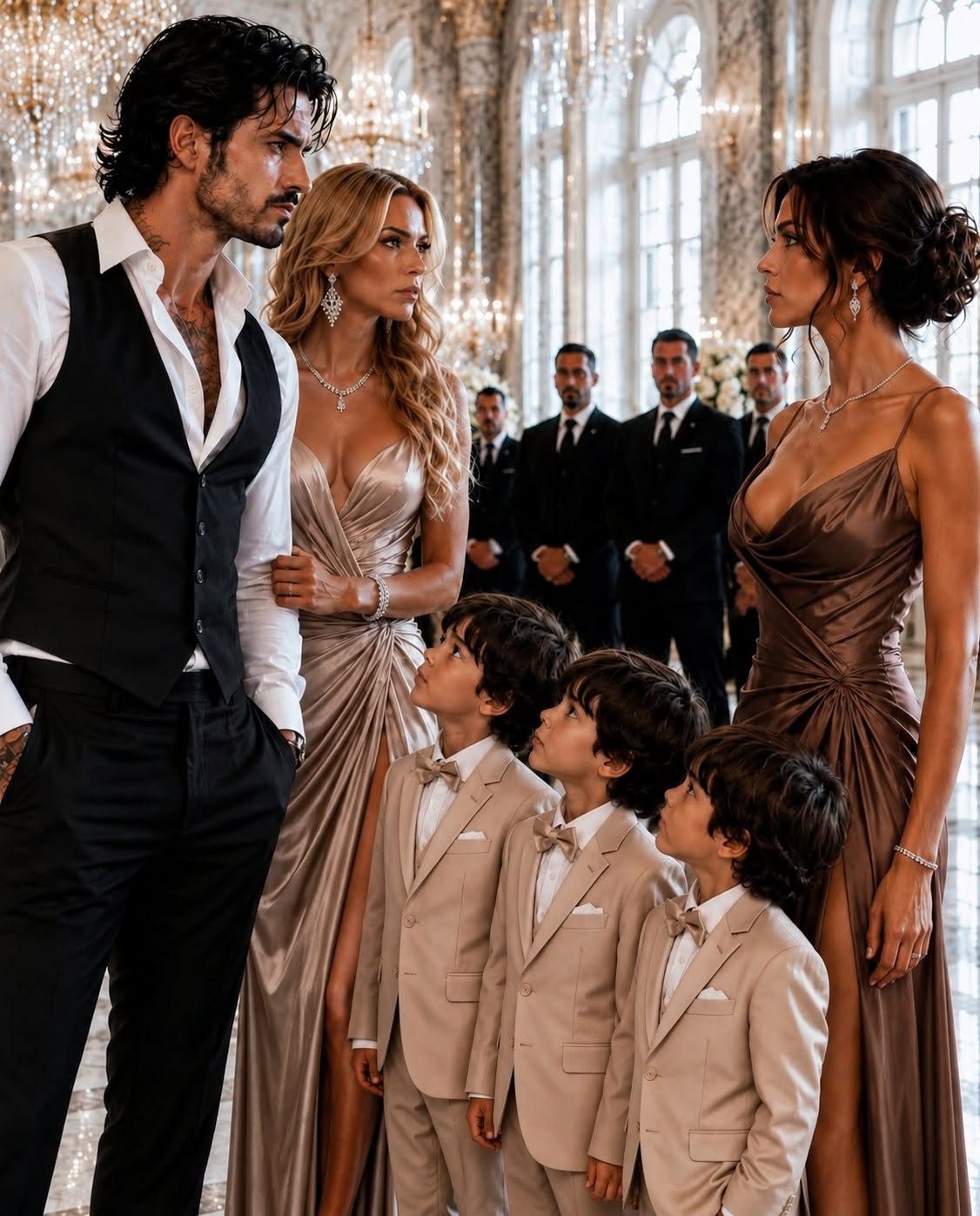
PART 3
Gabriel did not become a father overnight.
That might have been easier.
It also would have been less honest.
He became one Tuesday afternoon at a time.
At first, Tuesdays were his days with the boys.
Not whole days.
Two hours after kindergarten.
I was always there.
The first Tuesday, Gabriel arrived at our apartment carrying nothing.
No toys.
No enormous boxes.
No expensive surprises.
Just himself.
Ben opened the door and looked behind him.
“Where’s the stuff?”
Gabriel blinked.
“What stuff?”
“Dad stuff.”
I covered a smile.
Gabriel crouched.
“I’m new at this. What qualifies as dad stuff?”
Ben thought carefully.
“Snacks.”
Gabriel nodded.
“That seems like a serious oversight.”
Theo appeared.
“Mom says you aren’t supposed to buy our affection.”
“I have been informed.”
“You can still buy crackers.”
“Excellent distinction.”
Henry walked into the hallway holding a book.
“Are you staying for dinner?”
Gabriel looked at me.
I had not planned that.
Henry waited.
I looked at the clock.
Then at Gabriel.
Then at my son.
“Yes,” I said. “He can stay.”
That first dinner was spaghetti.
Nothing elegant.
Nothing complicated.
Ben spilled milk.
Theo refused mushrooms on philosophical grounds.
Henry asked Gabriel whether he had ever failed a math test.
Gabriel said no.
Theo accused him of being suspicious again.
After dinner, the boys wanted to show him their room.
He followed them down the hall.
I stayed behind in the kitchen, clearing plates.
A minute later, I heard silence.
Then Gabriel’s voice.
“What’s this?”
I already knew.
The photograph.
The one Henry had mentioned at the gala.
It was tucked inside a small memory box on the boys’ shelf.
A picture from our wedding.
Not the formal portrait with hundreds of guests.
A candid photograph taken by my cousin after the ceremony.
Gabriel and I were standing behind the reception tent.
He had loosened his tie.
I was laughing.
His forehead rested against mine.
We looked young.
Ridiculously young.
Happy.
When I reached the bedroom doorway, Henry was holding it.
“This is the picture.”
Gabriel stared at it.
“I remember.”
“Mom said you used to be married.”
“We were.”
Theo sat cross-legged on the rug.
“Why did you stop?”
Gabriel looked at me.
I could have rescued him.
I didn’t.
Not because I wanted him uncomfortable.
Because one day our sons would ask harder questions.
We needed to learn how to answer the easy ones truthfully.
“Because I made some bad choices,” Gabriel said.
Henry studied him.
“Like what?”
“Grown-up ones.”
“That’s vague,” Theo said.
“It is.”
“Mom says vague answers usually mean adults don’t want to explain something.”
Gabriel looked toward me.
“Your mother has given you an alarming education in cross-examination.”
“You’re changing the subject,” Theo said.
I laughed.
Gabriel surrendered.
“Your mother and I stopped being good at talking to each other. And instead of trying hard enough to fix that, I made choices that hurt her.”
The boys became quiet.
Gabriel continued.
“Sometimes adults can be sorry about something and still not be able to undo it.”
Ben climbed onto his bed.
“Did you say sorry?”
“Yes.”
“Did Mom forgive you?”
Gabriel looked at me again.
This time, I answered.
“I’m working on it.”
Ben accepted that too.
Children, I was learning, did not always need perfect endings.
They needed safe truths.
Weeks became months.
Gabriel never missed a Tuesday.
Not once.
If a meeting threatened to interfere, the meeting moved.
If he had to travel, he returned.
He learned that Henry hated being rushed.
That Theo loved museums but became bored at sporting events.
That Ben could fall asleep anywhere except his own bed.
He learned how to separate three nearly identical navy jackets by checking the small colored stitches I had sewn into the collars.
He learned that Henry ate the crust first.
Theo saved it for last.
Ben negotiated over whether crust should legally count as bread.
In return, the boys learned him.
Gabriel liked black coffee.
He could not draw.
He knew how to fix almost anything mechanical.
He disliked loud restaurants.
He could make excellent pancakes and terrible scrambled eggs.
And despite his reputation for terrifying boardrooms full of adults, he was strangely helpless when Ben asked him to make voices while reading picture books.
“You sound weird,” Ben informed him one evening.
“I am improvising.”
“You sound like a robot with a cold.”
“I have limited theatrical training.”
“Mom does better voices.”
“Your mother does most things better than I do.”
I looked over from the sofa.
Once, a remark like that from Gabriel would have been charm.
Now it sounded like fact.
There was a difference.
The first time he attended a school event, he asked my permission three times.
It was Family Reading Morning.
Parents came into the kindergarten classroom and read with the children for an hour.
“You don’t need to come,” I told him.
“I know.”
“The boys won’t think anything if you don’t.”
“I know.”
“You have a board meeting.”
“I moved it.”
Of course he had.
I studied him.
“You want to come.”
“Yes.”
“Then come.”
He stood at the back of the classroom at first.
He was too tall for the tiny chairs.
Too serious-looking for a room decorated with paper suns and construction-paper letters.
Ben solved the problem by pulling him toward the carpet.
“Sit.”
Gabriel obeyed.
Within ten minutes, three children who were not ours had joined them.
Apparently being six feet three inches tall made Gabriel an ideal human bookshelf.
I stood by the classroom window watching him read The Very Busy Beaver with six small children gathered around him.
Our teacher, Ms. Alvarez, came beside me.
“He’s trying very hard.”
I smiled.
“Yes.”
“He seems nervous.”
I almost laughed.
People who knew Gabriel Cross professionally would have considered the idea impossible.
“He is.”
Ms. Alvarez watched him.
“The boys talk about him.”
My heart tightened.
“What do they say?”
“That their dad came back.”
I looked at her quickly.
“She means into their lives,” Ms. Alvarez explained. “They know he didn’t leave them.”
I nodded.
“We’ve been careful about that.”
“You’re doing well.”
There was no judgment in her voice.
Just kindness.
I watched Henry lean against Gabriel’s shoulder while he turned a page.
Something inside me eased.
Not healed.
Healing was too dramatic a word.
But eased.
Sometimes that was enough.
Serena contacted me in February.
Four months after the gala.
Her message was brief.
There is something I should give you. Not because I expect anything from you. Because it belongs to the truth.
I almost deleted it.
Instead, we met at a café near Bryant Park.
She arrived without makeup.
Without an entourage.
Without Gabriel.
I realized how rarely I had ever seen Serena as herself.
For years she had existed in my mind as an image.
A woman sitting on Gabriel’s desk.
A woman from magazine covers.
A woman standing beside my former husband.
A symbol was easier to hate than a person.
She placed a small folder between us.
Inside were printed emails.
The first had been written five years earlier.
From Serena to Eleanor.
I saw Claire today. I think she may be pregnant.
Eleanor’s reply was beneath it.
Do you know for certain?
No.
Then another.
Have you told Gabriel?
No.
And finally:
I believe this must come from Claire. I will try to contact her privately.
I looked up.
“Why are you giving me this?”
“Because you deserve to know I didn’t spend five years conspiring to keep your children from him.”
“I never said you did.”
“No.”
She looked out the window.
“But I spent five years knowing I had failed to say something when it mattered.”
I closed the folder.
“You were afraid he would come back to me.”
“Yes.”
“There wasn’t even a relationship between you anymore.”
“No.”
“That makes it worse.”
“I know.”
Again, no defense.
I found I respected that.
Not enough to forget.
But enough to listen.
Serena wrapped both hands around her coffee.
“I was twenty-eight and convinced that being chosen by the right man would prove something about me.”
“Gabriel was married.”
Her cheeks reddened.
“I know.”
“You knew me.”
“Barely.”
“You came to my house.”
“Twice.”
“You sat at my dinner table.”
“Yes.”
There were some truths that deserved to remain uncomfortable.
Serena did not ask me to make them comfortable.
“I’m sorry,” she said.
“For the kiss?”
“For wanting what belonged to someone else. For pretending I didn’t understand the consequences. For being relieved when your marriage ended.”
She looked at me.
“And for seeing you pregnant and allowing my pride to matter more than honesty.”
I stared at her for a long time.
“I don’t know whether I forgive you.”
“You don’t have to.”
“I might someday.”
Her eyes filled unexpectedly.
“That’s more than I expected.”
I did not hug her.
We did not become friends.
Life was not a movie.
Some relationships did not need transformation.
They only needed an ending that no longer poisoned the future.
When I walked away from Serena that afternoon, I realized I had spent years carrying her inside my anger.
For the first time, I left her behind.
Gabriel and I changed more slowly.
Trust returned in pieces.
Tiny ones.
He told me when he would be late.
Then he stopped being late.
He asked instead of assuming.
He listened when I said no.
He learned that access to the boys did not mean access to me.
And somehow, respecting that boundary made me less afraid of lowering it.
One night in March, we sat at my kitchen table after the boys were asleep.
Gabriel had stayed to help Henry finish a model of the solar system.
Saturn hung crookedly from a string above the dining table.
Jupiter had fallen into a bowl of apples.
Neither of us had the energy to fix it.
Gabriel drank tea.
I drank wine.
“You hate tea,” I said.
“I’m trying to become flexible.”
“That may be beyond modern medicine.”
He smiled.
Silence settled comfortably.
That was new.
During our marriage, silence had become accusation.
Now it could simply be quiet.
“What are you thinking?” I asked.
He looked at the hallway.
“That I missed so much.”
The words held no demand for reassurance.
So I gave him the truth.
“Yes.”
He nodded.
“I know.”
“You can’t make it up.”
“I know.”
“They don’t need five years of experiences compressed into one.”
“I know.”
“You say that a lot now.”
“I had significant deficiencies in listening.”
I laughed.
He watched me.
The air shifted.
Not dramatically.
Just enough.
My laughter faded.
He looked down at his tea.
“I still love you.”
There it was.
No warning.
No speech.
Just the truth.
I set down my glass.
“Gabriel.”
“I’m not asking you to do anything with that information.”
“Then why say it?”
“Because I spent too many years hiding behind what I thought was easier for other people.”
He raised his eyes.
“You deserve to know.”
I did not know what to say.
So I told him my truth.
“I don’t know what I feel.”
“I understand.”
“Sometimes I look at you with them and I remember why I loved you.”
His breathing changed.
“And sometimes I look at you and remember your office.”
He nodded.
“I understand that too.”
“I can’t live inside either memory.”
“No.”
“I have to know who you are now.”
Gabriel was quiet.
Then he said, “So do I.”
That answer stayed with me.
Spring came.
The boys turned six.
Their birthday party was held in Riverside Park.
Twenty children.
Cupcakes.
A magician who lost control of a rabbit.
Three cakes because Theo had argued that triplets were individual citizens entitled to separate flavor preferences.
Gabriel arrived early and spent an hour helping me attach paper decorations to picnic tables.
Eleanor brought bubbles.
Laura organized games.
My mother came from Boston.
That had been another conversation.
She had never forgiven Gabriel.
Unlike me, she saw no reason to reconsider.
“He hurt you,” she said the night before the party.
“Yes.”
“And now because he can make pancakes, everybody forgets?”
“Nobody forgot.”
“Claire.”
“Mom, I’m not asking you to trust him.”
“Are you trusting him?”
I looked toward my living room.
Gabriel sat on the floor helping Ben tape wrapping paper around a cardboard box for the school recycling project.
“Yes,” I said.
My mother stared at me.
“That scares me.”
“Me too.”
That softened her.
She touched my cheek.
“I watched you put yourself back together.”
“I know.”
“I don’t want you broken again.”
“I’m not the same person I was.”
“No.”
A reluctant smile touched her face.
“You’re much more annoying now.”
“Three children will do that.”
She laughed.
At the party the next day, my mother and Gabriel stood near the picnic tables.
I watched from a distance.
Gabriel said something.
She answered.
He listened.
Then he nodded.
Later I asked what they had discussed.
My mother refused to tell me.
Gabriel did too.
It was Eleanor who eventually revealed it.
“He apologized to her.”
“For what?”
“For leaving her daughter to rebuild a life alone.”
I looked across the park.
Gabriel was holding three paper plates while Ben carefully assigned pieces of cake.
No grand gesture.
No demand that anyone acknowledge he had changed.
Just an apology given to someone who had carried part of the damage.
That mattered.
In June, the boys spent their first afternoon alone with Gabriel.
I had postponed that step for months.
Not because I thought he would harm them.
I knew he would not.
Because letting him have them without me felt like admitting something irreversible.
He was not visiting my children anymore.
They were his children too.
He picked them up at noon.
I stood in the doorway.
“Henry needs his inhaler in the front pocket.”
Gabriel touched the bag.
“Front pocket.”
“Theo will claim he doesn’t need sunscreen.”
“He does.”
“Ben gets carsick if—”
“Claire.”
I stopped.
Gabriel’s expression was gentle.
“I have the list.”
Of course there was a list.
Three pages.
I had emailed it the night before.
“I know.”
“They’ll be home by six.”
“Five forty-five.”
He smiled.
“Five forty-five.”
The boys piled into the car.
Gabriel opened the rear door.
Three booster seats had been installed.
That almost undid me.
Not a sports car.
Not the imposing sedan I remembered.
A large, extremely ordinary SUV with three booster seats.
Theo waved.
“Bye, Mom!”
Ben shouted, “Dad says we can get ice cream if nobody gets arrested!”
I stared at Gabriel.
He looked horrified.
“That was a joke.”
“Work on your material.”
Then they were gone.
I closed the door.
My apartment became silent.
For the first time in six years, I had six hours with nowhere I was required to be.
I stood in the middle of my living room.
Then I cried.
Not because I was afraid.
Not exactly.
Because motherhood had occupied every corner of my life for so long that I had forgotten what silence sounded like.
And because somewhere in Manhattan, the man I had once believed I would grow old beside was taking our three sons to a science museum.
Life was strange.
Not cruel.
Not generous.
Simply strange.
At five forty-three, I heard them in the hallway.
Ben entered first.
“We saw a giant whale!”
Theo followed.
“It was a blue whale model, not an actual whale.”
“I know.”
“You said saw.”
“I did see it.”
Henry came last, carrying Gabriel’s hand.
That stopped me.
Henry was affectionate, but carefully so.
He did not hold hands casually.
Gabriel looked at me.
Something passed between us.
A recognition.
A milestone neither of us would embarrass Henry by announcing.
“How was it?” I asked.
“Excellent,” Gabriel said.
“Dad got lost,” Theo announced.
“I was temporarily uncertain.”
“You went into the dinosaur hall three times.”
“It’s a confusing building.”
“I’m six and I knew where we were.”
Gabriel looked at me.
“Your children are merciless.”
“Our children.”
The words came naturally.
I realized what I had said only after they were out.
Gabriel did too.
Neither of us corrected them.
That summer, Gabriel began changing parts of his life I had never asked him to change.
His name had always carried weight.
Some of it legal.
Some of it inherited.
Some of it rooted in an older world of private loyalties and businesses no respectable newspaper described accurately.
When we were married, I had learned not to ask certain questions.
That had been one of the cracks between us.
Now Gabriel came to me one evening with a stack of documents.
“I’m restructuring the family companies.”
I stared at him.
“Why are you telling me?”
“Because decisions I make affect the boys.”
He sat across from me.
“I’ve spent most of the last five years moving our holdings into businesses that can withstand daylight.”
“That sounds almost poetic.”
“My accountant would disagree.”
“What does it mean?”
“It means by the time the boys are old enough to understand the Cross name, I want them to inherit choices instead of obligations.”
I studied him.
“Was this because of them?”
“It started before I knew about them.”
“Why?”
He thought for a moment.
“Because I realized I had built an entire life around things I claimed I had no choice about.”
His gaze met mine.
“That was one of the lies I used to excuse being absent from our marriage.”
There was nothing romantic in what he was saying.
No promise that love had transformed him.
He had begun the work before the boys appeared.
That made it more convincing.
“You don’t have to become a different person for them,” I said.
“No.”
He nodded.
“But I can become a person who gives them more freedom than I had.”
That, I understood.
By autumn, Tuesdays had become Tuesdays and Saturdays.
Then occasional dinners.
Then Sunday mornings when Gabriel would arrive with groceries and the five of us would make breakfast.
The first time I realized we had become a family again, nobody said anything important.
It was raining.
Henry was reading on the sofa.
Theo and Ben were constructing something impossible from cardboard.
Gabriel stood at the stove making soup.
I sat at the kitchen counter answering emails.
Music played quietly.
Ordinary.
Entirely, beautifully ordinary.
I looked up.
Gabriel was chopping carrots.
He glanced at me.
“What?”
“Nothing.”
“You’re staring.”
“I’m allowed.”
His mouth curved.
“Historically, when you stare at me like that, I’m about to be told I’m doing something wrong.”
“You are.”
He looked at the cutting board.
“What?”
“Those pieces are enormous.”
“They shrink.”
“Carrots do not shrink that much.”
“You have very strong vegetable opinions.”
“I’ve raised three children. I have strong opinions about everything.”
He smiled.
Then returned to chopping.
And I understood.
I loved him.
Not the man in the wedding photograph.
Not the husband I remembered.
This man.
The one standing in my kitchen making badly cut soup.
That realization did not mean I owed him a second chance.
Love was not a contract.
It was information.
What I did with it remained my choice.
A week later, I asked Gabriel to dinner.
Without the children.
He looked alarmed.
“That expression is reassuring,” I said.
“You have never invited me to dinner without an agenda.”
“I have an agenda.”
“That is significantly less reassuring.”
We went to a small Italian restaurant we had loved when we were first married.
It had changed owners.
The tables were different.
The menu was different.
That seemed appropriate.
After dessert, I put down my spoon.
“I’m willing to try.”
Gabriel became completely still.
“Try what?”
“Us.”
He stared at me.
“Claire.”
“Do not make me repeat this.”
“I just want to be sure I understood.”
“I am not moving in with you.”
“Okay.”
“I am not marrying you.”
His expression remained serious.
“Okay.”
“The boys do not get told anything yet.”
“Absolutely.”
“We go on dates.”
“Dates.”
“Like normal adults.”
“I have limited experience.”
“So do I. My last first date was approximately a geological era ago.”
He almost smiled.
“And if this doesn’t work,” I continued, “we remain parents.”
“Yes.”
“No retreating because it becomes uncomfortable.”
“Never.”
“No assuming that loving me means you get to make choices for me.”
“I understand.”
“And Gabriel?”
“Yes?”
“If you kiss another model, I’m becoming a nun.”
He stared at me.
Then he laughed so loudly the couple beside us turned around.
I laughed too.
It felt strange.
Free.
When he walked me home, he stopped outside my building.
Five years earlier, Gabriel would have assumed he was coming upstairs.
Now he put his hands in his coat pockets.
“Good night.”
I looked at him.
“That’s it?”
His eyebrows rose.
“You gave me fourteen rules during dinner.”
“I did not.”
“Thirteen, then.”
“You’re not going to kiss me?”
“I was under the impression restraint was central to the new program.”
I stepped closer.
“It is.”
“Claire.”
“Yes?”
“I need very clear instructions.”
So I kissed him.
It was nothing like the kisses from our marriage.
Those belonged to people who thought love made them permanent.
This kiss belonged to two people who knew permanence had to be chosen repeatedly.
When I stepped back, Gabriel’s eyes remained closed for a second.
“Well,” he said.
“That was articulate.”
“I’m processing.”
“Good night, Gabriel.”
I went upstairs smiling.
We dated for eleven months.
I insisted on calling it dating because the word irritated him.
He took me to restaurants.
I took him bowling.
He was terrible.
This improved my affection considerably.
We went to galleries.
We walked through Central Park.
Sometimes we talked about the past.
More often, we talked about the future.
He met the friends I had made without him.
I met people who had entered his life after me.
He began therapy.
Not because I demanded it.
Because, as he put it, “I have discovered that self-awareness apparently requires professional assistance.”
The boys gradually understood.
Theo figured it out first.
“You and Dad are dating.”
I almost dropped a plate.
“What makes you think that?”
“You wear perfume when you go out with him.”
“I wear perfume other times.”
“Not the expensive one.”
Henry appeared.
“I knew too.”
Ben looked confused.
“What’s dating?”
Theo answered.
“It’s when grown-ups eat dinner and lie about not wanting dessert.”
Gabriel walked into the kitchen.
“Accurate.”
Ben looked between us.
“Are you getting married?”
“No,” I said.
Gabriel said nothing.
I noticed.
So did Theo.
“Dad didn’t say no.”
“Dad values continued existence.”
I gave Gabriel a look.
He became interested in the refrigerator.
He waited another four months.
There was no restaurant.
No orchestra.
No ballroom.
No photographers.
It happened on a Sunday morning.
The boys were at Eleanor’s apartment.
I was making coffee.
Gabriel stood at my kitchen window.
“Claire.”
I turned.
He was holding no ring.
That surprised me.
“I want to ask you something.”
“That sentence has historically led to paperwork.”
He smiled.
“Not today.”
I waited.
“I don’t want our old marriage back.”
My chest tightened.
“Neither do I.”
“I loved you then.”
“I know.”
“But I didn’t know how to be your partner.”
I set down my mug.
“I think I do now.”
He came closer.
“And I know enough to understand that believing that doesn’t make it true automatically.”
I smiled faintly.
“Therapy has been busy.”
“Extremely.”
He took my hand.
“I don’t want an answer today.”
“Gabriel.”
“I mean it.”
“What are you asking?”
He looked at me.
“Whether someday you might want to marry me again.”
There was no ring.
No pressure.
No audience.
Just a question.
I thought about the girl I had been the first time I married Gabriel Cross.
She had believed love was certainty.
That if two people loved each other enough, they would somehow become immune to loneliness, mistakes and fear.
I knew better now.
Love did not make relationships safe.
Choices did.
Listening did.
Truth did.
Boundaries did.
Forgiveness did.
And sometimes forgiveness did not mean forgetting what happened.
It meant refusing to let what happened make every future decision.
“I don’t need someday,” I said.
Gabriel stared at me.
“Claire.”
“Yes.”
His expression changed.
“What?”
“Yes.”
“You said—”
“I know what I said.”
“You told me you weren’t going to answer today.”
“You said that.”
For once in his life, Gabriel Cross appeared incapable of speech.
I laughed.
Then he wrapped his arms around me.
Not tightly.
Not possessively.
Just enough.
I pressed my face against his shoulder.
“We do it differently this time,” I whispered.
“Yes.”
“Small wedding.”
“Yes.”
“No society pages.”
“Yes.”
“The boys do not plan it.”
A pause.
“They have opinions.”
“They always have opinions.”
“Ben wants cake.”
“Ben always wants cake.”
I leaned back.
“And if we ever stop talking to each other—”
“We talk about why.”
“If you’re unhappy—”
“I tell you.”
“If I’m unhappy—”
“You tell me.”
“And nobody decides alone what is best for both of us.”
Gabriel looked at me.
“Never again.”
We married the following spring.
Not at the Cross estate.
Not in Manhattan.
Not beneath chandeliers.
We chose a small garden overlooking the Hudson.
Thirty-two guests.
Laura cried before the ceremony began.
My mother cried during it.
Eleanor cried through almost everything and denied it afterward.
Serena sent flowers.
I had not invited her.
She had not expected to be invited.
The card contained one sentence.
I hope the life you build now belongs entirely to the people you have become.
I kept it.
Not because Serena became part of our family.
Because closure deserved acknowledgment too.
The boys wore navy jackets.
Henry carried the rings.
Theo had prepared a schedule for the ceremony.
Ben had been specifically instructed not to touch the cake.
He touched it within six minutes of arriving.
When I reached the end of the aisle, Gabriel looked at me.
Five years earlier, his trembling hands at a charity gala had been the first crack in the armor I remembered.
Today, his hands were steady.
Mine were too.
We did not repeat our original vows.
Those promises belonged to people who had not yet learned what promises required.
Gabriel went first.
“I once believed loving someone meant protecting them from every difficult truth.”
He looked at me.
“I know now that love without truth becomes distance.”
My eyes filled.
“So I promise you honesty when honesty is uncomfortable, presence when leaving would be easier, and respect for every choice that belongs to you.”
When it was my turn, I took his hands.
“I once believed forgiveness meant pretending pain no longer mattered.”
Gabriel’s eyes shone.
“I know now that forgiveness can mean remembering clearly and choosing freely.”
I glanced toward our sons.
“So I promise not to let fear speak for me when I can speak for myself. I promise to tell you when I need you and when I need space. And I promise that whatever comes next, we face it as partners.”
Ben whispered loudly, “Can we have cake now?”
Everybody laughed.
Gabriel looked toward him.
“Almost.”
“That means yes.”
Theo corrected him.
“It means eventually.”
Ben sighed dramatically.
The ceremony continued.
When Gabriel kissed me, the boys cheered.
Not because their parents had magically erased five lost years.
We hadn’t.
Those years remained.
They always would.
Henry, Theo and Ben had first steps Gabriel never saw.
First words he never heard.
Birthday candles he never helped them blow out.
There was no rewriting that.
There was only what came afterward.
And what came afterward was enough.
Two years later, we attended the Hudson Children’s Foundation gala again.
The same ballroom.
The same chandeliers.
Different people.
Or perhaps we were simply different.
I stood near the balcony doors while Gabriel spoke with a foundation trustee.
Henry, Theo and Ben—eight now—were at the children’s table arguing about whether one person could reasonably eat four miniature desserts.
Ben believed strongly in personal freedom.
Theo had created a mathematical model.
Henry was pretending not to know them.
Laura walked up beside me.
“Thinking about the last time?”
“Yes.”
“Hard not to.”
Across the ballroom, Gabriel looked toward me.
Even from thirty feet away, I knew exactly when he found me.
His entire expression softened.
Laura followed my gaze.
“He still does that.”
“What?”
“Looks for you when he enters a room.”
I smiled.
“He used to do it too.”
“Before?”
“Yes.”
I thought about that.
Perhaps love had always been there.
But love had never been the entire problem.
People liked to imagine relationships were saved by discovering that two people still loved each other.
Ours had not been.
Ours had been saved by discovering that love alone was insufficient.
Gabriel crossed the room.
“Everything okay?”
“Fine.”
He looked toward the boys.
“Why does Theo have a calculator?”
“Dessert negotiations.”
“Of course.”
Ben spotted us.
“Dad!”
Gabriel turned.
“Can I have another chocolate thing?”
“What did your mother say?”
Ben sighed.
“That you would say that.”
Gabriel looked at me.
I raised three fingers.
Three desserts maximum.
He nodded.
“Three.”
Ben looked betrayed.
“Dad.”
“Your mother and I are a united government.”
“That doesn’t sound democratic.”
Theo appeared beside him.
“Technically, family governments are rarely democracies.”
Henry joined them.
“You two are embarrassing.”
“You ate three desserts,” Theo said.
“That is irrelevant.”
Gabriel looked at me.
I started laughing.
Soon he did too.
Around us, Manhattan glittered.
People talked.
Glasses clinked.
Music drifted beneath the chandelier where, seven years earlier, Gabriel had seen three gray-green pairs of eyes and realized his life contained a truth he had never imagined.
That night had once seemed like the moment everything broke open.
Now I understood it differently.
It was the moment everything began telling the truth.
Later, as we were leaving, Ben slipped his hand into mine.
His other hand found Gabriel’s.
Henry and Theo walked ahead of us.
At the doors, Ben looked up.
“Mom?”
“Yes?”
“Was this the place where Dad found us?”
Gabriel and I exchanged a glance.
“In a way,” I said.
Ben considered that.
“I think we found him too.”
Gabriel stopped walking.
Ben kept tugging his hand.
“Come on, Dad.”
Gabriel looked at me.
There were some emotions a person never became powerful enough to hide.
I squeezed his arm.
“He’s right.”
Gabriel looked toward our sons.
Then at me.
“Yes,” he said quietly.
“He is.”
We stepped outside together.
The city was bright around us.
Gabriel had once missed five years.
For a long time, I believed those missing years would define everything that followed.
They didn’t.
What defined us were the ordinary mornings afterward.
The school events.
The pancakes.
The difficult conversations.
The apologies that asked for nothing.
The trust earned one promise at a time.
The boundaries respected.
The chances given freely instead of demanded.
And the three boys who never needed their parents to have a perfect story.
They only needed us to show up for the one we were still writing.
So we did.
Together.

One thought on “PART 3 AND FULL STORY: Five years after my Mafia boss husband divorced me for a younger model5-019”