The chandeliers of the Pierre Hotel ballroom didn’t just sparkle; they judged. Beneath them, Lydia Carver, the CEO of Carver Tech and arguably the most powerful woman in Manhattan, held a glass of champagne that cost more than most people’s monthly rent. She wore a smile that was practiced, porcelain, and completely hollow.
“Lydia, darling, the donation for the arts wing is simply generous beyond words,” Senator Miller droned on, his hand sweating slightly on her shoulder.
“It’s for the children, Senator,” Lydia said, her voice smooth as silk. “Legacy is everything.”
But Lydia had no legacy. She had a conglomerate, three penthouses, and a private jet. But when the lights went out at night, she had silence.
The orchestra swelled into a waltz. The heavy oak doors at the back of the ballroom creaked open. Usually, security would have been on it instantly. But the intruder was so small, so jarringly out of place, that the room simply froze in collective confusion.
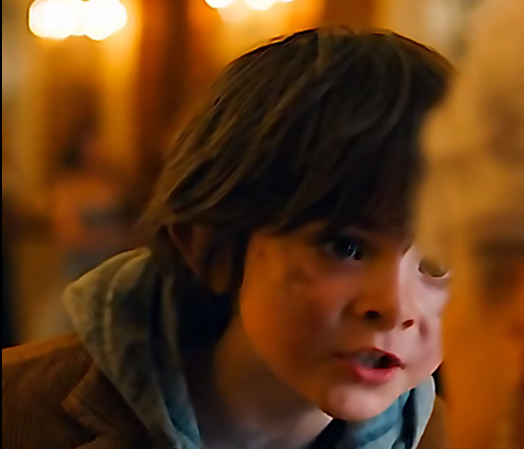
He couldn’t have been more than six years old. He wore a t-shirt three sizes too big, stained with mud, and his feet were bare against the polished marble floor. He looked like a smudge of reality on a canvas of fantasy.
Murmurs rippled through the crowd. “Where is security?” “How did he get in?” “Is this a stunt?”
Two burly guards in earpieces materialized, reaching for the boy’s arms. The boy flinched, curling in on himself.
“Stop!”
The command cracked through the room like a whip. Lydia didn’t know she was going to say it until the word was in the air. She set her glass down on a passing tray, the crystal clinking sharply, and walked toward the entrance. The crowd parted like the Red Sea.
Lydia stopped three feet from the boy. Up close, he smelled of rain and exhaust fumes. He was trembling.
Slowly, ignoring the gasp of the Senator’s wife, Lydia Carver sank to her knees. Her fifty-thousand-dollar Dior gown pooled onto the floor, soaking up the grime from the boy’s feet. She didn’t care.
“Hi,” she whispered, her voice losing its boardroom edge.
The boy looked up. He had eyes the color of storm clouds. Eyes that Lydia saw in the mirror every single morning. The breath hitched in her throat.
“You’re the lady,” the boy said, his voice raspy.
“I’m Lydia. What’s your name?”
“Leo.”
Lydia reached out, her hand hovering. “Leo, where are your parents? How did you get in here?”
Leo hesitated. He dug a dirty hand into his pocket and pulled out a crumpled, damp piece of paper. He didn’t hand it over immediately. He stepped closer, leaning in until his forehead almost touched hers. The room was deadly silent.
“My mom told me to find you,” he whispered.
Lydia felt a chill that had nothing to do with the air conditioning. “Who is your mom, Leo?”
“She said… she said to tell you that she never forgot the song about the moon.”
Lydia stopped breathing. The world tilted on its axis.
Twenty-two years ago. A cold dormitory room. A baby girl wrapped in a coarse hospital blanket. Lydia, just nineteen, weeping as she signed the papers. Her parents had given her an ultimatum: The baby or the inheritance. The baby or a future. She had chosen the future, but before she handed the child over to the agency, she had hummed it. The Moon Song. A silly, made-up lullaby she hadn’t thought of in two decades.
Sleep, my little moon beam, the stars are just for show…
“Where is she?” Lydia’s voice broke, loud enough now for the crowd to hear the panic. She grabbed the boy’s shoulders, perhaps too tightly. “Leo, where is she?”
“She’s outside,” Leo said, tears finally spilling over. “She’s sleeping on the bench. She won’t wake up.”
Lydia stood up so fast she nearly tripped over her dress.
“Ms. Carver,” the head of security stepped in. “We can handle this—”
“Get out of my way!” Lydia screamed, a raw, animalistic sound that stripped away the billionaire CEO and left only a terrified mother.
She didn’t run; she sprinted. She kicked off her heels, running barefoot across the marble, grabbing Leo’s hand. They burst through the lobby doors and into the biting New York night.
“There,” Leo pointed.
Across the street, on a park bench shadowed by an elm tree, a figure lay huddled under a thin coat.
Lydia didn’t look at the traffic. She ran across the avenue, horns blaring, tires screeching. She fell onto her knees beside the bench.
The woman was thin. Too thin. Her face was pale, her lips blue. But the structure of the jaw, the curve of the brow—it was undeniable.
“Sarah?” Lydia whispered the name she had given the baby before the papers were signed. The name the adoptive parents had promised to keep.
The woman’s eyelids fluttered. She looked at Lydia with glassy, feverish eyes. She smiled, a weak, broken thing. “You came,” she rasped. “I didn’t think… you’d come.”
“I’m here,” Lydia was sobbing now, pulling her daughter’s cold body into her arms, trying to transfer her warmth, her wealth, her life force into this fragile frame. “I’m here. I’ve got you. Someone call an ambulance! Now!”
Security had caught up. Phones were out. Sirens wailed in the distance.
“I didn’t come for money,” Sarah whispered, her hand gripping Lydia’s silk sleeve with surprising strength. “I’m sick, Mom. The doctors said… they said I don’t have long. I couldn’t leave Leo alone. I had to know… if you were real.”
“I’m real,” Lydia cried, brushing the hair from Sarah’s forehead. “I’m so real. And you are going to be fine. I will buy the hospital if I have to. You hear me? You aren’t going anywhere.”
“The song,” Sarah breathed, her eyes drifting shut. “Sing it.”
The sirens were deafening, the flashing lights blinding. But in that bubble on the street corner, Lydia Carver, the woman who owned the city, began to sing. Her voice cracked and wavered, singing a nonsense song about moonbeams and stars.
Leo huddled under her arm, sandwiched between his mother and the grandmother he had just met.
The paramedics arrived, swarming the scene. They loaded Sarah onto the stretcher. Lydia didn’t let go of her hand. She climbed into the back of the ambulance, pulling Leo up with her.
“Ma’am,” the driver said. “Only one passenger allowed.”
Lydia looked at him. Her makeup was smeared, her dress was ruined, and her feet were bleeding. She looked him dead in the eye with the ferocity that had built an empire.
“Drive,” she said.
He drove.
[SIX MONTHS LATER]
The Carver Gala was canceled that year. In fact, Lydia Carver hadn’t been seen in the boardroom for half a year. Rumors swirled that she had lost her mind, that she was stepping down.
But on a warm Tuesday afternoon, in a private garden in upstate New York, Lydia sat on a blanket. Sarah sat in a wheelchair next to her, looking frail but breathing. The best specialists in Zurich had bought them time. Maybe years.
Leo was running across the grass, chasing a golden retriever.
“He looks like you,” Sarah said softly, watching her son.
“He has your spirit,” Lydia replied. She reached over and took her daughter’s hand. “I missed twenty years, Sarah. I’m sorry. I would give every penny back to change that.”
Sarah squeezed her hand. “You’re here now. That’s all that matters.”
Lydia looked at her phone. Thirty missed calls from the board of directors. She powered it off and tossed it onto the grass. She began to hum the Moon Song, and for the first time in her life, Lydia Carver felt rich.
