The rain in Seattle didn’t wash things clean; it just made the grime slicker. Julian Vance adjusted the cuffs of his Italian suit, checking his reflection in the tinted window of his sedan. At thirty-five, he was the picture of success: the youngest CEO in the city’s history, a man who had turned his family’s tragic past into an empire. But the emptiness in his eyes was the one thing his money couldn’t fix.
He had just left a board meeting where he’d ruthlessly acquired a competitor. He felt nothing. No joy, no thrill. Just the cold mechanics of winning.
As he reached for the door handle, a small, grimy hand tugged at his jacket.
“Mister? Mister, you gotta listen.”
Julian stiffened, his security detail stepping forward instantly. Julian waved them off. He looked down. It was a boy, no older than ten, barefoot in the freezing drizzle. His clothes were oversized rags, but his eyes were sharp, intelligent, and desperate.
“I don’t have cash, kid,” Julian said, his voice flat. “Go to the shelter on 5th.”
“It ain’t about money!” the boy shouted, his voice cracking. “It’s about the Lady. The Lady at the Heap. She talks about you.”
Julian paused. “The Heap” was local slang for the massive landfill on the outskirts of the city, a place where the desperate scavenged for scrap metal to sell for pennies. “Nobody at the dump knows me.”
“She does,” the boy insisted, shivering. “She says she had a son. A boy named Julian. She says he liked to draw birds. She says… she says he died in the fire, but she talks to him anyway.”
The world seemed to tilt on its axis. Julian felt the blood drain from his face. “What did you say?”
“She draws birds too,” the boy said, pulling a crumpled, dirty piece of paper from his pocket. “Look.”
Julian took the paper. It was a sketch, drawn with charcoal on the back of a fast-food wrapper. It was a blue jay, rendered with a specific, delicate style—the wings slightly exaggerated. It was the exact way Julian used to draw them when he was seven. The exact way his mother had taught him before the house fire that took her life fifteen years ago.
“Get in the car,” Julian ordered, his voice trembling.
The drive to the outskirts took forty minutes. The transition was stark: from the steel and glass of the skyline to the mud and rust of the Heap. The smell hit them before they even stopped—a cloying mix of rot, burning rubber, and wet cardboard.
The boy, who said his name was Leo, guided Julian through the labyrinth of trash mounds. They walked past rusted washing machines and mountains of tires. Julian’s expensive loafers sank into the muck, ruining them, but he didn’t care. His heart was hammering against his ribs like a trapped bird.
It’s impossible, his mind screamed. I saw the coffin. I saw the closed casket. Uncle Marcus identified the body because I was in the hospital with smoke inhalation.
“There,” Leo whispered, pointing toward a makeshift shelter constructed from wooden pallets and blue tarp.
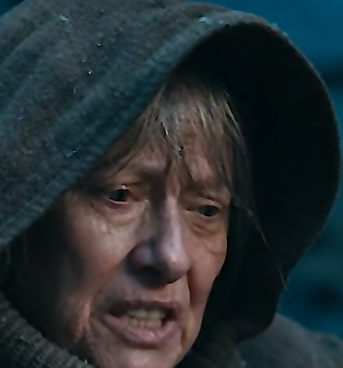
A figure was hunched over a small fire in a rusted barrel, trying to warm a tin of beans. She was thin, her gray hair matted and tucked under a dirty woolen cap. She wore layers of mismatched coats, likely scavenged from the piles.
Julian stepped closer, a twig snapping under his foot.
The woman turned. Her face was lined with deep crevices of hardship, her skin weathered by the sun and cold. But the eyes… they were a piercing, unmistakable violet-blue.
Julian couldn’t breathe. “Mom?” he whispered, the word feeling foreign on his tongue after a decade and a half.
The woman froze. She squinted, her hands trembling as she set the beans down. She looked at him—really looked at him—and a look of profound confusion and sorrow washed over her.
“No,” she croaked, her voice raspy from disuse. “No, don’t do this. I’m not crazy today. I don’t want to see ghosts.”
“I’m not a ghost,” Julian choked out, tears mixing with the rain on his face. He stepped into the light of the fire. “It’s me. It’s Julian.”
The woman stood up, swaying. She reached out a hand, her fingers blackened with soot. On her ring finger sat a diamond ring—filthy, the band bent, but unmistakably the custom heirloom his father had commissioned in 1990.
“Julian died,” she whispered, tears cutting tracks through the grime on her cheeks. “He died in the fire. Marcus told me. He brought me the papers. He said… he said if I loved you, I’d sign the estate over to the trust to pay for your funeral and then leave, so I wouldn’t tarnish your memory with my grief.”
Julian caught her as her knees gave out. He held her, the smell of the dump vanishing, replaced by the faint, impossible memory of her lavender soap, somehow lingering beneath the years of dirt.
“Marcus told you I died?” Julian’s voice turned to ice. “Marcus told me you died. He said the fire trapped you in the studio. He raised me. He controls the company.”
The woman pulled back, gripping his arms with surprising strength. “He came to the hospital. My face… it was burned. I was bandaged. He told me you didn’t make it. He made me sign papers while I was on morphine. Then he put me in a care home, but I ran away. I couldn’t bear to be in the world without you. I came here… to wait until I could join you.”
She reached into her layers of clothing and pulled out a plastic sandwich bag. Inside was a folded, yellowed letter.
“I wrote this,” she sobbed. “Every day for fifteen years, I wrote to you in my head, but I wrote this one down just in case I was wrong. In case God was kind.”
Julian took the letter, but he didn’t read it yet. The rage boiling inside him was hot enough to dry the rain. Uncle Marcus. The man who had sat at the head of the table, who had taken Julian’s inheritance and “managed” it, who had played the grieving brother while banishing Julian’s mother to a living hell to seize the assets.
Julian looked at Leo, the barefoot boy who had saved his life. “Leo, do you have family?”
“No, sir. Just the Lady.”
“Well, you do now,” Julian said. He wrapped his suit jacket around his mother’s shoulders. “We’re leaving. Both of you.”
“Where are we going?” his mother asked, looking at the luxury car in the distance with fear.
“First,” Julian said, helping her walk over the uneven ground, “we are going to get you warm. We are going to get you food. And then…” His jaw tightened, his eyes hardening into flint. “Then we are going to pay Uncle Marcus a visit. And I’m going to introduce him to the ghost he created.”
As they walked away from the dump, Julian didn’t look back at the trash. He looked at his mother’s hand in his, and the boy walking beside them. He had spent fifteen years building an empire on a lie. Tomorrow, he would tear it down to build a family on the truth.
