The fluorescent lights of the MegaMart hummed with a low, headache-inducing buzz. For James, a 28-year-old Loss Prevention Officer, that sound was the soundtrack to his daily grind. He stood by the sliding glass doors, arms crossed over a chest that had stopped its fair share of shoplifters, scanning the flow of Tuesday afternoon shoppers.
James took his job seriously. He wasn’t a cop, but he was the line of defense for the store. He had tackled teenagers stealing vodka, detained professional theft rings loaded with electronics, and stopped people trying to walk out with cartloads of unbagged meat. He had seen the worst of people: the aggression, the entitlement, the lies. He had grown a thick skin, a layer of cynicism that protected him from the sob stories he heard every day.
But then he saw the man in the bread aisle.
He appeared on Monitor 4 in the security booth first. A man, seemingly ancient, wearing a tweed coat that looked three sizes too big and decades out of style. He wasn’t looking at the expensive items or the electronics. He was staring at the generic white bread, the kind that cost $1.29.
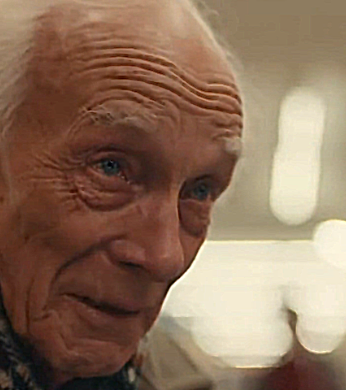
James watched as the old man, whose name he would later learn was Walter, picked up the loaf. His hands were shaking violently—a tremor so bad the plastic bag crinkled loudly, audible even in James’s imagination. Walter looked left. He looked right. The fear in his watery blue eyes was visible even through the grainy camera feed.
Then, with a clumsy, desperate movement, Walter shoved the soft loaf inside his coat. He zipped it up halfway, the square shape bulging against his frail chest, and began to shuffle toward the exit, head down.
“Got you,” James whispered, stepping out of the booth to intercept him. But there was no adrenaline rush this time. Just a heavy feeling in his gut.
James positioned himself between the registers and the door. As Walter approached, he looked like a ghost. His skin was translucent, his cheeks sunken. He walked with the fragility of someone who might shatter if the wind blew too hard.
“Excuse me, sir,” James said, stepping into his path. His voice was firm, practiced, but not aggressive. “I need you to come with me.”
Walter stopped. He didn’t run. He didn’t argue. He didn’t pull a knife or scream profanities. He just froze. The color drained from his already pale face.
“I’m sorry,” Walter whispered, his voice cracking like dry leaves. “I’m so sorry.”
Usually, James would escort the suspect to the “back room”—a sterile, windowless office where they would fill out paperwork, call the police, and issue a lifetime ban. He reached out to guide the man by the elbow, but as his hand brushed the tweed coat, he felt how thin the man was underneath. He was nothing but bird bones and trembling skin.
Walter’s legs gave out. He began to sink toward the linoleum floor, overwhelmed by shame and terror.
“Please,” Walter sobbed, clutching his chest. “My wife… Martha. She’s hungry. We ran out of money three days ago. The medicine… the prices went up again. I just wanted her to have toast. She loves toast.”
James looked around. Shoppers were stopping. People were staring. A manager was walking over, looking stern, ready to enforce policy.
In that split second, James had a choice. He could be the Loss Prevention Officer, the man who followed the rules. Or he could be a human being.
James didn’t pull the man up. Instead, he did the unthinkable.
James sat down on the floor.
He crossed his legs and sat right there on the dirty MegaMart tile, eye-level with the weeping 82-year-old. The store went silent.
“It’s okay, Walter,” James said softly, ignoring the confused look of his manager. “Breathe. You aren’t in trouble.”
“I stole,” Walter wept, pulling the squashed loaf of bread from his coat. “I’m a thief. I’ve never stolen a thing in my life. I fought in Korea. I worked forty years at the mill. And now I’m stealing bread.”
James gently took the loaf from him. “You’re not a thief, sir. You’re a husband who loves his wife. And you’re not stealing this.”
James reached into his own pocket and pulled out his wallet. He turned to the crowd that had gathered—people who had been ready to judge, ready to record a ‘takedown’ on their phones.
“I’m buying this,” James announced, his voice carrying through the silence. “And I’m buying whatever else Martha needs.”
He looked at the manager. “Put it on my break tab.”
The tension in the air shattered, replaced by something warm and electric. A woman near the front of the crowd wiped a tear from her cheek. She stepped forward. “I’ll get the milk,” she said.
“I’ve got some deli meat in my cart,” a construction worker added, walking over and placing a package of turkey next to James on the floor. “Take it.”
“I’ll pay for his produce,” a teenager shouted from the back.
Within minutes, James and Walter were surrounded. It wasn’t an arrest scene anymore; it was a community rising up. People began piling groceries around them on the floor—canned soup, fresh fruit, a rotisserie chicken, a bouquet of flowers for Martha.
Walter looked around, bewildered, tears streaming down his face, but these were no longer tears of fear. “Why?” he asked James. “I tried to rob you.”
James placed a hand on the old man’s shoulder. “Sir, nobody should have to choose between medicine and food. Not after forty years at the mill. Not ever.”
James helped Walter to his feet. They didn’t go to the back room. They went to the register. The total came to over two hundred dollars, but James didn’t pay a dime of it. The customers ahead of them fought over who got to swipe their card.
James walked Walter to the bus stop, carrying four heavy bags of groceries.
“You saved my life today,” Walter said, gripping James’s hand with surprising strength. “Not just because of the food. But because you gave me my dignity back.”
James watched the bus pull away, feeling a different kind of satisfaction than he ever got from catching a thief. He went back inside, ready to face the manager, ready to be reprimanded for breaking protocol.
Instead, the manager was waiting by the door with a coffee. “Good work, James,” he said, clearing his throat. “Good work.”
James realized then that the strongest way to protect the store wasn’t always by guarding the merchandise. Sometimes, it was by guarding the humanity of the people walking through the doors.
