The wheels of Alejandro Romero’s custom-built titanium chair hummed softly against the cobblestones of Barcelona’s Gothic Quarter. It was a sound he despised—the sound of his confinement. At thirty-four, Alejandro possessed the kind of wealth that could alter skylines. His name was etched in steel on skyscrapers from Dubai to New York. His bank accounts were bottomless. But as he sat outside the Michelin-starred restaurant El Sueño, watching the condensation drip from a heater lamp, he felt destitute.
Five years. That’s how long it had been since the crash that twisted his spine and severed his connection to the world below his waist. The doctors, the best money could buy in Switzerland and the US, had all used the same word: Permanent.
“It’s getting cold, Señor Alejandro,” a soft voice said.
It was María. Technically, she was just the cleaner for his penthouse, but over the last year, she had become the only person he tolerated. She didn’t look at him with pity, nor did she look at his wallet with hunger. She looked at him.
“Let them freeze, María,” Alejandro muttered, staring at his reflection in the restaurant window. “I can’t feel my legs anyway. What does it matter?”
María sighed, adjusting the blanket over his lap, not out of servitude, but out of care. “The cold is bad for the soul, not just the legs.”
It was then that the girl appeared.
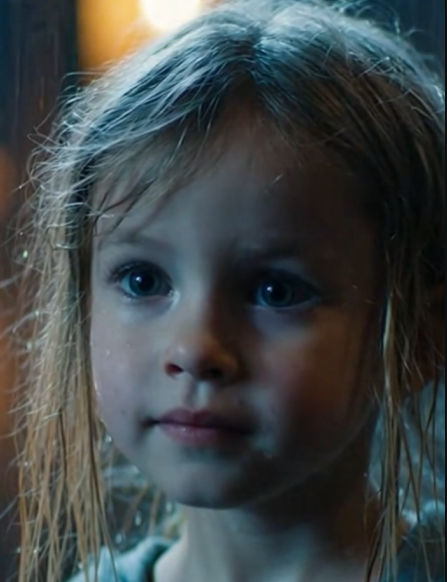
She couldn’t have been more than five years old. She was a wraith of a child, her dress a patchwork of dirty cotton that offered no defense against the Spanish winter. Her feet were bare, the skin cracked and red against the grey stones. Most people walking by pretended she was invisible, accelerating their pace to avoid eye contact.
But she didn’t walk past Alejandro. She stopped directly in front of his wheelchair.
She didn’t beg. She didn’t hold out a cup. She looked at his expensive suit, then down at the wheels, and finally, she locked eyes with him. Her irises were a startling shade of amber, burning with an intensity that unsettled him.
“Give me food,” she said, her voice raspy but steady, “and I’ll help you walk again.”
Alejandro blinked. The sheer audacity of the child stunned him. He let out a dry, bitter chuckle. “Walk? Little one, I have paid millions to men with degrees on their walls who tell me that is impossible. What makes you think a sandwich will change physics?”
The girl took a step closer. She didn’t flinch at his harsh tone. “If you don’t believe,” she whispered, tilting her head, “I’ll believe for you.”
The silence that followed was heavier than the city noise around them. Alejandro felt a strange tightness in his chest—not pain, but a sudden, sharp intake of breath.
María didn’t wait for his permission. She reached into the take-out bag hanging from the back of the chair—filet mignon and truffle potatoes that Alejandro had barely touched. She handed the heavy container to the child.
“Here, sweetheart,” María said gently. “Take it. It’s warm.”
The girl took the box with trembling hands. She opened it, the steam hitting her face. But instead of devouring it, she closed the lid. “Thank you,” she said.
Then, she did something that stopped Alejandro’s heart. She knelt on the dirty cobblestones. She placed her tiny, grime-streaked hands on his knees. Through the fabric of his trousers, he felt… heat. Not the ambient heat of the restaurant lamps, but a searing, focused warmth from her palms.
She closed her eyes for ten seconds. Then she stood up, smiled—a smile missing a front tooth—and ran into the shadows of the alley.
“Did you see that?” Alejandro whispered, his voice shaking.
“I saw a hungry child, Señor,” María said, wiping her eyes.
“No,” he said, staring at his knees. “I felt… something.”
The next day, Alejandro demanded to go back to the same spot. He brought two bags of food this time.
She was there.
“You came back,” she said.
“You took my dinner,” he grumbled, masking his anticipation. “I brought you lunch.”
She took the food, but again, she only ate a few bites. She carefully wrapped the rest.
“Why are you saving it?” Alejandro asked.
“For the others,” she said simply. “My brother. The dog with the bad leg. They are hungry too.”
She finished her ritual. She knelt. She placed her hands on his paralyzed legs. She closed her eyes.
“I believe for you,” she murmured.
This continued for a month. The staff at El Sueño began to whisper about the billionaire and the beggar. They didn’t know that for the first time in five years, Alejandro wasn’t drinking himself to sleep. He was waiting for 7:00 PM.
He learned her name was Lucia. He learned she had run away from a foster home that beat her. He learned she slept in the doorway of an old bookstore because the vent blew warm air.
And he learned that “belief” was a physical force.
It happened on a Tuesday. The rain was torrential. María had tried to convince him to stay indoors, but Alejandro refused. He sat under the restaurant awning, soaked despite the umbrella. Lucia arrived late, shivering so violently her teeth clattered.
She looked sick. Her skin was pale, her eyes glassy.
“Lucia,” Alejandro said, panic rising in his throat. “You need a doctor. Forget the prayer today.”
“No,” she chattered. “A deal… is a deal.”
She knelt. She placed her hands on his legs.
But this time, her strength failed. She collapsed forward, her small head resting on his shins. She didn’t move.
“Lucia!” Alejandro screamed. He looked around for help, but the streets were empty due to the storm. María had gone inside to get towels.
“María! Help! She’s not moving!”
He reached down, grabbing her shoulder, but he couldn’t pull her up. She was slipping off his lap, sliding toward the wet pavement where the water rushed into the gutter.
“No, no, no,” he gritted his teeth. He had to reach her. He had to stop her from falling into the freezing water.
He strained. He pushed every ounce of his will into his dead legs. If you don’t believe, I’ll believe for you.
A spark.
It wasn’t a thunderbolt. It was a twitch. A firing of a dormant nerve in his right thigh.
Alejandro gasped. He focused on that spark, fanning it into a flame. He didn’t think about the doctors. He thought about Lucia dying in the rain.
With a roar of effort that tore at his throat, Alejandro Romero threw his weight forward. His legs didn’t hold him up—they buckled instantly—but they moved. He crashed out of the chair, landing on his knees on the pavement, wrapping his arms around the unconscious girl.
He didn’t feel the pain of the impact. He felt the cold wetness of the ground against his shins.
He could feel the ground.
“I’ve got you,” he sobbed into her wet hair. “I’ve got you.”
Six months later.
The press conference was packed. Cameras flashed blindingly as Alejandro Romero approached the podium. He was not in a wheelchair. He leaned heavily on a cane, his gait slow and painful, but he was standing. He was six feet tall again.
“They call this a medical miracle,” Alejandro said into the microphone, his voice thick with emotion. “They say my recovery is scientifically inexplicable. But they are wrong.”
He gestured to the front row. Sitting next to María, wearing a clean velvet dress and shiny black shoes, was Lucia. She swung her legs back and forth, looking bored by the speeches.
“I was a man who had everything but possessed nothing,” Alejandro continued. “I was poorer than the child asking for bread. She didn’t just feed my body with hope; she taught me that the only way to heal yourself is to save someone else.”
He looked at Lucia.
“She promised she would believe for me. And today, I stand because of that belief.”
Alejandro announced the opening of the Lucia Foundation that day—a billion-dollar initiative to house and feed every street child in Barcelona and fund spinal research.
As the applause thundered, Alejandro walked—slowly, steadily—off the stage. He went straight to the front row. Lucia looked up.
“Are we going to get pizza now?” she asked.
Alejandro laughed, dropping his cane to scoop her up into his arms—legs strong, heart full.
“Yes, little one. Anything you want.”
