Arthur Henderson was a man composed of sharp angles and silence. His music shop, “Henderson’s Harmony,” sat on the corner of 4th and Main like a dusty relic of a bygone era. It smelled of rosin, old wood, and brass polish. Arthur spent his days behind the high oak counter, glaring over the top of his spectacles at anyone who dared to browse without buying. To Arthur, instruments were sacred artifacts, and children were sticky-fingered barbarians.
Except for one.
It started on a Tuesday in November. The bells above the door chimed, admitting a gust of freezing wind and a scrawny boy who couldn’t have been more than twelve. He wore a windbreaker three sizes too big and sneakers that were held together by gray duct tape.
Arthur opened his mouth to bark his standard greeting—“Browsing or buying?”—but the boy moved with a singular, ghostly purpose. He walked past the rows of shiny trumpets and hanging guitars, straight to the center of the showroom. There stood the shop’s crown jewel: a vintage Steinway grand piano, polished to a mirror finish. A heavy cardstock sign on the music stand read: PLEASE DO NOT TOUCH.
The boy sat on the plush leather bench. He hesitated for a second, his dirty hands hovering over the pristine ivory keys.
Arthur stepped out from behind the counter, his chest inflating to deliver a scolding. “Hey! Can’t you read the—”
The boy pressed a key. Then a chord. Then, the air in the shop changed.
He didn’t play “Chopsticks” or “Heart and Soul.” A cascading melody, complex and haunting, erupted from the instrument. It sounded like a mix of Rachmaninoff and something entirely new—a raw, jazz-infused improvisation that spoke of hunger, cold nights, and a desperate hope.
Arthur Henderson stopped dead in his tracks. He watched the boy’s profile. The kid’s eyes were closed, his face turned upward as if feeling the warmth of a sun that wasn’t there. For five minutes, the dusty shop wasn’t a shop; it was a cathedral.
When the boy finished, he sat still, shoulders heaving slightly. He opened his eyes, saw Arthur standing there, and flinched, terrifyingly expecting a blow. He scrambled off the bench. “I’m sorry. I just… I had to.”
Arthur cleared his throat, trying to find his gruff voice. “What is your name, son?”
“Marcus,” the boy whispered.
“Come back tomorrow, Marcus,” Arthur said, his voice unusually soft. “But wipe your shoes first.”
For six months, this became their ritual. Every day at 3:30 PM, Marcus would enter. Arthur would pretend to be busy polishing a saxophone. Marcus would play for an hour. He couldn’t read a lick of sheet music; he played by ear, absorbing songs from the radio or the street and transmuting them into gold. Customers would sometimes stop and listen, mesmerized, asking Arthur who the prodigy was. Arthur would just tap his temple and say, “He speaks the language.”
Then came the silence.
On a Monday, Marcus didn’t show up. Arthur paced the floor, checking his watch every ten minutes.
Tuesday. No Marcus.
By Friday, the silence in the shop was deafening. The Steinway looked like a coffin. Arthur realized with a start that he didn’t know Marcus’s last name. He didn’t know where he lived. He only knew the music.
Two weeks passed. Arthur began to lose hope, fearing the worst in a neighborhood known for swallowing people whole.
Then, the bells chimed.
Arthur spun around. Marcus stood in the doorway. But the boy looked smaller, grayer. And his right arm was encased in a heavy plaster cast, held against his chest by a frayed sling.
“Marcus!” Arthur hurried around the counter, forgetting his cane. “Where have you been? What happened?”
Marcus looked at the floor, shame coloring his cheeks. “I fell coming down the fire escape,” he mumbled. “Broke the radius and the ulna. That’s what the doctor said.”
Arthur looked at the cast, then at the Steinway. “It will heal, son. Bones knit.”
“The doctor said I need physical therapy,” Marcus said, his voice trembling. “To get the motion back. To move the fingers right. But Mom… she says the insurance won’t cover it. We can’t afford it.” A tear cut a clean track through the grime on his cheek. “He said my hand might get stiff. Frozen.”
Marcus looked up, his eyes devastated. “I won’t be able to play anymore, Mr. Henderson. Not like before.”
He turned and walked out of the shop before Arthur could say a word.
Arthur stood alone in the dim light. He looked at the “Do Not Touch” sign. He thought about his own life—a failed concert pianist who let bitterness rot his love for the art. He thought about the magic that had filled this room for six months.
Not on my watch, Arthur thought.
That evening, Arthur Henderson did something he hadn’t done in twenty years. He made a withdrawal from his personal savings. Then, he made two phone calls. One to a grumpy old physical therapist who owed him a favor, and one to a delivery service. He used his network of local shopkeepers to track down the address of a boy named Marcus who lived in the tenements on 8th Street.
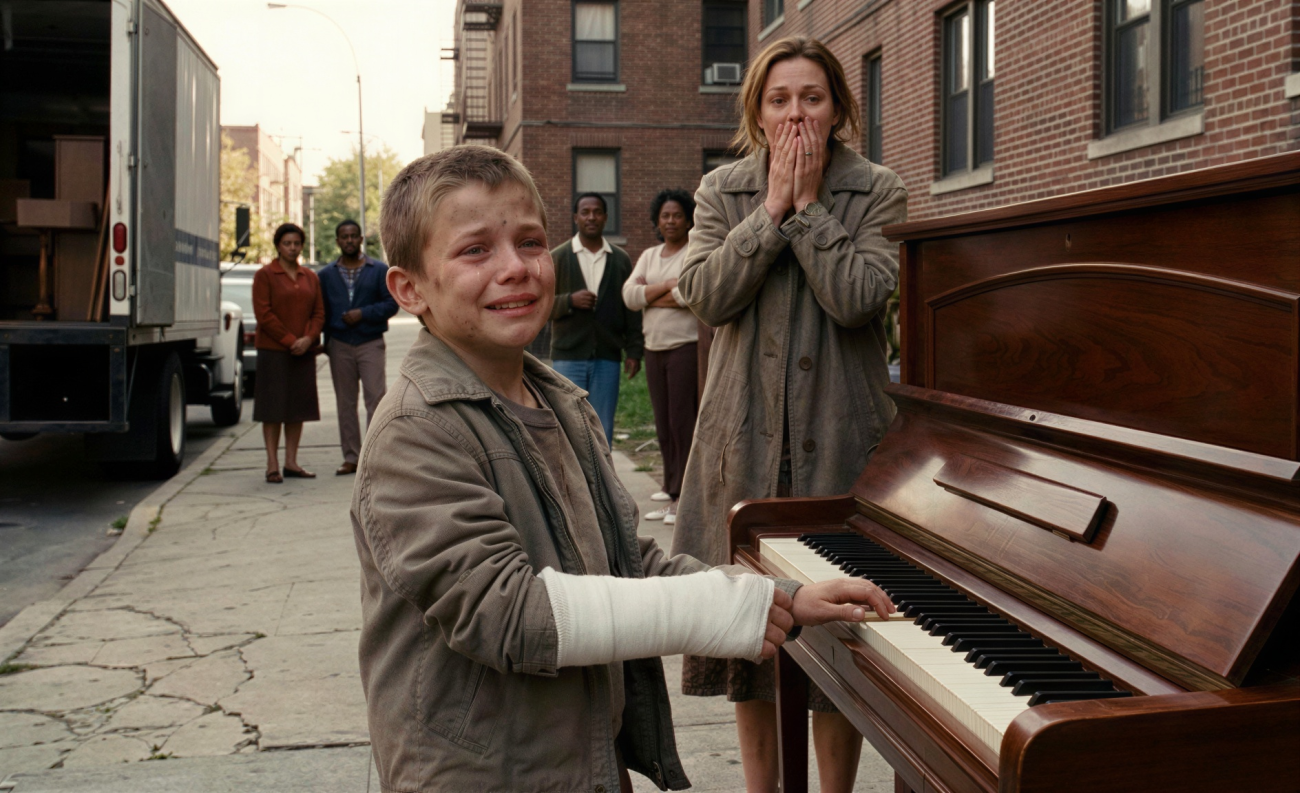
The next afternoon, a large truck rumbled down the cracked pavement of 8th Street, looking out of place among the peeling paint and rusted fire escapes.
Marcus was sitting on his front stoop, picking at his cast, when the truck hissed to a halt. Two large men jumped out.
“Looking for the residence of Marcus Williams!” one shouted.
Marcus’s mother, a tired woman in a waitress uniform, stepped out. “That’s my son. What did he do?”
“He didn’t do nothing, ma’am,” the driver said. He threw open the back of the truck.
Strapped to the wall was a beautiful, upright Yamaha piano. It wasn’t the Steinway, but it was sturdy, tuned to perfection, and glowing with polish.
“This is a mistake,” his mother said, shaking her head. “We can’t pay for that. We can’t pay for anything.”
“Invoice is marked paid in full,” the driver said, handing her a clipboard. “Along with a voucher for six months of in-home physical therapy and weekly lessons with a Mrs. Higgins. Compliments of a Mr. Arthur Henderson.”
Marcus stood up. He walked toward the truck, his good hand reaching out to touch the wood. He read the note attached to the keys:
“The world has too much noise and not enough music. Don’t you dare let your hands freeze. – A.H.”
Marcus fell to his knees on the sidewalk and wept.
EPILOGUE
Fifteen years later, the Lincoln Center was sold out. The murmurs of the crowd died down as the lights dimmed.
A man in a tuxedo walked onto the stage. He was tall, strong, and moved with a graceful confidence. He sat at the grand piano, adjusting the bench.
He leaned into the microphone.
“Tonight’s performance is dedicated to a man who is sitting in box seat number four,” the pianist said, his voice thick with emotion. The spotlight swung up to reveal an elderly Arthur Henderson, frail but smiling, dabbing his eyes with a handkerchief.
“When I was a boy,” Marcus told the thousands of people watching, “I was poor, hungry, and broken. This man didn’t just give me a piano. He gave me a key to a future I didn’t know I was allowed to have.”
Marcus placed his hands on the keys—hands that were strong, flexible, and full of magic—and began to play.
