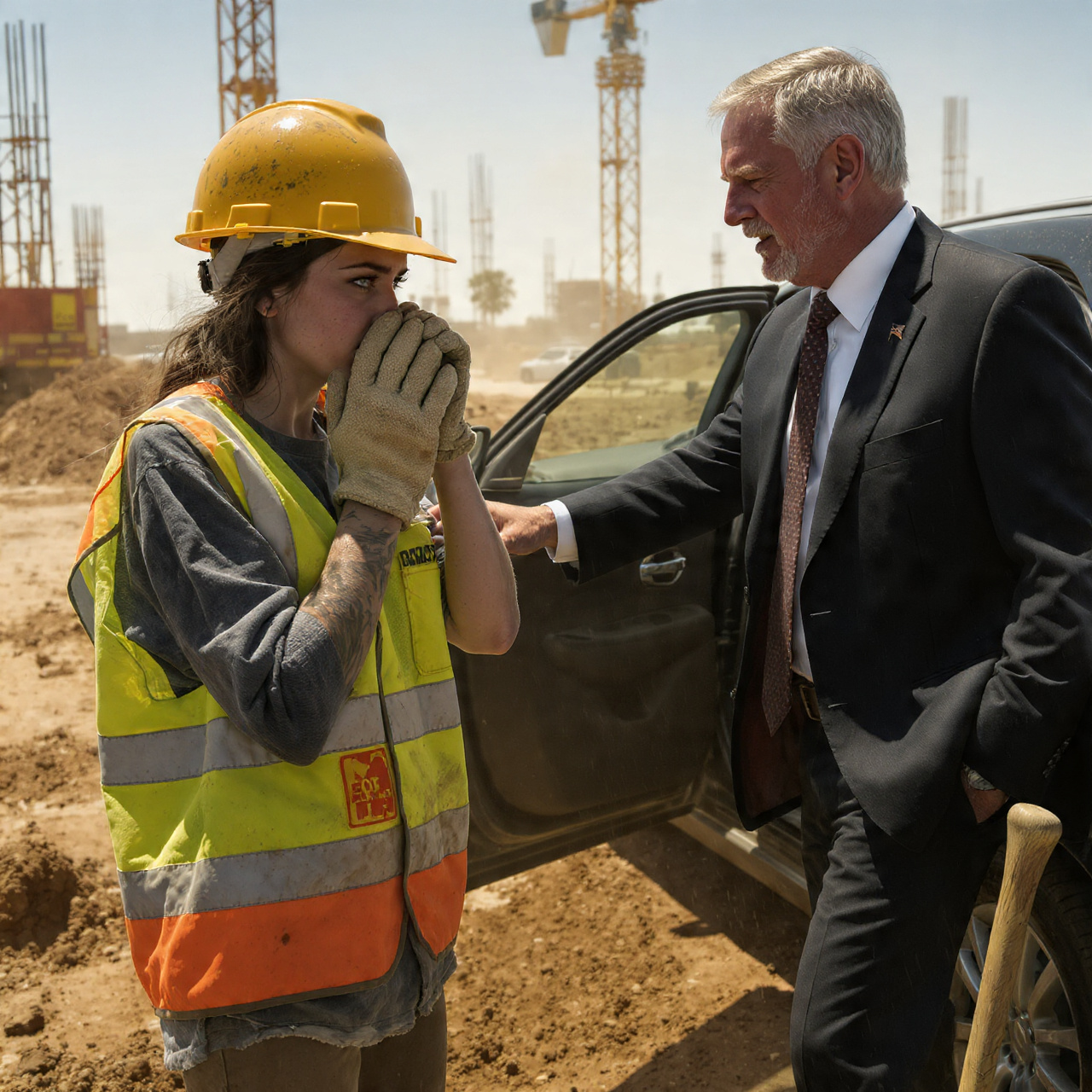
I stepped out of the Mercedes onto the construction site, designer shoes sinking into mud. That’s when I saw her.
A girl in an oversized vest, shoveling cement. She turned to wipe her face, and I froze.
Those green eyes. My wife’s eyes. My missing daughter Sofia’s eyes.
“You! Hey, you!” My voice cracked.
She dropped the shovel, terrified. “Please don’t fire me, boss. I have a sick grandmother.”
I grabbed her calloused hands. “What’s your name?”
“Lucía, sir. I’m just a construction worker.”
“Show me your neck.”
She stared at me like I’d lost my mind.
“Sofia had three birthmarks. Right here.” I pointed to the spot. “Shaped like Orion’s belt.”
Her hand went to her neck instinctively. “Lots of people have moles.”
“Not like those.”
The foreman came running, face red. “Mr. Mendoza! Get away from that girl!”
I didn’t move.
“This worker’s trouble,” he continued. “No papers, probably lying about everything.”
“How dare you.” I turned on him. “You’re fired. Get out.”
He went pale and left muttering.
I knelt in the mud in front of Lucía. “Twenty years ago, I lost my three-year-old daughter in a park. She had your eyes. And three moles forming a triangle.”
“My grandmother says my moles are special,” Lucía whispered. “That they’re a sign from heaven.”
“Can I see them?”
Slowly, she lowered her collar.
Three moles. Perfect triangle. Orion’s belt.
I collapsed, sobbing. “You’re my Sofia.”
She was crying too. “I don’t understand. My grandmother raised me since I can remember.”
“What’s her name?”
“Mercedes Fuentes.”
“I need to meet her.”
Lucía hesitated. “She’s very sick.”
“Please.”
She nodded.
The San Miguel neighborhood was another world. Unpaved streets. Sheet metal houses. My Mercedes looked obscene.
“It’s here.” Lucía pointed to a faded blue house.
Inside was one room. Damp, dark, poor. On a cot lay an elderly woman with clouded eyes.
When she saw me, terror flashed across her face.
“Who is it?” Her voice trembled.
“My boss, grandma.”
I stepped closer. “Doña Mercedes, where did you get Lucía from?”
Silence.
“Grandma, what does he mean?” Lucía’s voice broke.
The old woman closed her eyes, tears streaming. “I knew this day would come.”
“What secret?” Lucía stepped back.
“I didn’t kidnap her,” Doña Mercedes said firmly. “I saved her.”
“You stole my daughter!”
“No! I found her crying in the street, dirty, hungry, abandoned. No one was looking for her.”
“We moved heaven and earth! Rewards! News coverage!”
“That was later,” the old woman said. “Much later. When I found her, she’d been lost for days. A three-year-old eating from garbage.”
The words hit me like bullets.
“My husband worked at the police station. He said they’d accuse me of kidnapping if I returned her. So I kept her.”
Lucía sobbed. “It can’t be true.”
But it made horrible sense.
The day Sofia disappeared, I was on my phone closing a deal. My wife was home sick. The nanny was new, careless.
We thought Sofia was with her mother. Then with the nanny. Then with relatives.
By the time it hit the news, almost a week had passed.
I’d lost my daughter long before anyone took her.
“So I’m Sofia?” Lucía whispered.
Doña Mercedes nodded. “You always were. But you were also always my Lucía. I raised you. I loved you.”
“You lied to me!”
“I protected you. Do you think it would’ve been better knowing your real parents neglected you so badly they lost you?”
The words pierced me.
My wife died two years after Sofia disappeared. Cardiac arrest, the doctor said. But it was really a broken heart.
And I kept working. Building. Making money. Trying to fill the void.
Until today.
“What do you want from me?” Lucía asked, looking at me.
“I don’t know,” I admitted. “I only know I spent twenty years dying inside. Wondering if you suffered. If you were hurt.”
“I never thought of you. Because I never knew you existed.”
It hurt. But it was fair.
Doña Mercedes coughed violently. Blood stained the blankets.
“She needs a hospital,” I said. “Now.”
“There’s no money—”
“I’ll take care of everything.”
The old woman looked surprised. “I don’t want your charity.”
“It’s not charity. It’s the least I can do for the woman who took care of my daughter when I couldn’t.”
I called my doctor. Within thirty minutes, a private ambulance arrived.
Paramedics loaded Doña Mercedes onto a stretcher.
“Lucía,” the old woman grabbed her hand. “Whatever happens, remember I loved you.”
“I know, grandma.”
At the hospital, the doctor examined Doña Mercedes. Pneumonia, advanced. She needed immediate treatment.
“How much?” Lucía asked.
“I told you, I’ll pay,” I said.
“I can’t let you—”
“She raised my daughter. She kept her safe when I failed. This isn’t negotiable.”
Over the next three weeks, Doña Mercedes recovered slowly. I visited every day. So did Lucía.
We talked. Really talked.
I learned Lucía had finished high school while working nights. That she’d wanted to study engineering but couldn’t afford it. That Doña Mercedes had sacrificed everything for her.
“She never had new clothes,” Lucía said. “Never went to a doctor. Everything was for me.”
“She loved you.”
“I know. And I love her. But I’m also angry. She stole twenty years from you.”
“No,” I said quietly. “I stole them from myself. I was the one who wasn’t paying attention. I was the one who chose work over my daughter.”
Lucía looked at me. “What happens now?”
“That’s up to you.”
She was quiet for a long time. “I don’t know how to be Sofia. I’ve been Lucía my whole life.”
“Then be Lucía. Just… let me be part of your life. However you want.”
She nodded slowly.
When Doña Mercedes was discharged, I offered to set them up in a better place. Lucía refused.
“We can’t accept that.”
“What about this: I pay for your engineering degree. You work for my company after you graduate. You earn it.”
Lucía’s eyes widened. “Are you serious?”
“Completely. You’re brilliant—the foreman’s notes said you spotted structural issues in the foundation that the engineers missed.”
“I… yes. Yes. Thank you.”
But there was something else I needed to do.
I hired a private investigator. Not to punish Doña Mercedes—she’d saved my daughter’s life. But to find the nanny who’d lost Sofia that day.
He found her in three days. She was working at a different house, still careless, still negligent.
I didn’t press charges. I didn’t ruin her life.
I just made sure she never worked with children again. One phone call to the right people. Problem solved.
For Doña Mercedes, I set up a trust fund. Medical care for life. A small pension. She cried when I told her.
“Why?” she asked. “Why are you being kind to me?”
“Because you loved my daughter when she had no one else. Because you gave everything for a child who wasn’t yours. That’s more than I did.”
Six months later, Lucía started engineering school. She visited me every Sunday. We had dinner. Talked. Slowly built something new.
She didn’t call me Dad. Maybe she never would.
But one Sunday, as she was leaving, she hugged me.
“Thank you, Roberto. For everything.”
Not Dad. But not sir, either.
Just my name.
It was enough.
One year later, at Lucía’s graduation, I sat between her and Doña Mercedes. The old woman was frail but smiling.
“You did good,” I told her.
She patted my hand. “We both did. Finally.”
Lucía walked across the stage in her cap and gown. When they called her name—Lucía Sofia Mendoza Fuentes—she’d chosen to take both names, honor both families—she looked at us and smiled.
That smile. My wife’s smile. My daughter’s smile.
I’d lost twenty years. But I’d gained something too.
A daughter who was strong. Independent. Brilliant.
Not because I’d raised her. But because someone else had loved her enough to try.
And that was a gift I could never repay.
But I could honor it.
By being the father she deserved. Finally.
