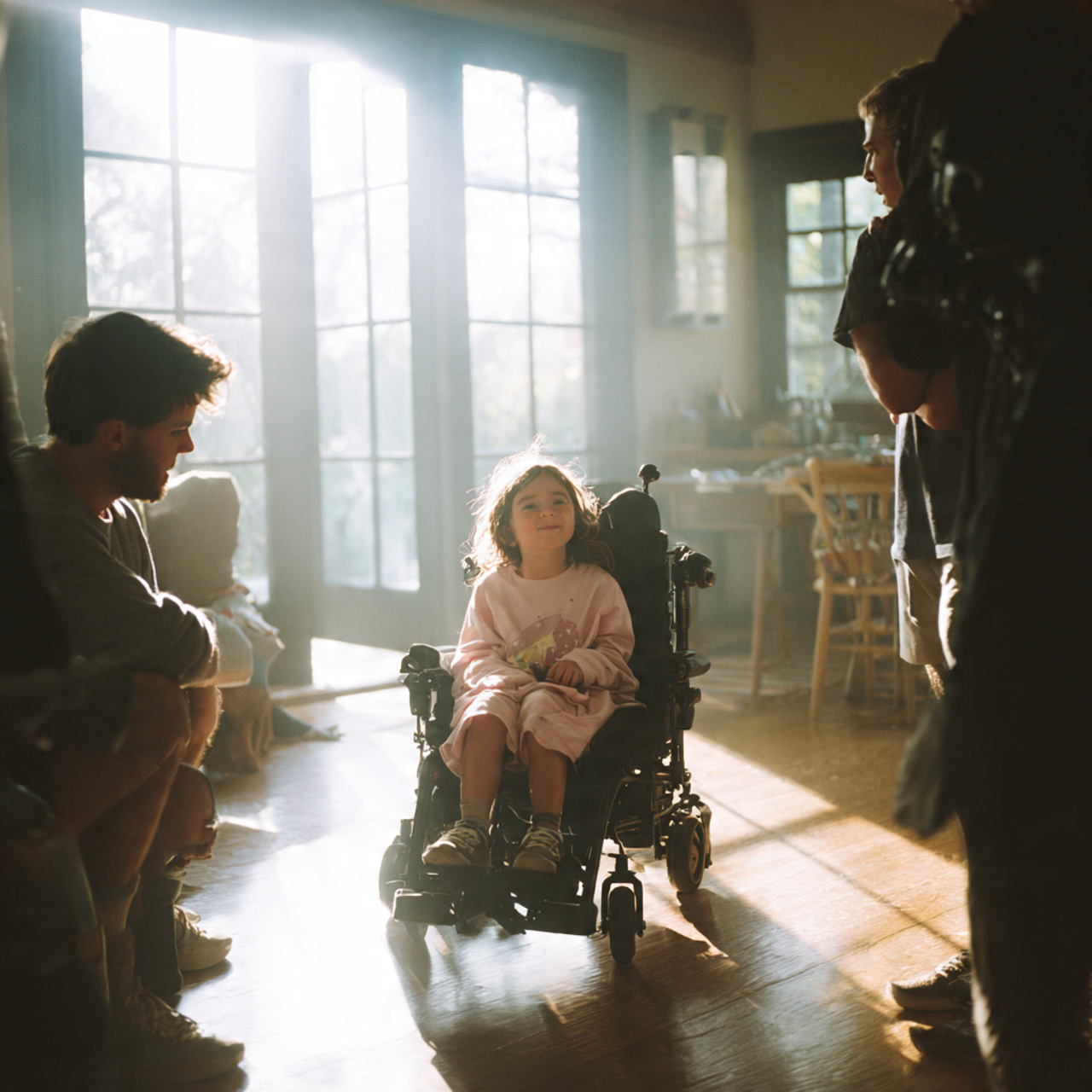
Mark Wilson stood guard over his daughter Lily like a soldier who’d forgotten how to stand down. Three years of failed treatments had taught him one thing: hope was just pain with better marketing.
“I can make her walk again,” the boy said.
Lily’s wheelchair creaked as she leaned forward. The boy looked maybe eleven, clothes held together by dirt and electrical tape, but his eyes were steady.
“Get away from her,” Mark snapped, shoving him back.
The boy stumbled but didn’t run. “I’m not asking for money.”
“Then what do you want?”
“Five minutes.”
Mark laughed bitterly. “Doctors couldn’t fix her. Surgeons. Therapists. Millions of dollars. And you think—”
“Your spinal cord was bruised,” the boy said, looking at Lily. “Incomplete injury. That’s why you still feel pins in your feet sometimes.”
Lily gasped. “How do you know that?”
Mark’s hands went cold. “We’re leaving.”
“Wait.” The boy pulled out a worn photograph. Two images taped together—a girl in a wheelchair, then the same girl standing. “This was my sister.”
Lily took it with shaking hands. “Where is she now?”
“Gone. But she walked before she left.”
Mark wanted to tear the photo apart. Wanted to scream. But Lily was crying, and her tears looked too much like the hope he’d spent three years trying to kill.
“Five minutes,” Mark said. “That’s all you get.”
They moved to the grass. The boy—Eli—crouched in front of Lily’s wheelchair.
“I won’t touch you unless you say yes,” Eli said.
Mark crossed his arms. “I’m watching every second.”
Eli picked up a small stone and rolled it against Lily’s shoe. “Can you feel that?”
“Barely.”
He pressed harder. “Now?”
“A little more.”
Mark’s jaw tightened. “That’s just nerves.”
“Exactly,” Eli said. “Which means they’re still there.”
He looked at Lily. “Close your eyes. Don’t think about walking. Just think about your feet.”
Her breathing slowed.
“My legs feel warm,” she whispered.
Mark stepped forward. “Lily?”
“They feel heavy.”
Eli nodded. “Heavy means awake.”
“No.” Mark reached for the wheelchair. “We’re done.”
“Dad, please.”
Mark froze. She never raised her voice.
Eli wiped sweat from his forehead. “Try to move your toes. Just one.”
Lily’s face tightened.
Nothing happened.
“That’s enough—” Mark started.
“Wait,” Lily breathed. “I think… I think one moved.”
Mark stared at her feet. They were completely still.
“Sweetheart, nothing moved.”
“I felt it,” she insisted.
Eli stood slowly. “That’s how it starts.”
Mark grabbed his arm. “What happened to your sister?”
Eli’s face darkened. “People didn’t let her finish.”
“What does that mean?”
“It means belief scares people. And fear makes them cruel.”
Mark’s chest ached. “Where do you sleep?”
“Anywhere.”
“Not anymore.” Mark’s voice cracked. “You’re coming home with us.”
Eli’s eyes widened. “What?”
“I don’t trust you,” Mark said. “But I trust her. And if she wants to try…” He looked at Lily. “Then we try.”
Over the next two weeks, Eli came to their house every afternoon.
He never touched Lily without permission. Never made promises. Just sat with her, talking quietly, asking her to concentrate.
“Your legs aren’t broken,” he’d say. “They’re listening. You just have to speak louder.”
On day five, Lily’s big toe twitched.
Mark saw it with his own eyes.
On day nine, she wiggled three toes.
On day twelve, she bent her knee half an inch.
Mark called her neurologist. The doctor was skeptical but agreed to new scans.
“There’s increased neural activity,” she said, stunned. “I’ve never seen this before.”
“What changed?” Mark asked.
The doctor looked at him. “You tell me.”
Day fifteen arrived with rain.
Eli was drenched when he knocked on the door. Mark handed him a towel and dry clothes—his own clothes, clothes Mark had bought him three days earlier when he’d officially moved into their guest room.
“You don’t have to do this,” Eli had said.
“I know,” Mark replied. “That’s why I am.”
Now Lily sat in her wheelchair in the living room, her face tight with concentration.
“I can feel my ankles,” she said. “Like they’re waking up.”
Eli knelt in front of her. “Then wake them up all the way.”
“What if I can’t?”
“You already have,” Eli said. “You just don’t know it yet.”
Lily closed her eyes.
Minutes passed.
Then her left foot lifted.
Just an inch. Just a second.
But it lifted.
Mark’s knees buckled. He grabbed the couch.
Lily’s eyes flew open. “Dad! Did you see?”
Mark couldn’t speak. Tears poured down his face.
Eli smiled—the first real smile Mark had seen from him. “Do it again.”
Lily lifted her right foot.
Then her left again.
Mark dropped to the floor beside her, sobbing into his hands.
“I don’t understand,” he choked out. “How is this possible?”
Eli’s smile faded. “Because you let her believe.”
Three weeks later, Lily took her first step.
It wasn’t graceful. She stumbled. Mark caught her.
But she stood on her own two feet.
The video Mark posted went viral within hours. News crews showed up at their door. Doctors requested interviews. A university offered to study Eli’s methods.
“I don’t have methods,” Eli told them. “I just listened.”
But the neurologist who examined Lily confirmed it: her spinal cord was regenerating nerve pathways that had been dormant. The incomplete injury was healing.
“It’s unprecedented,” she said. “But it’s real.”
Mark sat on the porch that evening with Eli beside him.
“Why us?” Mark asked quietly.
Eli was silent for a long moment.
“My sister died because I gave up,” he said finally. “Because people told me I was crazy. Because I stopped believing before she could finish healing.”
Mark’s throat tightened. “I almost did the same thing.”
“But you didn’t,” Eli said. “You chose her over your fear.”
Inside, Lily was walking laps around the living room, laughing every time she completed one.
Mark watched her through the window.
“You gave her back her legs,” Mark said.
Eli shook his head. “She never lost them. She just needed someone to tell her they were still there.”
Mark pulled Eli into a hug—fierce, tight, the kind fathers give sons.
“You’re staying,” Mark said. “As long as you want. This is your home now.”
Eli’s shoulders shook. He hadn’t cried since his sister died.
“Thank you,” he whispered.
Two months later, Lily walked into her school for the first time in three years.
The hallway went silent.
Then it erupted in applause.
Her best friend ran to her, tears streaming down both their faces.
“You’re walking,” she sobbed.
“I know,” Lily said, grinning. “I know.”
Mark stood at the entrance, watching.
Eli was beside him, wearing a clean jacket and new shoes—things Mark had insisted on buying.
“You saved her,” Mark said.
Eli shook his head. “You both saved me.”
The viral video led to a foundation. Donations poured in. Mark used every dollar to find other children like Lily—kids with incomplete spinal injuries, kids told they’d never walk again.
Eli worked with each one.
Not all of them walked.
But twelve did.
Twelve children stood when doctors said they wouldn’t.
Twelve families learned that belief wasn’t weakness.
And a homeless boy who once had nothing became the brother Mark never had and the hero Lily always knew he was.
Three years after that day in the park, Lily ran her first 5K.
Eli ran beside her the entire way.
At the finish line, Mark was waiting with a sign: “Miracles are just people who don’t quit.”
Lily crossed the line and collapsed into her father’s arms, both of them crying and laughing.
Eli stood back, smiling.
“Come here,” Mark called to him.
Eli joined them.
“You’re family,” Mark said. “Forever.”
Lily hugged Eli tight. “You didn’t give me my legs back,” she said. “You gave me my life back.”
Eli’s voice broke. “You gave me mine first.”
The photograph Eli had shown them that first day—the one of his sister—now hung framed in their living room.
Beneath it, a new photo: Lily standing, arms around Mark and Eli, all three of them whole.
The caption read: “Hope is dangerous. That’s why it’s worth it.”
