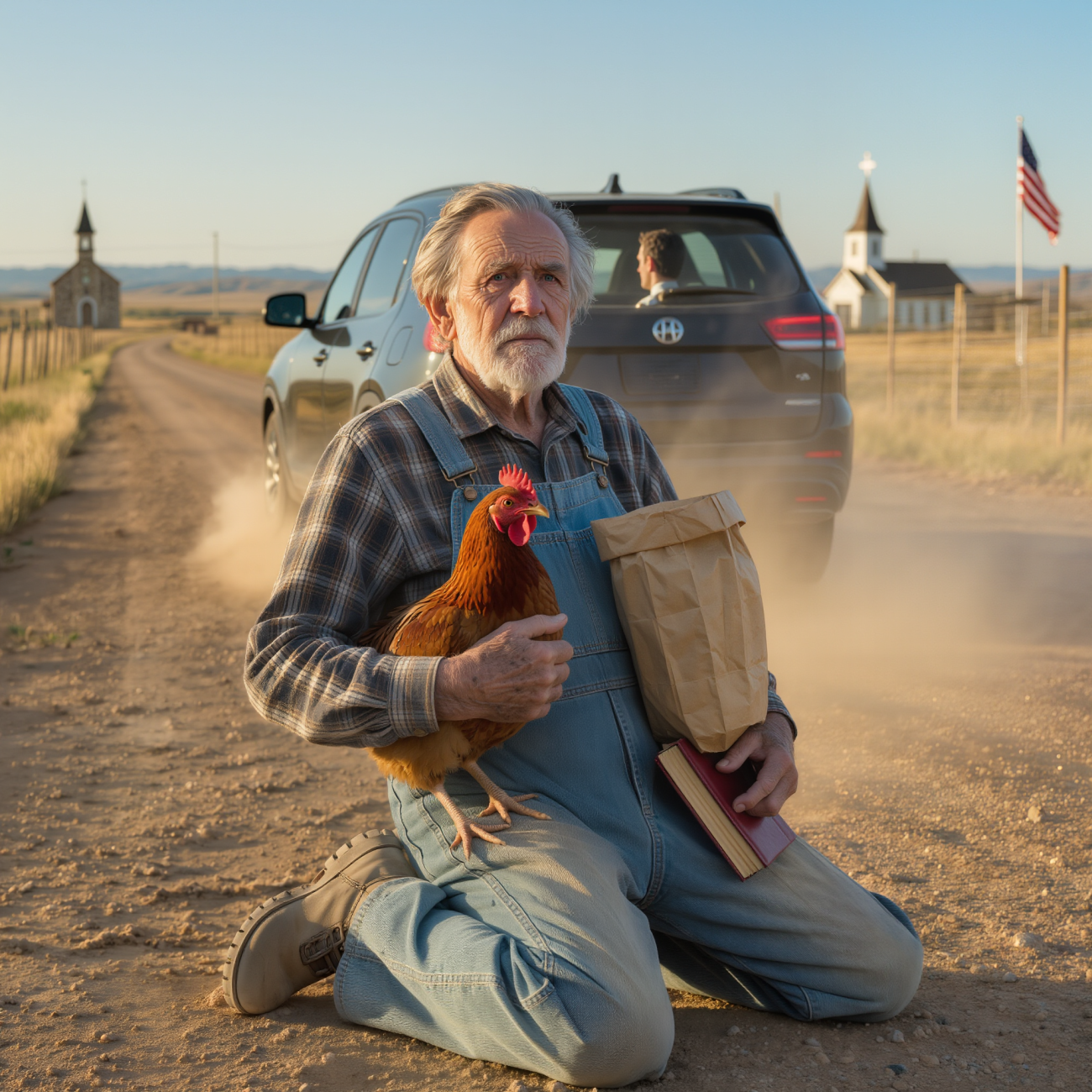
He never thought the hand he had held during childbirth would become the fist that threw him onto the dusty road.
George Mason, burdened by his eighty-two years and a body bent from decades of farmwork, felt his knees sink into the dry earth that July afternoon as his son, Robert—attorney Robert Mason, a renowned lawyer in Los Angeles—slammed the door of his late-model SUV with a dry bang that echoed like a final verdict.
The old man’s only remaining companion was a rusty red hen, clucking nervously under his trembling arm, the last remnant of a life crumbling like old mortar under the rain. The sun beat down relentlessly on the dusty road that connected the Double Star Ranch with the little town of St. Nicholas Crossing in Arizona. George watched the black SUV, gleaming like a new coffin, drive away, raising a cloud of dust that burned his eyes and filled his throat with a bitter taste that wasn’t just dirt.
It was humiliation.
It was disbelief.
It was the taste of betrayal served by his own flesh and blood.
The hen stirred restlessly, as if sensing the pain piercing the old man’s chest. That pain which has no words in any language. That pain known only to those who have been discarded by the ones who swore to love them forever.
“Dad, you can’t live with us anymore. You’re in the way. My wife says you smell bad, that you cough all night, that you’re good for nothing.”
Robert’s words still echoed in George’s ears, words spoken with the same coldness you’d use to read an eviction notice. He hadn’t even looked his father in the eye while saying it.
Thirty minutes earlier, the attorney had arrived at the humble clapboard house where his parents had lived for half a century, grabbed the old man’s few possessions—a change of clothes, a faded photograph, a worn Bible. He had stuffed them into a plastic grocery bag and practically dragged his father to the SUV.
Elellanena, George’s wife, had tried to get in, too. But Robert had gently pushed her back.
“You’re staying, Mom. At least you can still clean and cook. He’s useless now.”
George had stood up from the road with difficulty, his joints protesting like old wood, and looked around.
The landscape stretched out arid and golden under the afternoon sun—withered cornfields from the drought, twisted mesquite trees, rusty barbed-wire fences marking land that was once prosperous. In the distance he could see the town’s silhouette with its twin-steeple church and its shingled-roof houses stacked like faded colored boxes. Three miles of dusty road separated him from any form of help, and his legs were no longer the same ones that had walked those fields for sixty years.
The hen clucked again, and George gently stroked her, feeling the animal’s warmth against his sunken chest.
“At least you’re not abandoning me, Red,” he murmured, his voice cracking.
He began to walk slowly, shuffling his feet, the plastic bag dangling from one hand, the hen pressed against his chest with the other. Every step was a titanic effort, every breath a reminder that his body no longer obeyed as it once did. The dust rose around him like mocking ghosts, and the heat gripped the back of his neck with the cruelty of an invisible whip.
His thoughts returned again and again to the same devastating question.
How had he arrived here? At what moment had the boy he had rocked in his arms, taught to ride a horse, sent to college with money earned selling cows, turned into this heartless man who threw him onto the road like trash?
Before continuing with this story, I invite you to subscribe to the channel, activate the bell, and leave a like so more people can hear stories that touch the soul. Also, tell us in the comments what city and country you are watching this video from. Your message brings us closer than you imagine.
Memories assaulted him as he walked, sharp as lightning flashes in his mind.
He remembered when Robert was born on a January morning in ’63, in the same clapboard house where they had just thrown him out. George had ridden three hours through the rain to bring the midwife from the neighboring town because Elellanena had gone into labor early. The baby had been small, blue, barely breathing, and George had taken him in his calloused hands and blown on his face, as he had seen done with weak calves, until little Robert coughed and cried loudly.
“This child is going to be someone great,” the midwife had said, wrapping the baby in knitted blankets.
And George had sworn at that moment that he would do everything necessary for his son to have a better life than his own.
He had kept that promise.
For thirty years, George worked from sunup to sundown on the land he leased, growing corn, beans, and squash. He milked cows at four in the morning, sold cheese at the market, repaired fences, pruned trees, hauled water when the rains didn’t come. Elellanena baked at night, washed other people’s clothes, raised chickens and pigs. Every single dollar earned with sweat and blood was religiously saved in a coffee can hidden under the mattress.
When Robert finished high school, George sold his two best cows, Pigeon and Star, which he had raised since they were calves, to pay the tuition for the community college in the neighboring town. When the young man finished college and said he wanted to study law in Los Angeles, George sold almost everything—the new plow, the team of oxen, even the gold watch he had inherited from his father.
“Study, son,” George had told Robert the morning he left for the city with his cardboard suitcase and his dreams of becoming an attorney. “Study so you don’t have to break your back in the fields like me. We’ll manage here.”
And they managed.
They ate beans and corn tortillas for years without meat, without luxuries, so they could send money to Robert every month. George got up before dawn and went to bed when the stars were already shining, and he never complained. It was his son. It was his future. It was the reason why every sacrifice was worthwhile.
Robert graduated with honors. George and Elellanena traveled to Los Angeles on a second-class bus in their best clothes, which were also their only decent clothes, to see their son receive his degree. The ceremony took place in a huge auditorium filled with young men in suits and elegant families who spoke with refined accents. George felt small there with his calloused hands and old shoes, but when he saw Robert cross the stage in his cap and gown, he felt his chest swell with such immense pride that he could barely breathe.
He cried. He cried without shame, wiping the tears with the back of his hand while Elellanena squeezed his arm.
“We did it, old man,” she whispered. “Our son is a lawyer.”
But something changed that day.
When Robert introduced them to his classmates and professors, he did it with a certain shame, as if he wished that old, poorly dressed farmer couple wasn’t there. He didn’t take them to the graduation party. He told them it was only for students. He sent them back to the cheap motel where they were staying, and he left with his new friends to celebrate in places George couldn’t even imagine.
That night, lying on the hard motel bed, listening to Elellanena’s snores, George felt a pang of fear for the first time. A small, almost imperceptible fear, like a splinter that pierces without one realizing it. The fear that maybe—just maybe—he had raised a son who no longer recognized him as a father.
The following years confirmed that fear.
Robert got a job at a major firm in Los Angeles, started earning well, bought expensive clothes and luxury cars. He visited the ranch less and less. When he did go, he was always in a hurry, always on the phone, always seemed uncomfortable in the humble house where he was born.
He married Lorraine, a city woman—beautiful and elegant, but with cold eyes that looked at George and Elellanena the way you look at old furniture that is no longer useful. The wedding was in a luxury ballroom in Los Angeles, and George felt so out of place among so many stuck-up people that he could barely enjoy the food served on plates as big as wagon wheels.
They had two children, Robert Jr. and Danielle, grandchildren George barely knew. He saw them once or twice a year when Robert brought them to the ranch more out of obligation than affection. The children were bored in the country, complaining about the heat, the dust, the lack of internet.
One day, Robert Jr. asked:
“Grandpa, why do you live in such an ugly house? Why don’t you have air conditioning?”
George didn’t know how to answer. How could he explain to a ten-year-old boy raised in abundance that this “ugly” house was the result of a lifetime of honest work? That air conditioning wasn’t necessary when one was used to the heat of the fields?
Over time, visits became even rarer. Robert sent money every month, a modest amount that barely covered food and medicine, but he no longer went in person. He called every two or three months—brief, cold conversations in which he asked, “How are you?” without truly wanting to know the answer.
George felt his son drifting away like a ship lost on the horizon, but he didn’t know how to stop him. He didn’t know how to remind him that blood is thicker than water, that family is the only thing that truly matters, that money and success are worth nothing if you forget where you came from.
Then the day everything changed arrived.
George got sick. A persistent cough that wouldn’t go away with homemade teas or syrups. Elellanena took him to the town health center, where a young, tired-looking doctor told him he needed tests—X-rays, blood analysis.
“It could be something serious, George. You have to get the tests done in Los Angeles.”
But George didn’t have the money for that. The money Robert sent barely covered the basics.
Elellanena called her son and explained the situation.
“Sick again, Dad,” Robert sighed over the phone. “You’re too old now. What’s the point of spending money on tests?”
But he finally agreed to pay for them, reluctantly, like someone paying a traffic ticket.
The tests revealed that George had early-stage pulmonary emphysema, the result of a lifetime breathing wood smoke in the kitchen and working in dusty fields. The doctor prescribed expensive medicines, inhalers, continuous treatment.
“Dad, this is too expensive. I can’t be paying this much every month,” Robert complained.
George, with his characteristic humility, told him not to worry, that he would manage, that it wasn’t necessary. But inside, he felt something break. His son—the son he had given everything to—was now haggling over the medicine he needed to breathe.
George’s health deteriorated. The cough worsened. He lost weight. He became more fragile. Elellanena cared for him devotedly, preparing marshmallow root teas, rubbing his chest with homemade ointments, praying rosaries for him to get better. But the old man grew weaker and weaker.
One night, during a severe respiratory crisis, Elellanena called Robert again, crying, begging him to come because his father was very ill.
Robert arrived the next day, but he wasn’t alone. He brought Lorraine, his wife, and on both their faces there was not concern, but annoyance.
“Dad, this can’t go on,” Robert said, pacing the small living room of the house as if he were an attorney in a courtroom. “You and Mom are too old now. This house is falling apart. You can’t live alone. Mom can’t take care of you the way you need. You have to come live with us in Los Angeles.”
George and Elellanena looked at each other with hope. Maybe, after all, their son still loved them. Maybe he was going to take care of them in their old age, just as they had cared for him in his childhood.
They gathered their few belongings, said goodbye to the neighbors, to the house where they had lived for fifty years, to the ranch they knew like the back of their hand. The trip to Los Angeles was silent. Robert drove his luxury SUV with a serious expression. Lorraine checked her cell phone with an annoyed look, and George and Elellanena sat in the back seat, holding hands, feeling like strangers in an unknown land.
Robert’s house was huge and modern, with a large yard and three stories, but there was no room for his parents in the heart of that family. They were set up in a small room in the back next to the laundry room—a space used to store old junk. The bed was uncomfortable, the room smelled of dampness, and barely any light came through the small window.
“It’s temporary,” Robert said. “Until I find a more suitable place for you.”
The first few days were confusing. George and Elellanena didn’t know how to move around in that big, cold house. Lorraine had made it clear, with gestures more than words, that they weren’t welcome in certain areas. They couldn’t use the main living room. They couldn’t enter the kitchen when she was preparing food. They couldn’t make noise because “Dad needs silence to work in his study.”
They ate separately at the small kitchen table, eating the leftovers of what the family had for dinner earlier. Elellanena cried silently at night, and George hugged her without saying anything because there were no words to console that kind of pain.
The grandchildren, Robert Jr. and Danielle, completely ignored them—walking past as if they were invisible, without a greeting, without a smile. When George tried to start a conversation, the children responded with single words and retreated to their rooms filled with expensive toys and bright screens.
One afternoon, George dared to sit on the living room couch to watch a football game on the large television. Robert Jr. came in and said disdainfully:
“Grandpa, that’s my dad’s chair. You can’t sit there. Besides, you smell funny.”
George stood up without protesting, his cheeks burning with shame, and went to his little room. That night he had a severe coughing fit that left him breathless, frightened, clutching his chest as he felt he was suffocating. Elellanena ran to find Robert, knocking on his bedroom door desperately.
Robert came out in pajamas, annoyed at being woken up.
“What is it now?”
When he saw George coughing, thrashing in the small bed, his expression was not concern, but exasperation.
“Give him water, Mom. And please tell him to cough softer. I have an important court date tomorrow, and I need to sleep.”
Three months passed like this. Three months in which George and Elellanena became shadows in that house that was never a home. Three months in which George felt his dignity erode day after day like stone underwater.
Lorraine complained constantly about their presence.
“They smell. They make noise. They’re getting in the way. Your father coughs all night and keeps me awake. Your mother leaves hair in the bathroom. I can’t take this anymore, Robert.”
And Robert—the son George had raised, the successful attorney, the man who walked around Los Angeles in expensive suits and a Swiss watch—began to see them with the same eyes as his wife.
One day, George heard him talking on the phone in the yard, thinking no one could hear him.
“Yes, Attorney Davis, I’m reviewing the case. No, no problem. Just a family inconvenience that I’ll resolve soon. My parents—they’re a burden, you know. They’re too old now. They’re good for nothing. I’m looking at options to get rid of them without looking like a bad son.”
George felt the world crash down on him.
Get rid of them?
Was that how his son spoke of them—as if they were trash to be thrown away?
The last straw was a Sunday.
George, wanting to be helpful, went out into the garden to water the plants. It was something he knew how to do, something he had done all his life. But he overwatered an expensive ornamental plant that Lorraine had bought. The plant drowned, its leaves turning yellow.
Lorraine flew into a rage. She came into the house screaming, called Robert, pointed at the “disaster.”
“Your father is useless. He killed my plant that cost five hundred dollars. He can’t do anything right. I want them out of my house.”
Robert did not defend his father. He didn’t tell his wife to calm down. He didn’t remember that this man had sacrificed cows and gold watches to send him to college. He simply nodded.
“You’re right. It’s too much.”
That same afternoon, without any further warning, Robert put his father in the SUV. Elellanena tried to get in, too, clutching the door, but Robert pushed her away firmly.
“You’re staying, Mom. At least you can clean and cook. He’s useless now.”
And that’s how George ended up on the road with a plastic bag, a rusty red hen, and a heart shattered into a thousand pieces.
As he walked under the scorching sun, with every step more difficult than the last, George felt life slipping away from him. It wasn’t just the physical exhaustion, the heat, the thirst burning his throat. It was the weight of betrayal; the humiliation of being discarded by the son to whom he had given everything. He thought about just collapsing there in the dust of the road and waiting for death to claim him.
Why go on? Why fight when there was nothing left to live for?
But then the hen clucked, stirring restlessly against his chest, and George felt the animal’s warmth, life pulsing in that tiny body. Red depended on him. And even if it was just a hen, it was something. It was someone who needed him.
George quickened his pace, dragging his feet, refusing to fall. Not out of pride, not out of hope, but for that hen clucking against his broken heart.
He reached the town as the sun began to set, painting the sky orange and purple. St. Nicholas Crossing was a small town with cobblestone streets and clapboard houses where everyone knew everyone. George crossed the main square where some old men were playing dominoes under the laurel trees. They watched him pass. They saw his lamentable condition, the plastic bag, the hen, the dust that covered him from head to toe. Some greeted him with sadness. Others looked away, ashamed for him or for themselves.
George didn’t know where to go. His house on the ranch now belonged to Robert, who had convinced his parents to sign a paper to “protect the property from taxes,” but which was actually a cession of rights. The old man no longer had a roof over his head. He had no family. He had nothing except the clothes on his back and a hen that seemed more loyal than his own blood.
He walked to the church, an old stone building with twin steeples rising toward the sky like hands in prayer. The carved wooden door was ajar. George entered, grateful for the cool dimness inside, for the silence that smelled of incense and candle wax. He collapsed onto the last pew, exhausted, and put the hen on the floor next to his feet.
Red stayed still, as if she understood this was a sacred place.
Father Michael, the town priest, came out of the sacristy and saw the old man slumped on the pew. He recognized him immediately.
“George, what are you doing here at this hour? Are you all right?”
George looked up, and the priest saw in those tired eyes a pain so deep that it broke his heart.
“Father,” the old man murmured, his voice broken, “my son threw me onto the road like a mangy dog. I have nowhere to go.”
Father Michael, a man of fifty with premature gray hair and a kind heart, felt indignation boil in his chest. He knew Robert Mason, the successful attorney who returned to the town occasionally in his luxury SUV, flaunting his wealth, boasting about his important cases in the city. He had always felt that something didn’t quite fit with that man, that there was something empty behind all that facade of success. Now he understood what it was.
He lacked humanity. He lacked heart.
“Come, George,” the priest said softly, helping the old man stand up. “You’ll stay here at the rectory tonight. Tomorrow we’ll see what we can do.”
George wanted to protest, to say he didn’t want to be a burden to anyone else, but he was so tired, so broken, that he simply nodded. The priest took him to a small but clean room behind the church. He brought him fresh water, bread, and cheese. George ate slowly, each bite an effort, while Red pecked at crumbs on the floor.
That night, lying in a bed that wasn’t his own, in a room that smelled of saints and candles, George cried for the first time since he had been thrown onto the road. He cried silently, with sobs that shook his frail body while the darkness wrapped around him like a cold embrace. He cried for the lost years, for the son he had loved and who now despised him, for the wife who was trapped in that house of luxury and cruelty. He cried for himself, for the man who had worked honestly all his life and now didn’t even have a patch of ground to fall dead on.
But what George didn’t know as he wept in the darkness of that borrowed room was that destiny has mysterious ways of balancing injustices.
He didn’t know that at the bottom of that plastic bag Robert had filled with contempt, among the old clothes and the worn Bible, there was a document. A yellowed, folded, forgotten document that held a secret capable of crumbling Attorney Robert Mason’s perfect life like a house of cards in a storm.
But that revelation would have to wait.
For now, George could only cry, clinging to the small hope that maybe—just maybe—there was still a little goodness left in this cruel world. And as he cried, Red nestled at his feet, clucking softly, as if telling him he wasn’t alone, that he never would be as long as she had breath.
Morning arrived with the crowing of roosters and the smell of freshly baked bread wafting up from the rectory kitchen. George woke up disoriented, forgetting for a moment where he was. Then reality crashed down on him like a stone.
His son had abandoned him. He no longer had a home. He no longer had anything.
Red chirped gently from the corner where she had slept, and George sat up with difficulty, feeling every bone in his body protest the effort. Father Michael knocked on the door and entered with a tray of hot coffee and sweet rolls.
“Good morning, George. I hope you got some rest.”
The old man nodded silently, ashamed of being a burden to the priest. They ate together in silence as the morning light entered through the small window, illuminating the austere room.
When they finished, Father Michael leaned back in his chair and observed the old man with a serious expression.
“George, I need you to tell me everything that happened. Why did your son treat you like that? What led him to abandon you on the road?”
George lowered his gaze, his trembling hands gripping the coffee cup. Talking about it was like opening a wound that was still bleeding. But Father Michael had those kind eyes that invited confession, and George needed to vent the pain that was suffocating him inside.
With a broken voice, the old man recounted everything.
He spoke of the years of sacrifice, of the cows sold, of the gold watch pawned, of the nights without eating so Robert could study. He spoke of how his son had changed after graduation, of how the city had turned him into someone cold and calculating. He spoke of Lorraine, the wife who looked at him with contempt, of the grandchildren who ignored him, of the three months of humiliation in that big house where he was never welcome. And finally, with tears rolling down his wrinkled cheeks, he spoke of that terrible moment on the road, when his own son turned his back on him and left him with nothing but a trash bag and a hen.
Father Michael listened without interrupting, but his face hardened with every word. When George finished, the priest stood up and walked to the window, looking out at the churchyard with a stormy expression.
“This cannot stand, George. What your son did is an abomination. It goes against every divine and human law. The commandment says, ‘Honor your father and your mother.’ You shall not discard them when they are no longer useful to you.”
“Father, I don’t want to cause trouble,” George murmured. “I just want… I don’t know what I want. Maybe just to die in peace.”
Father Michael turned abruptly, fire in his eyes.
“Don’t say that. You are not going to die like a dog on the street. We are going to find a way for you to regain your dignity, and your son—your son—is going to have to answer for what he did.”
That same day, Father Michael made some calls. He spoke with the municipal social services director, Miss Sharon Evans, a middle-aged woman known for her commitment to abandoned seniors. He told her George’s situation, and Ms. Evans appeared at the rectory before noon, indignant and ready to help.
She was a robust woman with short hair and eyes that shone with determination. When she saw George sitting in the church backyard stroking Red, she felt her heart break.
“George,” she said, sitting next to him on an old wooden chair, “I came to tell you that you are not alone. There are options. We can find you a spot in the municipal senior home, or maybe with a family willing to take you in exchange for a small government aid payment. You don’t have to live on the street.”
George shook his head slowly.
“I don’t want to be a burden to anyone, ma’am. I’ve carried enough in my life. Now I just hope… hope that God remembers me.”
Miss Evans exchanged a look with Father Michael. Both knew that George wasn’t talking about dying of old age in a comfortable bed. He was talking about giving up, letting go, allowing sadness to consume him until nothing was left.
It was something they had seen before in other abandoned seniors—that moment when the will to live is extinguished like a candle in the wind.
“George,” Miss Evans said, taking the old man’s wrinkled hands in hers, “you have rights. Your son cannot just abandon you like this. There are laws. I’m going to talk to the district attorney’s office. I’m going to file a complaint for elder abandonment.”
George looked at her with tired eyes.
“What good are laws, ma’am? My son is an attorney. He knows all the tricks, all the loopholes. He’ll find a way to get away with it. He always does.”
It was true, and everyone in that yard knew it. Robert Mason was one of Los Angeles’s most successful attorneys, specializing in corporate law and complex litigation. He had contacts in the judiciary, knew judges and magistrates, moved in circles where money and influence opened all doors.
What could an old farmer do against someone like that? What could a small-town social worker and a poor parish priest do?
But Miss Evans was not one to give up easily. That same afternoon, she went to the district attorney’s office in St. Nicholas Crossing and filed a formal complaint for the abandonment of a vulnerable person. The assistant district attorney, a young man named Attorney Martinez, took the statement with skepticism.
“Miss Evans, I understand your concern, but these cases are very difficult to prove. If the son claims the father left voluntarily or that there was a misunderstanding, it’s very complicated.”
“There are witnesses,” Miss Evans insisted. “Father Michael can testify. I can testify about the condition in which we found George. And there must be other people who saw when he was abandoned on the road.”
Attorney Martinez sighed.
“Even so, Attorney Mason has the resources to defend himself. He can drag out the process for years. And in the meantime, who takes care of George?”
It was the eternal dilemma. Justice was slow, expensive, and favored those with money to pay for it. George had nothing. He didn’t even have the strength to fight when Ms. Evans returned to the church that afternoon with the discouraging news. She found the old man sitting on the same pew where he had arrived the day before, staring at the altar with an absent expression. Red was dozing at his feet.
“George, I filed the complaint,” she said, sitting next to him. “It’s going to be difficult, but not impossible. We’re going to fight for you.”
George smiled sadly.
“I don’t have the fight left in me, ma’am. I’ve been fighting for eighty-two years—against the earth that wouldn’t yield a harvest, against the drought, against poverty, against oblivion. I’m tired. So tired.”
That night, while George dozed in the rectory room, Father Michael and Ms. Evans stayed up talking in the kitchen, trying to find a solution.
“There has to be something more we can do,” the priest said nervously, pouring coffee into chipped mugs. “We can’t let that man destroy his father like this. It’s monstrous.”
“I know, Father, but without solid evidence, and without resources to hire an attorney who can stand up to someone like Robert Mason, our hands are tied.” Ms. Evans drank her coffee with a bitter expression. “What hurts the most is seeing how George is letting himself die. I’ve seen that look before. It’s the look of someone who has already given up.”
Father Michael was about to reply when they heard a noise in George’s room. They ran in and found the old man standing, the plastic bag overturned on the floor, clothes scattered, and in his trembling hands a yellowed envelope that looked very old.
George stared at the document with wide eyes, as if he couldn’t believe what he was seeing.
“George, what’s going on?” Father Michael asked.
The old man looked up and, for the first time since he had been abandoned, there was something more than sadness in his eyes. There was astonishment. There was confusion. And maybe, just maybe, there was a glimmer of hope.
“Father, Miss Evans… I—I had forgotten I had this,” his voice trembled. “I kept it many years ago. My wife told me to keep it safe, that it might be important someday, but with time I forgot. Robert threw everything into this bag so fast he didn’t check what was inside. And this… this was between the pages of my Bible.”
Father Michael took the document George offered him. It was a notarial paper, yellowed with age, with seals and signatures. He began to read, and as his eyes scanned the lines, his expression shifted from interest to surprise and finally to complete astonishment.
Ms. Evans peered over his shoulder, reading too, and her mouth opened in a perfect O of disbelief.
“Good heavens,” Father Michael murmured. “George, did you know what this says?”
The old man shook his head.
“I kept it because my wife asked me to, but I never… I never read it properly. I don’t read very well, Father. I only know how to sign my name and read a few simple words. What does it say?”
Father Michael sat on the bed, still looking at the document as if it were a sacred object.
“George, this is a will. The will of Steve Mason, your father. It says here that Steve owned—my God—one hundred and fifty acres of land in what is now the industrial zone of Los Angeles. Land that he left to you, his only son. Did you know this?”
“My father… my father had a large piece of land, yes,” George said slowly. “But it was all wilderness, bad land that wasn’t good for planting. That’s why we came to the ranch here, to St. Nicholas, where the land was better. That was more than fifty years ago. I never knew what happened to that land. I thought it was lost, that someone had taken it.”
Miss Evans took the document and studied it with an expert eye. She had previously been a secretary in a notary public office and knew these types of papers.
“George, this is legal. It’s registered. It has all the seals, all the signatures. These lands are rightfully yours. Do you have any idea what those one hundred and fifty acres are worth today in the industrial zone of Los Angeles?”
George shook his head. He didn’t understand land values, industrial zones, or deeds. He had spent his entire life planting corn and raising chickens. The world of business, of big money, of urban properties was as foreign to him as the surface of the moon.
Father Michael stood up and began pacing, thinking aloud.
“If those lands are where this document says—and they are now an industrial zone—George, you could own a fortune. There could be factories, warehouses, businesses built on your land. They could owe you decades of back rent.”
The information was too much for George. He sat on the bed, dizzy, feeling the world spin around him.
“It can’t be. I’m a poor farmer. I can’t have… I can’t own anything like that. There must be a mistake.”
“There’s no mistake,” Ms. Evans said, reading the document once more. “It’s all here. The land coordinates, the boundaries, the property registration. George, this changes everything. With this, you can not only survive—you can regain your dignity. You can confront your son. You can prove to him that you are not a useless bother who can be thrown onto the road.”
But there was a problem, and Father Michael saw it immediately.
“This document is more than fifty years old. In all that time, hasn’t anyone claimed these lands? Hasn’t anyone tried to seize them? And more importantly, when George signed papers for his son to ‘protect the property,’ what exactly did he sign? Could Robert have included a clause that nullified rights to other properties?”
George paled. He remembered that day just a year ago. Robert had arrived at the ranch with papers. He had said they were to avoid problems with the government, to protect the house from taxes.
“George,” Robert had said back then, “this is just to protect the property. Trust me.”
George, who blindly trusted his son the attorney, had signed without reading. He hadn’t even asked what those papers said. He had only looked where Robert pointed, and he had put his name down with a shaky hand.
“I… I signed what Robert told me to,” the old man admitted now, his voice barely a whisper. “I didn’t read. I didn’t ask. I trusted him.”
The silence that followed was heavy, full of terrible implications. If Robert had been astute enough, he could have made his father sign a total cession of rights to any property, known or unknown. As an experienced lawyer, he would know how to draft a document that looked innocent, but actually stripped George of everything.
Miss Evans clenched her fists.
“That son of a— I’m sorry, Father Michael. But if Robert did what I think he did, it’s fraud. It’s a breach of trust. It’s exploitation of a vulnerable person. We have to investigate exactly what George signed. And we have to verify if these lands are still in George’s name or if someone has already registered them somehow.”
Father Michael added:
“We need to go to Los Angeles, to the public property registry. Get certified copies of everything. And we need an attorney—an honest attorney—who isn’t afraid to confront Robert Mason.”
George listened to all of this as if he were in a dream. Twenty-four hours ago, he had been dying of sadness on the road, convinced that his life had ended in the worst possible humiliation. Now these two strangers were telling him that he might own a fortune, that he might be able to fight his son, that maybe there was still hope.
It was too much. It was overwhelming. And a part of him didn’t want to believe it, because the pain of losing this new hope would be worse than never having had it.
“I don’t know if I can do this,” he finally said, his voice broken. “I don’t know if I have the strength to fight my own son. He’s an attorney. I am… I am nobody. Who is going to believe me? Who is going to help me?”
Ms. Evans knelt in front of him and took his hands.
“George, listen to me closely. You are not nobody. You are a man who worked honestly his entire life. A man who sacrificed everything for his son, only for that son to turn his back on him. You deserve justice, and we are going to help you get it.”
Father Michael nodded.
“I know an attorney in Los Angeles. His name is John Duran. He was a seminarian here many years ago before deciding that his vocation was law and not the priesthood. He is a good man, honest. He specializes in defending the weakest against the powerful. If anyone can help you, it’s him.”
George looked at these two people who barely knew him but were willing to fight for him. He felt something he hadn’t felt since Robert threw him onto the road: a small glimmer of hope. It was fragile, like a candle flame in a storm, but it was there.
He nodded slowly.
“All right. We’ll do what we can—but not for me. I’m old already. We’ll do it for my wife, Elellanena, who is still trapped in that house. And we’ll do it so Robert knows he can’t treat people like this—not even his own father.”
That night, the three of them stayed up late planning the next steps. First, they needed certified copies of the will. Then they had to go to the public property registry to verify the status of the lands. After that, they needed to locate the papers George had signed for Robert, and finally contact Attorney John Duran to take the case.
Meanwhile, in Los Angeles, Robert Mason slept soundly in his king-size bed, completely unaware that the father he had discarded like trash had just found a weapon that could destroy everything he had built.
Because Robert had a secret—one he guarded jealously.
He knew about the existence of those lands. He had been investigating for years, trying to find a way to legally appropriate them. That was the real reason he had brought his parents to live with him—not out of love, not out of filial duty, but to gain access to any documents they might keep, to convince them to sign papers that would benefit him.
When he realized that George didn’t have Steve Mason’s will, when he searched all over the ranch house and didn’t find it, he thought it might have been lost, that he would never be able to claim those lands. That’s why he decided to get rid of his father—because he no longer needed him. The old man had become a useless bother, and Robert didn’t have the time or patience for bothers.
But what Robert didn’t know was that the will had been there all along, hidden between the pages of an old Bible that he himself had thrown into a bag without even looking. And now that document was in the hands of people who were not afraid to use it—people who believed in justice, people who were willing to fight.
The next morning, Father Michael drove his old pickup truck to Los Angeles with George in the passenger seat and Red in a box in the back. Ms. Evans went with them, armed with folders, copies of the will, and fierce determination.
The trip took two hours—two hours in which George looked out the window at the changing landscape, from green fields to gray buildings, feeling like he was entering a world where he didn’t belong.
They arrived at the public property registry, a large bureaucratic building where endless lines of people waited to complete paperwork. They took a number and waited. Three hours later, they were finally seen.
Ms. Evans explained what they needed: information about a piece of land registered more than fifty years ago in the name of Steve Mason and later inherited by George Mason.
The employee, a middle-aged woman with thick glasses and a bored expression, checked her computer. She typed, frowned, typed some more. Finally, she looked at Ms. Evans with surprise.
“Here it is. One hundred and fifty acres of land, an area that now corresponds to the North Los Angeles Industrial Park, registered in the name of… yes, George Mason.”
She looked at George.
“Are you George Mason?”
George nodded, breathless.
“That’s me.”
The employee printed several documents.
“Sir, you know there are multiple companies operating on this land? You know there are pending legal lawsuits regarding the property? They have been trying to locate you for years. There is a law firm that represents several of these companies. They are offering to buy it or reach an agreement for the back rent.”
Father Michael and Ms. Evans exchanged triumphant glances. It was real. Everything was real. George was indeed the owner of an extremely valuable piece of land that had been illegally occupied for decades. The companies operating there owed him enormous amounts of money in rent.
“What firm is handling this?” Miss Evans asked.
The employee checked her papers.
“Mason and Associates Law Firm. The lead attorney is Robert Mason.”
The silence that followed was absolute. George felt the blood freeze in his veins. His son—his own son—not only knew about the lands, but had been working on the case for years, representing the companies that were illegally occupying his father’s property. Robert was not trying to help solve the problem; he was on the other side, working to dispossess George of his inheritance.
Ms. Evans clenched her teeth in fury.
“And what happened with those lawsuits? Why haven’t they found the owner?”
The employee shrugged.
“Mr. Mason argued that his father was illiterate, senile, that he couldn’t manage his own affairs. He filed petitions to be declared the legal guardian to represent him in the negotiations. But the judge hasn’t ruled yet because it requires Mr. George Mason to appear in person to verify his mental state.”
And there was Robert’s master move. If he managed to have his father declared incompetent, he could take control of all his properties and do whatever he wanted with them. He could sell the lands for a fraction of their real value to the companies he represented, keep a huge commission, and leave his father in poverty. It was brilliant. It was ruthless. It was completely legal—if done correctly.
But Robert had made a fatal mistake: he had underestimated his father. He had thought the old farmer was too stupid, too weak, too broken to fight. He had thrown George onto the road, believing he would die there, alone and forgotten, and then he could proceed with his plans without any obstacle.
He had not counted on the kindness of Father Michael. He had not counted on the determination of Ms. Evans. And he definitely had not counted on the will he had been looking for for years being in the trash bag he himself had packed.
“We need a certified copy of all this,” Father Michael said, his voice trembling with emotion. “And we need to contact Attorney Duran right now.”
Attorney John Duran’s office was in a modest area of Los Angeles, far from the gleaming buildings where lawyers like Robert Mason worked. It was a second-floor office above a hardware store, with windows overlooking a noisy street full of street vendors and trucks raising dust. But when Father Michael, Ms. Evans, and George climbed the narrow stairs and entered the office, they found something worth more than all the marble floors and leather furniture in the world.
They found a man who greeted them with genuine warmth and eyes that shone with something that had become rare in the legal world: integrity.
John Duran was forty-five, with graying hair and the tired look of someone who has fought many battles against more powerful adversaries. When Father Michael explained the case to him over the phone, he had agreed to receive them immediately, canceling other appointments.
Now, sitting behind a desk full of files and worn legal codes, he listened to George’s story with an expression that went from compassion to indignation as the story progressed. Then he reviewed all the documents they had brought—the will, the certified copies from the public registry, the papers George had signed for Robert.
He studied this last document with particular care, and his frown deepened.
“George, did you read this before you signed it?”
The old man looked down, ashamed.
“No, attorney. I—I don’t read very well. My son told me it was to protect the house, and I trusted him. I never thought that…”
His voice broke. Red, whom they had been allowed to bring into the office in her box, clucked softly as if to comfort her owner.
John sighed and pointed to several paragraphs in the document.
“George, this paper you signed is not just a protection for the ranch house. It is a general cession of rights and legal representation. In simple terms, you gave your son the power to act on your behalf in any legal matter, including the sale or administration of properties. Furthermore, there is a clause here that says you acknowledge having diminished mental capacity and therefore require your son to make decisions for you.”
Miss Evans jumped to her feet.
“That is fraud. George does not have any diminished mental capacity. He was tricked into signing that.”
John nodded gravely.
“It is fraud, yes. It is a breach of trust. It is the exploitation of a vulnerable person. But proving all that in court against an attorney like Robert Mason is going to be a very difficult battle. He is going to argue that his father signed voluntarily, that he understood what he was doing, that this is just a thankless old man trying to cause trouble.”
“So there’s nothing we can do?” Father Michael asked, feeling hope slipping through his fingers.
John smiled, but it was the grin of a wolf before the hunt.
“I didn’t say that, Father. I said it will be difficult—but we have several things in our favor. First, Steve Mason’s will predates any document Robert made George sign, which clearly establishes that the lands belong to George by right of inheritance. Second, we have the fact that Robert is representing the companies that are illegally occupying his father’s land, which is a monumental conflict of interest. Third, we have the physical abandonment of George—something that several witnesses can confirm.”
George looked up with a glimmer of hope in his tired eyes.
“Do you really think we can win, attorney?”
John looked at him directly, without false promises but with real determination.
“George, I’m going to be honest with you. Your son is a powerful attorney with many contacts. He can drag this process out for years. He can use delaying tactics. He can file appeal after appeal. But he has a problem: the evidence is on our side. And he has another, bigger problem—he got carried away by greed and made mistakes. The conflict of interest alone is enough for the state bar to sanction him. And if we can prove he abandoned you deliberately, he could face criminal charges.”
Miss Evans leaned forward.
“Attorney Duran, be frank. How much would this case cost? Because George does not have the resources to pay legal fees.”
John closed the folder with the documents and leaned back in his chair.
“Normally, I would charge about two hundred thousand dollars as a retainer for a case like this. But this case…” He paused, looking at George with something akin to respect. “I am going to take this case pro bono—free of charge—because some things are worth more than money. And one of them is putting corrupt lawyers who dishonor this profession in their place.”
The silence that followed was broken by George’s sobs. The old man covered his face with his trembling hands and cried, but this time they were not tears of pain, but of gratitude. Here was a stranger, a man who owed him nothing, willing to fight for him without expecting anything in return. It was something George had forgotten existed in the world: disinterested kindness.
Father Michael cleared his throat, also moved.
“God bless you, Attorney Duran. You are doing something truly Christian.”
John shook his head.
“I’m not as good as you think, Father. I have my selfish reasons, too. Years ago, Robert Mason crushed a client of mine in a lawsuit using tactics that bordered on illegal, but which I could never prove. Since then, I’ve wanted the opportunity to face him in a court where justice truly matters. This is that moment.”
Thus began the most important legal battle in George Mason’s life.
John Duran worked quickly. First, he filed an injunction to nullify the power of attorney George had granted to Robert, arguing it had been obtained through deception. Then he filed a formal complaint with the state bar for conflict of interest, attaching all the evidence that Robert was representing the companies occupying his own father’s land. Finally, he filed a civil lawsuit for fraud and a criminal complaint for elder abandonment.
When Robert Mason received the legal notifications, he was in his top-floor office reviewing contracts for one of his most important corporate clients. His secretary entered with the documents, and Robert read them with an expression of annoyance that quickly turned to disbelief and then to fury.
“John Duran,” he muttered, reading the name of the attorney representing his father.
He knew Duran. He despised him. He was one of those idealistic lawyers who took lost causes, who defended the poor and the helpless, who believed that the law existed to protect the weak. Robert had always thought that people like Duran were naive, that they didn’t understand that law was just a tool for whoever knew how to use it best.
Now that “naive” person was suing him—him, Attorney Robert Mason.
He immediately called his legal assistant.
“I want you to investigate everything about this case. I want to know where my father is, who is helping him, what evidence they have. And I want you to prepare a countersuit for defamation. Nobody accuses me of fraud and gets away with it.”
He slammed down the phone so hard the secretary jumped. Then he stood looking out the window of his office, seeing the city spread out at his feet, and for the first time in a long time, he felt something akin to fear.
That fear was justified when three days later the official summons from the state bar arrived. He had to appear to explain the conflict of interest. Robert knew what this meant. If found guilty, they could suspend him, fine him, even revoke his license. Years of a carefully built career, of reputation, could crumble—and all because of that “silly old man” who should, in his mind, be dead in a ditch somewhere.
He decided to take more aggressive measures. He hired a private investigator to locate George. It didn’t take long. The old man was still living at the St. Nicholas Crossing rectory under Father Michael’s protection.
Robert considered his options. He could try to talk to his father, convince him to withdraw the lawsuits, but he knew the old man—stubborn as a mule when he set his mind to something. No, he needed another strategy.
That’s when Robert made the mistake that would seal his fate.
He decided to go after Elellanena, his mother. If he controlled his mother, he could control his father. The old man would do anything for her.
So one afternoon, Robert arrived at his Los Angeles house and told Elellanena he would take her to visit her husband. The woman, who had been crying for George for weeks, gratefully accepted.
But Robert didn’t take her to St. Nicholas Crossing. He took her to a private nursing home on the outskirts of Los Angeles, a place that looked nice on the outside but was basically a luxury prison for seniors. He checked Elellanena in under a false name, took her identification and cell phone, and told the staff she was a patient with senile dementia who tended to run away.
“If anyone asks about her, she’s not here, and she can’t make calls without my authorization.”
Elellanena, frightened and confused, tried to protest.
“Robert, son, what are you doing? I just want to see your father.”
Robert leaned toward her with cold eyes.
“You’re going to stay here, Mom, until Dad stops acting like a martyr and withdraws those ridiculous lawsuits. When he comes to his senses, you can leave. In the meantime, get used to your new home.”
But Robert hadn’t counted on one thing.
Elellanena had raised chickens all her life. She knew how to recognize people by the way they walked, talked, and moved. And one of the nursing home staff—a young woman named Patricia—walked just like her cousin Rose from St. Nicholas Crossing.
When Patricia came in to check her vital signs, Elellanena asked her:
“Are you related to the Garcia family from St. Nicholas?”
Patricia looked at her in surprise.
“Yes, ma’am. My mother is a Garcia. Where are you from?”
Elellanena felt her heart skip a beat.
“I’m from St. Nicholas. I knew your mother when she was a little girl. Please, dear, I need your help. My son has me locked up here, and I need someone to tell Father Michael at St. Nicholas Church that I’m all right, but they won’t let me leave.”
Patricia frowned. There was something about the old woman’s lucidity that didn’t match the file that claimed senile dementia.
“Ma’am, are you sure? Because it says here—”
Elellanena interrupted her.
“Dear, I’m going to tell you something only people from St. Nicholas know. Your mother, Rose Garcia, has a moon-shaped birthmark on her left shoulder. I saw it when we were bathing in the river as children. If you don’t believe me, ask her.”
Patricia froze. No one could know that except someone who really knew her mother.
“Wait here, ma’am. I’m going to make some calls.”
That same night, Patricia called her mother in St. Nicholas Crossing. Rose Garcia confirmed everything. She knew Elellanena Mason, George’s wife. They were good, honest people. She couldn’t have dementia. Something strange was happening.
Rose immediately called Father Michael. And Father Michael called John Duran.
“Attorney, I think Robert Mason just committed a federal crime. He has Elellanena illegally confined in a nursing home.”
John felt adrenaline rush through his veins.
“Father, I need you to get me the exact location of that nursing home, and I need witnesses. We are going to get Elellanena out of there, and we are going to nail Robert Mason with his own mistakes.”
The next morning, John arrived at the nursing home accompanied by Father Michael, Ms. Evans, and a district attorney’s investigator he had convinced there was probable cause to investigate.
The nursing home director, nervous upon seeing an attorney and an official investigator, tried to deny that Elellanena was there.
“We do not have any patient by that name.”
John smiled.
“Then you won’t have a problem with us checking your facilities.”
The director paled. He knew that if he refused, he would look guilty, but if he allowed the search, they would find her. Finally, he nodded stiffly.
Patricia, the nurse, discreetly guided them to the room where Elellanena was. When they opened the door, they found the old woman sitting on the bed, her hands in her lap, tears rolling down her wrinkled cheeks. Seeing Father Michael, she let out a sob of relief.
“Father, thank God.”
The district attorney’s investigator took photos, recorded video, and took Elellanena’s statement. The nursing home director, seeing everything falling apart, tried to defend himself.
“I was just following the instructions of the relative who admitted her. He told me she had dementia.”
“Do you have that instruction in writing?” John asked. “Do you have medical documents diagnosing dementia? Do you have a court order?”
The director stammered. He didn’t have any of that. He only had the money Robert had paid him to keep Elellanena locked up without asking questions. Now that money seemed very little compared to the legal troubles coming his way.
They took Elellanena out of the nursing home that same morning. They took her directly to St. Nicholas Crossing, to the rectory where George was waiting for her, still unaware of what had happened.
When the old man saw his wife get out of the pickup truck, when he saw her walking toward him with her arms outstretched, he felt something inside his chest break and heal at the same time. They hugged in the churchyard—two elderly people who had shared more than fifty years of life together, who had survived poverty, sickness, and the betrayal of their own son.
George held her as if she were both the most fragile and the strongest thing in the world, and Elellanena cried against his sunken chest as she told him everything Robert had done.
“That scoundrel,” George murmured.
And it was the first time in his life he had used that word to refer to his son.
“That scoundrel locked you up, kept you a prisoner there. He’s no longer my son. He isn’t anymore.”
John Duran, watching the scene with Father Michael and Ms. Evans, felt his throat tighten with emotion, but he also felt the cold fury of the hunter who has just seen his prey make the fatal mistake.
“George, with what he did to Elellanena, your son just turned a civil case into a criminal one. Unlawful imprisonment, elder abuse—and we have witnesses. We have evidence. We have everything.”
That afternoon, John filed new complaints with the district attorney’s office. This time, they were not just for fraud or conflict of interest. They were for serious crimes that could send Robert Mason to prison.
Local media got hold of the story. A young reporter from a Los Angeles newspaper, always looking for corruption stories, sensed that there was something big here.
Successful lawyer dispossesses his elderly parents, abandons them, illegally locks up his mother.
It was the kind of story that sold papers and generated clicks.
The news exploded.
“Prestigious Lawyer Accused of Abandoning Father and Locking Up Mother.”
The headline spread. The article included photos of George—frail and dignified, holding Red. It included Father Michael’s testimony. It included documents proving that Robert knew about his father’s lands and had kept them hidden.
Attorney Mason’s carefully built reputation began to crumble like a sandcastle under the tide. His corporate clients started calling, concerned.
“Robert, these accusations… we need them resolved quickly. We cannot have our firm associated with this kind of scandal.”
Robert tried to control the damage, to offer explanations, to minimize.
“It’s all a misunderstanding. My father is senile. He doesn’t know what he’s saying. People are manipulating him.”
But the more he talked, the worse he looked. The evidence was too clear—the will, the public registry documents, the conflict of interest, Patricia’s testimony about Elellanena being illegally confined.
Robert realized too late that he had completely underestimated the situation. He had thought getting rid of his father would be easy, that no one would care about an old farmer. He hadn’t counted on that old man finding allies. He hadn’t counted on his own arrogance betraying him.
The preliminary hearing before the state bar was brutal.
Robert arrived in his five-thousand-dollar suit and Italian leather briefcase, hoping to intimidate with his presence, but he was met by a panel of five veteran attorneys who looked at him with expressions of disgust.
John Duran presented all the evidence. The documents showing that Robert represented the companies occupying his father’s land. The papers he had made George sign through deception. The testimonies about the abandonment. Elellanena’s unlawful imprisonment.
Robert tried to defend himself.
“Gentlemen of the panel, this is all a smear campaign. My father signed those documents voluntarily. I always acted within the law.”
But when asked why he hadn’t disclosed to his corporate clients that the land they occupied belonged to his own father, Robert hesitated. When asked why he had committed his mother without a medical diagnosis or court order, he had no convincing answer.
The panel retired to deliberate. Forty-five minutes later, they returned with the verdict: immediate suspension of his law license for six months while the case was fully investigated, and a fine of five hundred thousand dollars for unethical conduct.
It was a devastating blow. Robert left feeling the world crashing down on him. Without his law license, he couldn’t practice. His clients would abandon him. His reputation was destroyed.
But the worst was yet to come.
The criminal trial against Robert Mason began three months later in a Los Angeles courthouse filled with journalists, onlookers, and people from the town who had traveled from St. Nicholas Crossing to support George.
The old man entered the courtroom, leaning on Father Michael’s arm, dressed in his best clothes—still humble, mended dress pants and a starched white shirt that Elellanena had carefully ironed—and with Red in a small cage carried by Ms. Evans. The judge, seeing the hen, frowned but said nothing. He had read the full file and understood that the animal represented more than a pet. It was the symbol of a loyalty the son had denied the father.
Robert arrived half an hour later, accompanied by three defense lawyers he had hired with the savings he had left after the state bar fine. He wore a perfectly tailored dark suit, but he looked haggard, with deep circles under his eyes and an expression of bitterness that hardened his features.
When his eyes met George’s across the room, the old man saw something in his son he had never seen before: fear.
Robert Mason, the brilliant lawyer who had always controlled every situation, who had always had the right answers, was now trembling at the possibility of facing real consequences for his actions.
John Duran stood to present the prosecution’s case. He spoke with a clear, firm voice, without flowery rhetoric, but with the devastating simplicity of one who has the truth on his side.
“Your Honor, this case is about the vilest betrayal a human being can commit: the betrayal of the one who gave him life. Robert Mason not only abandoned his father on a road as if he were trash, he not only tricked that old man into signing documents that stripped him of his rights, he not only unlawfully locked up his mother to use her as a hostage. He also, for years, hid from his own father the existence of an inheritance that rightfully belonged to him, while enriching himself by representing the companies illegally occupying that land.”
The room fell silent.
John continued, presenting evidence after evidence. He showed Steve Mason’s will. He explained how those one hundred and fifty acres were now worth more than two hundred million dollars because they were in an industrial zone. He showed the contracts Robert had signed with the companies occupying the land—contracts where he committed to resolving the problem of the “phantom owner” in exchange for enormous commissions. He showed the documents Robert had made George sign, where the old man supposedly declared he had diminished mental capacity—something three independent doctors had evaluated and completely ruled out.
Then came the testimonies.
Father Michael took the stand and told, his voice trembling with emotion, how he had found George in the church that night, broken, hopeless, with only a hen as company.
Ms. Evans testified about the old man’s physical and emotional state, about the marks on his knees from the dust of the road where he had been thrown.
Patricia, the nurse, testified about how she had found Elellanena locked in the nursing home, lucid and terrified, held against her will.
But the most powerful testimony was George’s own.
When he was called to the stand, the old man walked slowly, leaning on a cane that he now needed due to the deterioration of his health after months of stress. He sat in the witness chair, swore to tell the truth with his hand on a Bible, and looked directly at John Duran with those tired eyes that had seen too much pain.
“George,” John began gently, “can you tell us in your own words what happened the day your son abandoned you on the road?”
George took a deep breath, and when he started speaking, his voice was low but firm.
“That day, my son came to my house. He didn’t even greet me properly. He just said I couldn’t live there anymore, that I was in the way. He grabbed my things, put them in a plastic bag like trash. He didn’t even let my wife get in the SUV with me. He drove me down the road and dropped me off in the middle of nowhere. He told me I was useless, that I smelled bad, that I coughed too much, that it was better if I left.”
The old man’s voice broke.
“I raised that boy with all my love. I sold my cows so he could go to school. I sold my father’s watch. I went hungry so he could eat. And when he saw me there, thrown in the dust… all he did was close the door of his SUV and drive away without looking back.”
Tears rolled down George’s wrinkled cheeks, and more than one person in the courtroom had to wipe their eyes.
One of Robert’s defense lawyers stood up for the cross-examination. He was a young, aggressive man—the type who had learned to win cases through intimidation.
“George, is it true that you voluntarily signed the documents your son presented to you?”
George nodded.
“Yes, I signed. But I didn’t know what they said. I trusted my son.”
“You trusted him…” The lawyer raised his voice with sarcasm. “Or is it that you, as the document you signed states, lack the mental capacity to understand complex legal matters?”
It was a cruel tactic, using the same words Robert had included in the fraudulent document to make George look incompetent. But the old man did not back down. He looked the lawyer directly in the eye and said with a dignity that silenced any mockery:
“Not reading well doesn’t mean being stupid, young man. I’ve lived eighty-two years. I’ve worked the land. I’ve raised cattle. I’ve raised a son. I’ve made difficult decisions. I just always trusted that son would tell me the truth. That was my only mistake—believing that blood meant something to him.”
The defense lawyer backed away, visibly uncomfortable.
The judge looked at Robert with a severe expression.
“Attorney Mason, do you wish to testify in your own defense?”
Robert stood up slowly. His lawyers had advised him not to testify—to exercise his right to remain silent. But Robert was an attorney. He was accustomed to defending his positions, and his pride wouldn’t allow him to stay silent while they painted him as a monster.
He took the stand and swore to tell the truth. John Duran looked at him with a neutral expression, but inside he felt the satisfaction of the hunter who has just seen his prey fall into the trap.
“Attorney Mason, is it true that you drove your father near the Double Star Ranch and left him alone on the road?” John asked.
Robert clenched his jaw.
“I took him back to his house. I thought he would be better there, in his own environment.”
“In his own house?” John raised an eyebrow. “The house you had acquired through the documents you made him sign. The house where no one lived anymore because you had taken your parents to Los Angeles.”
Robert hesitated.
“It was… it was temporary. I was going to make arrangements for him to live there with dignity.”
“Dignity?” John approached the stand, his voice rising. “Dignity like when you put him out of your SUV in the middle of the road without water, without food, without medication? Dignity like when you told your own mother that your father was useless? Dignity like when you locked your mother in a nursing home under a false name to pressure your father to withdraw the lawsuits?”
Robert paled.
“I never… My mother was there for her own safety. She also has memory problems.”
John pulled out a document.
“According to the medical report ordered by the district attorney’s office, Elellanena Mason has all her mental faculties intact. There is no diagnosis of dementia or memory problems. Why did you lie to the nursing home director, saying your mother was senile?”
“I didn’t lie,” Robert said weakly. “I just took precautions.”
“Attorney Mason, yes or no? Did you know about the existence of the one hundred and fifty acres of land that belonged to your father?”
Robert hesitated. If he said no, he would be lying under oath, and there were documents proving otherwise. If he said yes, he admitted he had hidden crucial information from his father.
“I… I had knowledge that a piece of land existed,” he finally admitted.
“And did you inform your father about that land and its value?” John pressed. “Did you tell him it was worth more than two hundred million dollars? Did you tell him that you were representing the companies that were illegally occupying his property?”
Robert remained silent. That silence was more eloquent than any confession.
“How much did those companies pay you for your legal services in the last five years, Attorney Mason?” John asked.
Robert mumbled a figure.
“Louder, please, so the court can hear.”
Robert raised his voice.
“Approximately fifteen million dollars.”
A murmur of indignation ran through the room.
Fifteen million dollars.
While his father lived in a clapboard house without hot water, while George sold cheese at the market to survive, Robert Mason had earned fifteen million dollars helping the companies that were stealing his own father’s inheritance.
“One more question, Attorney Mason.” John looked at him steadily. “When you saw your father on the road that day, thrown in the dust, coughing, with no one to help him—did you feel anything? Remorse? Guilt? Love?”
Robert opened his mouth, but no words came out. What could he say? The truth was that he had felt nothing, only relief at getting rid of a problem—and that truth was so monstrous that not even he could admit it out loud.
The trial continued for three more days. More witnesses were presented, more evidence. Neighbors from St. Nicholas Crossing, who had seen George walking along the road that day, dusty and exhausted. The doctor who had treated the old man for dehydration and extreme stress. The public registry employees who confirmed that Robert had been investigating his father’s lands for years.
Lorraine, Robert’s wife, was also called to testify. She took the stand elegantly dressed, with expensive jewelry and imported perfume, but she looked nervous.
When John asked her if she had been present when Robert abandoned George, Lorraine tried to minimize.
“It was my husband’s decision. I just… I just thought it was better for everyone.”
“Better for everyone,” John repeated. “Or better for you, who complained constantly about the presence of your in-laws? Were you the one who pressured your husband to get rid of them?”
Lorraine turned red.
“I never said ‘get rid of them.’ I just said they couldn’t keep living with us. The house smelled bad. George coughed all night—”
“He coughed because he is sick,” John interrupted. “He coughed because he has pulmonary emphysema from working his whole life so his son could study and become an attorney. And instead of taking care of him, of giving him the medication he needed, you threw him away like trash.”
Lorraine started to cry, but they were tears of self-pity, not remorse.
When it was time for closing arguments, John Duran stood up and spoke not only to the judge, but to everyone present in the room.
“Your Honor, this case is more than a legal dispute over property or fraudulent documents. This case is about what kind of society we want to be. Are we a society where children can discard their parents when they are no longer useful? Where professional success and money are worth more than gratitude and filial love? Where the powerful can abuse the weak without consequences?”
He pointed to George and Elellanena, sitting in the front row, holding hands.
“That man sacrificed everything—his comfort, his health, his dreams—so his son could have a better life. And when that son achieved success, when he had the power and resources to repay even a fraction of that sacrifice, he chose cruelty. He chose betrayal. He chose money over blood.”
John turned toward Robert.
“The defendant not only committed crimes that are clearly defined in our penal code—fraud, unlawful imprisonment, elder abuse. He also committed something worse: he betrayed the most sacred trust that exists, the trust between father and son. And for that, he deserves not only the sanction of the law, but also the moral rejection of this society.”
Robert’s defense lawyer did what he could in his closing argument, arguing that it had all been a misunderstanding, that Robert had acted believing it was best for his parents, that there had been no criminal intent. But even as he spoke, it was obvious he didn’t believe his own words. It was just a job, just a paycheck—nothing more.
The judge retired to deliberate.
Two hours passed that felt like years. George and Elellanena waited in silence, praying the rosary quietly. Father Michael read his breviary. Ms. Evans checked documents over and over again as if she could change the result with sheer willpower. John Duran looked out the window, feigning calm but with his fists clenched in his pockets.
Robert waited at the other end of the room with his lawyers, pale, sweating despite the air conditioning. For the first time in his life, he was facing the real possibility of going to jail. He, Attorney Robert Mason, who had won hundreds of cases, who had humiliated adversaries in court, who had walked around Los Angeles as if he were untouchable.
Now he waited for the judgment like any common criminal.
Finally, the judge returned. Everyone stood up. The silence was so absolute that the clock on the wall could be heard ticking. The judge sat down, adjusted his glasses, and began to read the verdict in a monotone voice that made the suspense even more unbearable.
“In the case of the People versus Robert Mason, having reviewed all the evidence presented, the witness testimonies, and the arguments of both parties, this court finds the defendant guilty of the crimes of aggravated fraud, unlawful imprisonment, and abuse against vulnerable elderly adults.”
A collective gasp swept through the room. George closed his eyes and squeezed Elellanena’s hand. Father Michael murmured a prayer of thanks. Ms. Evans smiled with tears in her eyes. John Duran allowed a small smile of satisfaction to cross his face.
Robert slumped in his chair as if all the bones had been removed from his body.
Guilty.
The word echoed in his head like a death knell. Guilty. His career was over. His reputation destroyed. His life as he knew it—terminated.
The judge continued:
“The sentence will be five years in prison for the crimes committed, with the possibility of reduction to three years if the defendant shows genuine remorse and repairs the damage caused. Furthermore, the full restitution of all properties and rights fraudulently obtained from Mr. George Mason is ordered, as well as the payment of damages, which will be determined in a subsequent civil trial.”
Five years.
Robert felt the world collapsing around him. His lawyers were already preparing appeals, talking about legal techniques to reduce the sentence. But Robert barely listened to them. He could only look at his father across the room—that frail old man who had defeated the powerful lawyer simply with the force of truth and justice.
George slowly stood up, leaning on his cane. He walked toward where Robert was, and everyone held their breath, wondering what the old man would do.
When he reached his son, George looked him in the eyes for a long moment. Robert expected fury, expected insults, expected hatred. But what he saw in his father’s eyes was something much worse.
Disappointment.
Deep sadness.
The pain of a betrayed love.
“Robert,” George said, his voice broken, “I would have given you everything I had if only you had asked me with love. The lands, the money, everything. I didn’t care about wealth. I just wanted you to love me, to respect me, to treat me like your father. But you chose to steal what I would have given you. And for that, even though you are my son—even though you carry my blood—from today on, you are dead to me.”
Robert opened his mouth to speak, but no words came out. What could he say? How could he explain that greed had blinded him, that success had corrupted him, that he had forgotten who he was and where he came from? It was too late—far too late.
George turned and walked back toward Elellanena. The two elderly people left the courtroom holding hands, followed by Father Michael, Ms. Evans, and John Duran. Outside, a group of people from St. Nicholas Crossing, who had traveled to support them, was waiting. They applauded when they saw George come out. It was not a noisy celebration, but a respectful acknowledgment that justice, though slow, sometimes arrives.
That night at the St. Nicholas Crossing rectory, there was a simple but warm dinner. Father Michael made meatloaf. Elellanena baked biscuits by hand. Ms. Evans brought salad and baked beans. John Duran joined them, and for the first time in months, everyone could eat in peace—without the weight of uncertainty, without the fear of what was to come.
George, sitting at the head of the borrowed table, looked around and felt something he hadn’t felt in a long time: gratitude. Not for the legal victory, not for the recovered lands or the money he would eventually receive, but for these people who had helped him without asking for anything in return—for the priest who had given him shelter, for the social worker who had fought for him, for the attorney who had taken his case pro bono, and for his wife who had endured everything with him and was still by his side.
Red clucked softly in her box in a corner, and George smiled. That hen had been his only company in the darkest moment. Now, with the table full of friends, he was no longer alone. He never would be again.
The months following the verdict were ones of transformation.
George and Elellanena moved from the rectory to a small house in downtown St. Nicholas Crossing, which John Duran helped them rent temporarily with an advance from the funds they would eventually receive from the lands. It was a simple two-bedroom house with a yard where Red could roam freely, pecking at insects and taking dust baths in the sun. It wasn’t luxurious, but it was theirs. It was a home.
Meanwhile, the civil case for the lands proceeded in the courts. John had sued not only for the restitution of the property to George’s name but also for the payment of all back rent that the companies owed for occupying the land for decades without permission. Initial calculations suggested that George could receive between one hundred fifty and two hundred million dollars, a sum so astronomical that the old man couldn’t even imagine it.
“Attorney Duran,” George had told him one afternoon while reviewing documents at the kitchen table, “I don’t know what to do with so much money. I’ve never even had a hundred thousand dollars together. What am I going to do with millions?”
John had smiled warmly.
“George, that money will allow you to live with dignity for the rest of your days. You can have a comfortable house, medication, medical care. And if you want, you can help other people who are in the situation you were in.”
The idea resonated with the old man: helping others. He had spent so long being the one who needed help that he had almost forgotten the satisfaction of giving it.
“I would like that, attorney. I would like no other elderly person to have to go through what I went through.”
It was Elellanena who suggested the concrete idea.
“George, do you remember Ernie who lives on the edge of town? His son abandoned him, too. And there’s Carmen, who lives alone since her children moved out and never came back. There are many like us, old man. Many who need help.”
George nodded slowly, and in his tired eyes, something like a renewed purpose shone.
They talked with Father Michael and Ms. Evans about the possibility of creating a refuge for abandoned seniors in St. Nicholas Crossing. Not a cold nursing home where people are locked up until they die, but a real home where the elderly could live with dignity, respect, and companionship.
Father Michael was enthusiastic about the idea.
“George, the parish has a large plot of land behind the church that we aren’t using. If you wanted to build there…”
And so the project was born.
While the lawyers fought in court for the land money, George began planning how to use that fortune for something that really mattered. He spent hours with Elellanena, drawing rudimentary plans on paper, imagining spacious rooms with natural light, a dining hall where everyone could eat together, gardens where they could sit in the sun, chicken coops for anyone who wanted to raise birds like Red.
Robert, meanwhile, had gone to prison.
He had been sent to a medium-security correctional facility on the outskirts of Los Angeles, a place where he shared a cell with common criminals who had no sympathy for a rich lawyer who had fallen from grace.
The first few days were brutal. Robert, accustomed to expensive suits and five-star restaurants, now wore an orange uniform and ate watery beans on plastic trays. He slept on a bunk bed that smelled of urine and other people’s sweat. He heard shouting, fights, the constant sound of desperation that characterizes prisons.
But the worst was not the physical environment. The worst was his family’s silence.
Lorraine had visited him only once—just to hand him the divorce papers.
“I can’t stay married to a criminal,” she had told him coldly, without even looking him in the eye. “The children are ashamed. I’m ashamed. This is over, Robert.”
Robert Jr. and Danielle didn’t visit. They sent a brief letter, clearly drafted by Lorraine, where they said they needed space to “process all this.” But Robert knew the truth. His children were ashamed of him. They didn’t want to be associated with the scandal, with the public shame.
Just as he had been ashamed of his farmer parents, now his children were ashamed of their criminal father. The irony was not lost on him. He was living exactly what he had done to George—family rejection, abandonment, loneliness. Only Robert was living it from the other side, as the discarded son instead of the discarding father.
And it hurt. It hurt in a way he had never imagined.
At night, lying in his bunk, looking at the ceiling stained with moisture, Robert thought about his father. He remembered things he had forgotten or repressed for years: George teaching him to ride a horse when he was six, holding him firmly so he wouldn’t fall. George going to his high school graduation, even if it meant losing a day of farm work. George crying with pride the day Robert showed him his law degree.
When had everything broken? At what moment had Robert decided that his father was no longer good enough for him? When had love changed to shame, gratitude to disdain?
Robert had no answers. He only had the crushing weight of his actions and the increasingly clear realization that he had destroyed the most valuable thing he had—his family, his integrity, his soul.
One day, three months after entering prison, Robert received an unexpected visit. It was Father Michael. The priest entered the visitation room in his black cassock, his Bible under his arm, and sat across from Robert at the plastic table. They looked at each other in silence for a long moment.
“Did you come to gloat, Father?” Robert asked bitterly. “Did you come to tell me I deserved it?”
Father Michael shook his head.
“I came because your father asked me to.”
Robert felt his throat tighten.
“My father? George asked you to come see me?”
“Yes. He told me, ‘Father, go see Robert. See how he is. Even though he hurt me so much, he’s still my son. I don’t want him to be alone.’”
The words hit Robert like punches. His father—the man he had betrayed in the vilest way—still worried about him. He still remembered him. He still, in some incomprehensible way, loved him.
Robert covered his face with his hands and wept. He cried as he hadn’t cried since he was a child. He cried for everything he had lost, for all the terrible decisions he had made, for the empty man he had become.
Father Michael let him cry without interrupting, knowing that sometimes tears are the only way to begin cleaning a dirty soul.
When Robert could finally speak, his voice was broken.
“Father, I… I destroyed everything. I betrayed my father. I lost my wife. My children hate me. And the worst part is that I deserved it all. Every part of this hell I earned myself.”
Father Michael nodded.
“It’s true. You earned it. But the question now is not how you got here, but what you are going to do from here. Are you going to stay submerged in self-pity, or are you going to try to be a better man?”
“How can I be better?” Robert looked up in despair. “I’ve already lost everything. My career, my family, my freedom. I have nothing to offer anyone.”
Father Michael leaned forward.
“Robert, listen to me closely. You made terrible mistakes. You deeply hurt the people who loved you the most. But as long as you have life, you have a chance to change. Not to erase what you did—that’s impossible. But to learn from it, to genuinely repent, to try to repair even a fraction of the damage you caused.”
“My father will never forgive me,” Robert murmured.
Father Michael leaned back.
“Maybe not. Maybe the damage you caused him is too deep. But that’s not what’s important. What’s important is that you forgive yourself, that you become someone worthy of forgiveness—even if you never receive it. That’s what redemption means: becoming a better person, not because you expect a reward, but because it is the right thing to do.”
That conversation marked a change in Robert. It wasn’t immediate. It wasn’t dramatic. But it was real.
He started attending the literacy classes offered in the prison and began teaching other inmates to read and write. He used his legal knowledge to help cellmates understand their cases, prepare appeals, and write letters to their families.
Little by little, day by day, Robert began to use what he had left—his education, his skills—to help instead of exploit.
While Robert sought redemption in prison, George was building a legacy in St. Nicholas Crossing.
The civil case finally settled a year after the criminal trial. The companies occupying the land agreed to pay one hundred seventy million dollars for the back rent and bought the property for another hundred million. George, who had never had more than two thousand dollars in the bank, now had two hundred seventy million.
The news spread through the town like wildfire. Suddenly, everyone wanted to be George’s friend. People who had barely greeted him before now showed up at his door with gifts, with investment offers, with stories of need that sounded too convenient. It was overwhelming and a little sad.
George realized that wealth not only attracted help—it also attracted vultures. But he had good counselors. John Duran helped him establish a trust to protect the money. Ms. Evans helped him create a nonprofit foundation. Father Michael helped him stay focused on what truly mattered: using that fortune to do good.
The construction of the senior refuge began six months later. George hired local architects, town masons, and carpenters from St. Nicholas. He wanted the money to benefit his community, not large Los Angeles companies. He visited the construction site every day, walking slowly with his cane, watching the walls go up, the gardens take shape—his dream becoming a reality.
They named it Mason House in George’s honor, although he protested that it was too ostentatious. But Father Michael insisted.
“George, this place exists because you survived the worst and decided to turn your pain into something good. People must know it. They must be inspired by it.”
Mason House opened its doors a year and a half after George was thrown onto the road.
It was a beautiful complex of simple but dignified construction—private rooms with their own bathrooms, a spacious dining hall with large windows overlooking the garden, a small chapel, carpentry and sewing workshops, chicken coops, and a vegetable patch where residents could grow vegetables if they wished.
The first to arrive were Ernie and Carmen, those abandoned neighbors Elellanena had mentioned. Then came others—elderly people from nearby towns who had been discarded by their families, who lived in precarious conditions, who had lost hope.
At Mason House, they found not only shelter and food, but dignity, companionship, and purpose.
George and Elellanena also moved there—not as directors or administrators, but as residents. They ate with the others in the dining hall, participated in activities, and raised chickens in the coop. Red, now old, spent her days lying in the sun in the yard, clucking softly while George stroked her feathers.
“Red,” the old man would say, sitting in a wicker chair in the shade of a mango tree, “you were my only company when everyone abandoned me. I will never forget you.”
The hen would tilt her head as if she understood, and George would smile with that calm smile of one who has found peace after the storm.
Two years after the verdict, Robert was released from prison. He had served his full sentence because he didn’t want to apply for a reduction for good behavior.
“I need to pay my debt completely,” he had told his lawyer.
He was released on a Tuesday morning with no one waiting for him. Lorraine had remarried. His children were already young adults and had made it clear they didn’t want a relationship with him. Robert, at fifty-two years old, was completely alone. He had no home, no money. Everything he had owned had gone to pay fines and restitution. He had no law license; it had been permanently revoked. He was a destroyed man, starting from scratch at an age when most are at the peak of their careers.
He took a bus to St. Nicholas Crossing. He didn’t know exactly why he was going there. Perhaps to see his father one last time. Perhaps to ask for forgiveness, even though he knew he didn’t deserve it. Perhaps simply because he had nowhere else to go.
He arrived in town at sunset. He asked where George lived and was told, “At Mason House, the senior refuge behind the church.”
Robert walked there with slow steps, carrying a small backpack with all his belongings. When he saw the building, he was breathless. It was beautiful—simple, but full of warmth. He saw elderly people sitting in the garden, talking, laughing. Soft music drifted from a radio.
He entered the main courtyard, and there, sitting under a mango tree, he saw his father. George was older, more fragile, but his eyes were the same. He was holding a rusty red hen on his lap and speaking to her in a low voice.
When he saw Robert, he went still.
The two men looked at each other across the courtyard—father and son, united by blood, separated by betrayal.
Robert walked slowly until he was in front of George, then knelt on the grass, his old pants getting dirty, and with a broken voice said:
“Dad, I came to ask for your forgiveness. I know I don’t deserve it. I know what I did to you is unforgivable, but I needed you to know that I am sorry. Genuinely sorry. I destroyed all the good in my life out of greed, out of pride, out of stupidity. And I would give anything to go back in time and be the son you deserved.”
George looked at Robert with an inscrutable expression. The silence stretched for what seemed like an eternity. Finally, the old man spoke.
“Robert, when I saw you in that courtroom, I told you that you were dead to me. And for a long time, you were. The pain you caused me was worse than anything I have ever lived through. Worse than poverty. Worse than sickness.”
Robert lowered his head, tears falling onto the grass.
“I know, Dad. I know.”
“But Father Michael taught me something in these years,” George continued. “He taught me that clinging to hatred is like drinking poison and waiting for the other person to die. And I am too old to die poisoned by resentment.”
He raised his trembling hand and placed it on Robert’s bowed head.
“I can’t tell you that everything is forgotten. I can’t tell you that I completely forgive you—true forgiveness. But I can tell you that I am willing to try, if you are willing to show that you truly changed.”
Robert looked up, incredulous.
“Are you giving me a chance?”
George nodded slowly.
“One chance. Only one. Not to go back to being my son as before—that died on that road where you left me. But a chance to build something new. Something based on honesty, hard work, and real redemption.”
He stood up with difficulty, Red under his arm.
“Here at Mason House, we need help. We need someone to manage the accounts, help with paperwork, and organize the donations we receive. I can’t pay you much, but I can give you shelter, food, and the opportunity to use what you know to help people who really need it. Are you interested?”
Robert stood up, wiping his tears with the back of his hand.
“Yes, Dad. I am interested. I will do whatever is necessary.”
George nodded.
“Then welcome to Mason House. But remember—everyone works here. There are no privileges, no special treatment. Here are only elderly people trying to live their last years with dignity. Do you understand?”
“I understand.”
Robert extended his hand, but George ignored it. Instead, the old man looked his son in the eyes and said:
“A handshake is for business partners. Family hugs.”
And he opened his arms.
Robert collapsed into his father’s embrace, crying like a child. George held him with those old but still strong arms, and he also cried. It wasn’t a complete forgiveness. It wasn’t a fairy-tale happy ending. But it was a start—an opportunity to rebuild what had been broken, a possibility of redemption.
The months that followed were filled with hard work for Robert. He got up at five in the morning, helped prepare breakfast, organized the files, managed the donations, and helped the seniors with their basic legal affairs. He lived in a small room, ate the same simple food as everyone else, and for the first time in decades he didn’t wear a suit, but work clothes.
It was humiliating at times—running into people who recognized him, who knew who he had been and what he had done. Some people treated him with open contempt. But Robert accepted it. It was part of his penance, part of his path back to humanity.
Slowly—very slowly—the relationship with George began to heal. They didn’t return to being father and son in the traditional sense. That bond had been irreparably broken. But they built something new—a relationship of mutual respect, shared work, and common goals.
One afternoon, a year after Robert arrived at Mason House, the two of them were sitting in the garden watching the sunset. Red had died a few weeks earlier, peacefully of old age. They had buried her under the mango tree with a small ceremony where all the residents had spoken words of gratitude for the hen who had been a symbol of loyalty when no one else showed it.
“Dad,” Robert said quietly, “do you think you’ll ever be able to completely forgive me?”
George contemplated the sky turning orange and purple, just like that sky on the day he had been thrown onto the road.
“I don’t know, son,” he answered honestly. “There are wounds that are very deep. But I can tell you this—seeing you work here, seeing you help these elderly people that others discarded just as you discarded me, that gives me hope. Hope that maybe the son I raised is still in there, buried under years of greed and pride, but still alive.”
Robert nodded, a lump in his throat.
“I’m going to keep working, Dad. I’m going to keep trying to be better. Not to earn your forgiveness—I know I may never deserve it—but because it’s the right thing to do. Because these elderly people deserve dignity. Because you deserve dignity, and I denied it to you.”
George placed his wrinkled hand on Robert’s.
“Then you are already on the right path, son. Forgiveness will come or it won’t come. But redemption—you build redemption yourself, one day at a time, with every correct decision you make.”
And so, under the darkening sky over St. Nicholas Crossing, a father and a son who had been more separated than strangers began to find a path back to each other. It wasn’t the happy ending that appears in movies. It was something more real, more painful, but also truer: the slow and difficult reconstruction of what betrayal had destroyed.
George lived five more years.
Five years in which he saw Mason House grow, where more than fifty elderly people found home and dignity. Five years in which his relationship with Robert was repaired millimeter by millimeter, never returning to be perfect, but becoming real. Five years in which every morning he woke up grateful for having shelter, food, companionship, and the satisfaction of knowing that his pain had served for something good.
He died one spring morning in his bed, surrounded by Elellanena and Robert. His last words were:
“I never thought my life would end like this. Happy.”
He closed his eyes and passed peacefully, with a small smile on his lips, holding his wife’s hand with one hand and his son’s with the other.
At his funeral, which took place in the St. Nicholas Crossing church, Father Michael spoke of a man who had been betrayed in the worst way, but who had chosen not to die in bitterness. He spoke of a man who converted his pain into purpose, his humiliation into dignity, his loss into a legacy.
Robert wept throughout the service, but they were tears of gratitude mixed with pain—gratitude because his father, despite everything, had given him one last chance; pain because he had wasted so many years they could have spent together in love instead of separated by betrayal.
After the burial, Robert stayed at Mason House—not because he had nowhere else to go. He had already rebuilt some of his life, finding work as a legal consultant for nonprofit organizations. He stayed because he felt that was his place. His way of honoring his father’s memory was to continue the work George had started—giving dignity to those whom society had forgotten.
Years later, when Robert was a sixty-year-old man with gray hair at his temples and wrinkles on his forehead, he would welcome new Mason House residents with the same words his father had used with him:
“Everyone works here. There are no privileges, no special treatment. Here are only people trying to live with dignity. Do you understand?”
And when they asked him why he had dedicated his life to that place, Robert would tell the story. The story of an arrogant lawyer who threw his father onto the road with a hen. The story of a document that revealed a secret and destroyed a career. But above all, the story of a father who, despite having been betrayed in the vilest way, still found space in his heart to give one last chance.
“My father taught me the most important lesson of my life,” Robert would say, looking at the mango tree under which Red was buried. “He taught me that dignity is not in the money you have, nor in the power you exert, nor in the success you achieve. Dignity is in how you treat others—especially the weakest. And I learned that lesson in the most painful way possible—by losing everything to finally find the only thing that truly matters.”
And if this story moved you, I invite you to subscribe to the channel, activate the bell, and leave a like so more people can hear stories like this. You can also support us with a Super Thank You that helps us continue sharing stories full of truth and emotion. And if you made it this far, write the word dignity in the comments to let us know you were part of this story from the first pain to the last forgiveness.
