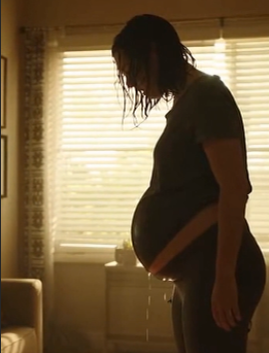
The heat in the house hadn’t broken since Tuesday.
Sarah had been lying on the old sectional for less than an hour when the world exploded in cold.
It hit her like a wall of glass — freezing water drenching her face, her neck, soaking through her maternity shirt, pooling in the hollow of her swollen belly. Her baby kicked so hard she screamed.
She scrambled backward, gasping, water dripping off her chin.
Barbara stood over her, the empty pitcher in one hand, the other smoothing her apron.
“You were snoring,” she said. “Lazy mothers raise lazy children.”
Sarah’s ears were ringing. She was thirty-eight weeks pregnant. She had been awake since 4 AM cleaning Barbara’s kitchen because Barbara claimed leftover chicken had “stained the air.” She had one hour of sleep. One.
“I’m calling Mark,” Sarah choked out, reaching for her phone.
Barbara laughed. The dry, hollow sound of a woman who had never been told no.
“Go ahead. Tell him his mother tried to wake his lazy wife. We’ll see who he believes.”
Sarah’s fingers wrapped around the phone. Then the first cramp hit — not a kick, not Braxton Hicks. This was different. It was a vice closing around her lower back, squeezing her uterus like a fist.
She dropped the phone.
When she shifted to stand, warmth flooded down her inner thighs. Not the ice water. Something else. Something from inside.
She looked down.
The puddle spreading across the hardwood was pink. Bright, diluted pink, swirling with the melting ice.
“Blood,” Sarah whispered. “There’s blood.”
Barbara glanced up from her magazine. “Probably just the ice melting off your red shorts.”
“I’m wearing grey leggings.”
Barbara sighed, deeply inconvenienced. She stood, positioning herself between Sarah and the hallway where the car keys hung.
“You are not getting in my car soaking wet. Clean this up first. I will not have Mark come home to a pigsty.”
Sarah took a step toward her. “Get out of my way.”
“Or what?” Barbara’s eyes were calm. Surgical. “You’ll tattle? You’re pathetic, Sarah. Mark deserves a strong woman.”
The room tilted. The pain was constant now, not coming in waves but sitting like a stone inside her pelvis. She was trapped. She was bleeding.
Then she heard a car in the driveway.
Barbara froze.
Mark wasn’t supposed to be home until six. It was barely 1:30.
He walked in carrying a brown paper bag, smiling, calling out something about tacos.
The smile lasted approximately one second.
He stopped. He saw his wife, soaking wet, clutching her stomach, face white as chalk. He saw his mother, standing in the hallway, blocking the path to the keys. He saw the floor.
He dropped the tacos.
Barbara moved instantly, her voice shifting into a warm, concerned coo. “She had an accident, Mark. I was just trying to help her get cleaned up—”
But Mark wasn’t looking at his mother. He was looking at the floor. He was looking at the color of the puddle at Sarah’s feet.
He crossed the room in three strides and scooped her up without saying a word.
“We’re going,” he said. That was all.
Barbara screamed at his back the entire way to the car. He didn’t look at her once.
At St. David’s Medical Center, they moved fast.
A fetal monitor found Leo’s heartbeat at sixty beats per minute. Too slow. Decelerating.
“Placental abruption,” Dr. Thorne said, already moving. “She goes under. General. Now.”
Mark tried to follow. A nurse named Brenda stopped him with one hand on his chest.
“Not this time, Dad.”
“I’m not leaving her!”
“Mark!” Sarah screamed from the gurney, the double doors already swinging open. “Don’t let her near the baby. Promise me.”
“I promise!” he yelled. The doors swung shut.
The waiting room was yellow. Cheerful, horrible yellow.
Mark sat in a plastic chair, his wife’s dried blood in the creases of his knuckles, staring at a muted cooking show.
His phone buzzed.
MOM: She’s being dramatic, Mark. I cleaned up her mess. It was mostly water.
He read it twice.
Mostly water.
He looked at his hands.
Before he could stand, a nurse appeared at the door. His heart lurched — but she wasn’t carrying the look of catastrophe.
“There’s someone in the lobby,” she said carefully. “Your mother. She’s claiming medical proxy. She says you’re having a breakdown.”
Mark went very still.
Then he walked down the hall.
He heard Barbara before he saw her — that shrill, demanding tone aimed at the security desk. She had changed into a pressed blue dress. She had fixed her hair. She looked like a concerned grandmother.
She spotted him. Arms opened. “Mark, thank God—”
He stepped back.
Her hands grabbed air.
“She fell, Mark,” Barbara said softly, pivoting without missing a beat. “She fell and you panicked. You don’t want to say things in a state like this that you can’t take back. I’m the only one who really loves you. Sarah will leave. Or she’ll—” She paused. “Or things happen. But a mother is forever.”
“Get out,” Mark said.
“Excuse me?”
“Get out of this hospital. Or I walk to that officer and tell him what I saw today. And then I ask them to look at how my father really fell down those stairs.”
The silence that followed was the loudest thing Mark had ever heard.
Barbara stared at him. Searching for the boy she had trained. The peacemaker. The one who always found the middle ground.
She didn’t find him.
She smoothed her dress, turned on her heel, and walked out.
She came back forty minutes later with two police officers.
Mark was already on his way back from the NICU — from seeing his son, pale and still and wired to machines, cold under a cooling cap that made him look like a tiny astronaut — when he turned the corner and saw them.
Barbara was dabbing her eyes with a tissue. She pointed at Mark.
“That’s him.”
The officers had a statement. Domestic dispute. Pushed his wife. Threatened his mother. Fled before help could be called.
Mark felt the handcuffs click before he had finished denying it.
“There is a cloud-based baby monitor on my bookshelf,” he said, his face against the wall. “Nanit. Blue icon. It records motion. It has been recording since 1:28 PM.”
A pause.
“Check the app,” Mark said. “If I’m lying, take me.”
The officer pulled out Mark’s cracked phone. FaceID. A few taps.
Silence stretched through the hallway.
Then — tinny, small, unmistakable — through the phone speaker:
Ice rattling. A splash. A scream.
“You were snoring. Lazy mothers raise lazy children.”
“Blood. There’s blood.”
“You probably wet yourself. Disgusting.”
The officer lowered the phone slowly. He looked at Barbara.
Her mouth opened and closed.
“It’s edited,” she said. “He’s a computer person—”
“This is a cloud timestamp, ma’am.”
“She fell! I tried to wake her!”
“You just said she was sleeping and you poured water on her,” the officer said, his voice flat and cold. He nodded to his partner.
The cuffs clicked off Mark’s wrists.
They turned to Barbara.
“No!” She backed into the nurses’ station. “I’m an old woman! I did nothing wrong! She deserved it — she was lazy! I got rid of his father for the same reason! He was weak! He was dragging us down!”
The hallway went silent.
Not the silence of shock. The silence of a room full of people who just heard a confession.
“You’re on body cam, ma’am,” the officer said quietly.
They walked Barbara out in handcuffs, her voice echoing down the corridor — cursing Sarah, cursing the baby, cursing her son — until the elevator doors swallowed the sound entirely.
Sarah was awake when Mark pushed open the recovery room door.
Pale. Monitors beeping. A thin hospital blanket pulled to her chin. But her eyes were open, and when she saw him, something in her face collapsed with relief.
“The baby,” she whispered.
“He’s alive,” Mark said, crossing the room, dropping to his knees beside the bed. “He’s fighting. He’s cold but he’s fighting.”
“And her?”
Mark looked up. “She’s in handcuffs. And they’re reopening your father-in-law’s case.”
Sarah was quiet for a long moment. The monitors beeped. Down the hall, somewhere, a newborn was crying.
“She wanted Leo,” Sarah said. “She didn’t want us. She just wanted a do-over.”
“She’s never going to touch him,” Mark said. It wasn’t a promise. It was a fact, delivered like a stone placed on the earth.
They called it therapeutic hypothermia.
For 72 hours, Leo’s body temperature was held at 92.3 degrees Fahrenheit. Cold enough to slow the damage. Cold enough to save what the loss of oxygen had threatened to take.
Sarah sat by the incubator and read him Goodnight Moon. She told him about the dog. She told him about the blue couch they were going to buy, the one Barbara had always said was too expensive.
Mark went back to the house once, came back smelling of bleach.
“The couch is gone,” he said. “I cut it up with a utility knife.”
He set a silver picture frame on the NICU tray table — his father, smiling, holding a fishing rod. Face down in Barbara’s closet. Under a pile of shoes.
“Grandpa’s watching you now,” Mark told Leo. “The real one.”
At the 72-hour mark, they began rewarming him. Half a degree per hour.
Mark and Sarah didn’t sleep. They watched the temperature climb, decimal by decimal.
96.0. 97.5. 98.1.
When the sedation stopped, the room went quiet.
Then Leo’s hand twitched. His face scrunched. He gagged against the breathing tube.
“He wants it out,” the nurse said, smiling.
The tube came out.
Silence.
Then: a thin, raspy, furious cry.
Sarah buried her face in Mark’s shoulder and wept until her incision ached.
The MRI on day seven showed a small bright spot near the basal ganglia. A scar. Possible stiffness on his left side. Physical therapy, likely. Milestones, maybe delayed.
“But I believe he will walk,” Dr. Thorne said. “I believe he will talk. I believe he will know exactly who you are.”
“We can do therapy,” Mark said.
“Yes,” Sarah said. “We can.”
They brought Leo home on a Thursday, after a thunderstorm had finally broken the August heat.
Mark had changed the locks. Changed the alarm code. The old sectional was gone. The house smelled like lemon cleaner and nothing — not potpourri, not fear.
Sarah stood in the empty living room, in the exact spot where the water had hit her. She waited to feel the ghost of Barbara’s voice. Lazy. Weak. Disgusting.
She heard the hum of the refrigerator instead.
She carried Leo to the nursery, sat in the rocking chair Barbara had called too expensive, and held her son against her chest. He curled toward her heartbeat immediately. He knew her.
Mark stood in the doorway.
“We made it,” he said.
“We did,” she said.
She pressed her lips to Leo’s warm forehead — warm, finally warm — and whispered against his skin.
“Welcome home. You’re safe now.”
UPDATE — SIX MONTHS LATER
Leo started rolling over last week. Three weeks ahead of the revised timeline his physical therapist gave us.
Barbara is awaiting trial on charges of aggravated assault, unlawful restraint, tampering with evidence, and first-degree murder in the death of her husband. She pleaded not guilty by reason of insanity.
The video disagreed.
Mark and I are in therapy. Some weeks are harder than others. But every time I watch Leo reach for a toy with both hands — both hands, the left one included — I feel something the ice water couldn’t freeze.
We won. Not loudly. Not perfectly. But we won.
To anyone living under someone else’s roof, under someone else’s rules, under someone else’s version of who you are: trust the pink on the floor. Trust the thing that looks wrong, even when everyone calls you hysterical.
Sometimes the danger doesn’t announce itself.
Sometimes it just smiles and picks up a pitcher.
