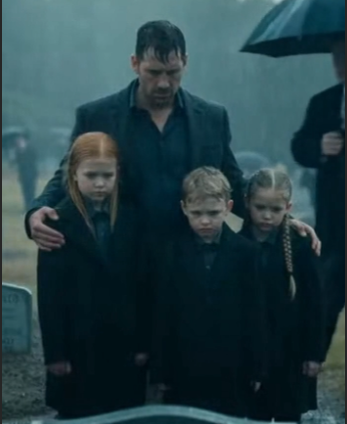
A billionaire crashed his ex-wife’s funeral and recognized his own face staring back from a ten-year-old boy… But the secret Emily kept for fifteen years was far more dangerous than anyone imagined.
The rain at Emily’s funeral was the least of my problems.
She had been gone for six days. A red light. A delivery truck. A phone call that ended everything. My wife, my partner, the woman who had rebuilt herself from ash—gone in thirty seconds on a New York street corner.
I was standing at the graveside holding three ten-year-olds when I saw him.
Richard Thompson. Chicago legal royalty. A man worth a hundred million dollars and every penny of it built on other people’s wreckage.
He stood twenty yards back, under a black umbrella, watching the casket like he was appraising real estate. He hadn’t been invited. He didn’t wait for invitations. That had always been the problem with Richard.
Then his gaze dropped to the children.
He saw Alexander’s jawline. Benjamin’s posture. Charlotte’s chin. And then—slowly, like a man being lowered into ice water—he saw the eyes. All three of them. Ice blue. Precise. Piercing.
His own eyes. Staring back at him from three ten-year-old faces.
His knees buckled.
I stepped in front of my kids before he could take another breath.
“They’re my children,” I said quietly. “And you don’t get to speak to them.”
He didn’t listen. He never listened.
He showed up at our door that night—9 PM, two lawyers in tow, suits that cost more than my car. I blocked the entrance with my body and told him to leave. He gave me a deadline instead.
“Tomorrow. 10 AM. Or we do this in court.”
I agreed. I needed time.
And I needed to look at the file.
Emily had kept everything. She was a lawyer—she kept records the way other people kept heirlooms. In the study safe, behind the fireproof door, was the answer to every question Richard was about to ask.
Donor 8742. Male. Six-foot-two. Dark hair. Blue eyes. JD, Ivy League. Interests: competitive chess, classical music, swimming, constitutional history.
I read it twice. Three times.
Then I sat back in my chair and understood what I was holding.
Emily hadn’t just picked a type. She had reconstructed a specific man—the version of Richard that existed before the cruelty, before the ego, before the empire. She had gone looking for the best of what she thought she loved, and she had found it.
The problem was, Richard would see the same thing.
I didn’t sleep. I sat by the window until sunrise.
The meeting the next morning was a performance in controlled rage. Richard arrived immaculate—charcoal suit, silk tie—flanked by three attorneys who set documents on my conference table before they even sat down.
I let them. I stayed seated. I let them come to me.
When they were done presenting their subpoenas and their petitions, I slid the donor profile across the table.
Richard read it in silence. I watched his face the way you watch a fuse burn.
He hit the “Interests” section. His jaw tightened.
“This is me,” he said flatly.
“It’s a donor,” I replied. “Anonymous. Legally protected. Waiver signed in 2010. I have a certified affidavit from the clinic director confirming no biological material from you was ever stored or used.”
“Chess. Ivy League. Constitutional history.” Richard pointed at the page with a trembling finger. “Nathan. She built me.”
“She built what she wanted,” I said. “She upgraded from the original model.”
Richard stood up so fast his chair scraped the floor. For a moment I thought he might come over the table.
“Get a court order,” he told his lawyers. “Unseal the records. I want the name.”
“You won’t get the name,” I said, standing now. “Anonymity is ironclad.”
“Nothing is ironclad against what I’m willing to spend,” Richard said softly. He buttoned his jacket. “I have a friend on the board at Lakeside Fertility. We play golf. He’s pulling the file tonight.”
He walked to the door and stopped.
“They finish soccer practice at 4:30 on Thursdays,” he said without turning around. “I’d hate for the boys to be confused by a man who looks just like their brother.”
He left.
I ran.
I pulled the kids from school twenty minutes before Richard’s town car arrived outside the building. I drove to my sister-in-law Olivia’s apartment and sat in her kitchen while the kids watched cartoons, and I told her everything.
Then I told her the part I hadn’t told anyone.
Emily had whispered it to me three days before she died, her hand weak in mine, her voice medicated and slow.
“It wasn’t random, Nathan. I knew who he was.”
Donor 8742 wasn’t a stranger. He wasn’t a profile pulled from a database.
He was Jonathan Thompson. Richard’s younger brother. The black sheep. The artist who had walked away from the empire at twenty-two, been sued into obscurity, and disappeared into the Vermont woods.
Emily had known Jonathan from her college years—they were friends before she ever met Richard. When she decided to build a family alone, she hadn’t wanted Richard’s genetics. She had wanted his better self. The version that had walked away. The version that chose paintings over power.
She had reached out to Jonathan. He had agreed. He had donated privately to the clinic, under anonymity, and signed away every legal right—all to protect the children from the one person who would weaponize them.
If Richard got the name, it wasn’t just about custody. It was about the Trust.
I pieced it together on the drive north, the kids asleep in the backseat while I ran the math. Richard had hidden a genetic condition for thirty years—a condition that legally disqualified him from running Thompson Holdings. The Trust clause was explicit: the CEO must be capable of producing biological heirs. Richard had blamed Emily for five years of a failure that was entirely his own.
Emily knew. Emily had always known.
And she had engineered the solution from fifteen years out.
By choosing Jonathan—Richard’s blood brother—she had created three heirs who were Thompson heirs. Legitimate. Irrefutable. The kind of evidence that would overturn Richard’s entire claim to the empire.
She hadn’t just built a family. She had built a legal bomb.
We hit Vermont at dawn. The GPS led us off the highway and down a gravel track that wound into the pines near Stowe. The cabin was small and weathered, smoke curling from the chimney, a beat-up truck parked out front.
I knocked. Heavy footsteps. The door opened.
Jonathan Thompson had a graying beard and paint-stained flannel. But under the beard: the jaw, the nose, the eyes.
The mug fell from his hand when I said Emily’s name.
He swayed against the doorframe. He stared at the minivan.
“Are they in there?” he whispered.
Before I could answer, the back door slid open and three ten-year-olds walked across the yard and stopped at the bottom of the porch steps.
Jonathan looked down at them.
Alexander reached into his pocket and held out the ivory chess King that Richard had sent the night before—a priceless antique, a threat disguised as a gift. “Did you lose this?”
Jonathan went very still. Then his eyes filled.
“That belonged to my grandfather,” he said, his voice breaking. “Richard took the whole set when I left.”
“Can we come in?” Charlotte asked. “I really have to pee.”
Jonathan laughed—a wet, broken sound—and opened the door wide.
We had forty minutes before Richard arrived.
Jonathan confirmed everything. The Trust clause. Richard’s hidden condition. The thirty-year lie. He pulled a sealed envelope from behind a canvas on the wall—Emily had sent it a week before she died. Inside: certified DNA results, Trust bylaws, and a signed affidavit laying out exactly what she had done and why.
“She planned this from the beginning,” Jonathan said, turning the envelope over in his hands. “She said the kids would need it someday. She said Richard would never stop.”
“He found us,” I said. “He tracked the car’s GPS. He’s coming.”
Through the window, dust was rising from the gravel road.
Two black SUVs, moving fast.
We made it to the treeline before the security team had the doors open. We ran for the creek, Charlotte in my arms, the boys keeping pace. We hid under an old service bridge while flashlight beams swept the water.
They found us anyway. Six men, professional and efficient. They dragged us back through the trees and into the yard where Jonathan was already on his knees, his lip split open, blood in his beard.
Richard stood by his car, watching the scene like a man reviewing quarterly results.
He walked over to the kids. He knelt in front of Alexander—mud on his trousers, not a single moment of hesitation.
“You have no idea who you are,” he said softly. “You’re a Thompson. You’re royalty. You could own half of Chicago.”
Alexander looked at him for a long, steady moment.
“I’m a Miller,” he said. “And my dad is right there.”
Richard’s face hardened. He stood. He told the guards to put the children in his car.
Jonathan pushed himself upright.
“I have the letter,” Jonathan said.
Richard went still. The word hung between them like a blade.
“From Dad,” Jonathan continued. “The one in the safe deposit box. The one he left to be opened only if I produced biological heirs.”
Richard’s voice was very quiet. “That’s a myth.”
“Was it? Or did he know you were lying? Did he know you falsified your medical records to stay in the chair?”
Richard didn’t answer.
“He knew,” Jonathan said. “He put it in writing. Emily found it. She built everything around it. These three children are the legitimate Thompson heirs, Richard. You’ve been running a company you were never entitled to run. And Emily left the proof.”
Silence in the clearing. Even the guards went still.
Then, from the end of the gravel road: lights. Three Vermont State Trooper cruisers, silent flashers, blocking the exit.
Olivia. She had called in every favor Emily had ever been owed.
The lead trooper walked into the clearing and informed Richard that a federal judge in Chicago had issued an emergency injunction. That the custody order was fraudulent. That the sealed medical records had been obtained illegally. That the restraining order—filed electronically that morning—was already in effect.
Richard looked at the cuffs. He looked at the trooper. He looked at the three children standing by the porch.
Alexander walked forward. He crossed the yard, past the guards, past his biological father’s lawyers, past all of it.
He stopped in front of Richard.
He held out the ivory King.
“You can have this back,” Alexander said clearly. “I don’t need it. I already have a dad.”
He opened his hand. The piece dropped into the mud between them.
Richard stared at it. The symbol of everything he had spent his life hoarding: lineage, legacy, proof that he mattered.
Lying in the dirt.
“You’re throwing away a kingdom,” Richard whispered.
I walked over and put my hands on my son’s shoulders.
“We’re building a family,” I said. “You wouldn’t understand the difference.”
The troopers moved in. Richard didn’t resist. He let them take his arms and walk him to the cruiser. He looked back once—not at me, not at the kids. At Jonathan.
Jonathan stood on the porch, blood drying on his lip.
“You won,” Richard said.
Jonathan shook his head. “I stopped playing your game. That’s not winning. That’s just waking up.”
The cruiser door closed. The SUVs were impounded. The security team was detained.
And for the first time in six days, the clearing was quiet.
One year later, the backyard smelled of charcoal and grilled corn.
Richard was in a minimum-security facility—wire fraud, HIPAA violations, coerced access to sealed medical records, and three counts of interstate stalking. The Thompson Holdings board had voted him out within a week of his arrest. The genetic condition he had hidden for thirty years was now part of the public court record.
Jonathan and I, acting as co-trustees, had liquidated the majority of the assets. We set up blind trusts for the kids, fully funded their education, and donated eighty million dollars—split between fertility research and legal aid for single mothers who couldn’t afford to fight men like Richard.
We didn’t keep a cent for ourselves.
Jonathan was sitting in a lawn chair with a sketchbook on his knee, watching Benjamin attempt cartwheels in the grass. He looked ten years younger than the hermit we’d found in the pines.
Alexander was at the picnic table with a chessboard. Jonathan had been teaching him openings all summer.
I flipped a burger and watched my son study the board.
“Checkmate,” Alexander said quietly.
Jonathan looked at the board, then smiled—a full, crinkly smile. “You trapped my Knight. Well played.”
“Mom taught me that,” Alexander said. “She said always watch the corners.”
I set down the spatula. I stood there with a lump in my throat.
Emily had watched the corners for fifteen years. She had seen Richard coming from a decade out. She had built a fortress around her children using nothing but law, love, and the careful selection of a kind man with familiar eyes.
She hadn’t just saved our family. She had dismantled his empire from the inside, one generation at a time.
Jonathan caught my eye across the yard. He lifted his glass.
I lifted mine.
Charlotte ran up to me and grabbed my hand. “Burgers ready? I’m starving.”
“Almost, Charlie.”
She beamed and ran back. The fireflies were starting in the hedges. The cicadas hummed. The kids laughed at something Jonathan said, and the sound of it filled the whole yard, the whole block, the whole evening.
Emily was gone. But this—all of this—was hers.
She had played the longest game. And she had won.
