She walked down the wedding aisle uninvited — holding his daughter he was told was “thriving.” But the little girl’s hollow eyes told a very different story.
Petals and Proof
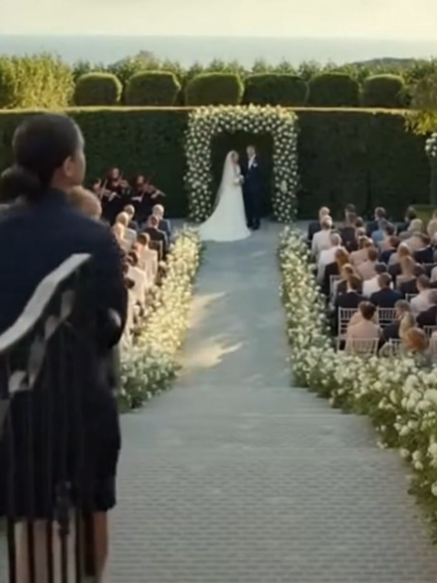
The wedding garden was flawless. White roses traced a narrow aisle across pale flagstone. Crystal chairs caught the noon light. A string quartet played something soft and forgettable. Two hundred guests sat in careful rows, champagne glasses balanced in manicured hands, ready to witness what money could make look like love.
Carter Vaughn stood at the altar in a charcoal suit that cost more than most people’s monthly rent. He looked like a man on the edge of something good — and he believed that. He had spent six months believing it.
Then the side gate opened.
The music didn’t stop immediately. It faltered — one bow catching wrong, then another, until silence spread like water through the crowd. Marissa stepped onto the petal-strewn aisle in her navy work uniform. She walked steadily, head up, arms holding something wrapped in a worn blanket. She didn’t slow down. She didn’t look at the guests. She looked at the altar.
“If you think you can buy silence,” she said, her voice carrying cleanly across the garden, “then you’ve never met a woman who watched a child get treated like she didn’t matter.”
Two hundred phones rose at once.
At the altar, Selene Marlowe went rigid. The warmth drained from her face so completely it was like watching a mask crack and slide. Beside her, her mother in pale satin raised a gloved hand to her mouth — not in surprise, but in the particular fear of someone watching a locked door come open.
Carter’s eyes moved to the bundle in Marissa’s arms. He saw a small shoulder. A worn honey-colored teddy bear. He felt the blood leave his face.
He knew that bear.
Poppy.
Three Months Earlier — Greenwich
Marissa had arrived at the Vaughn estate with a backpack that still smelled faintly of bus depots and stale coffee. Her husband had been gone eleven months, and grief had turned every job application into an act of will. She needed steady work. She wasn’t in a position to be particular.
The house was cold in the way that marble is always cold — no matter how many rugs you lay down or how high you turn the heat, something at its center stays indifferent. Staff moved quietly. Doors closed softly. The silence wasn’t peaceful. It was managed.
She noticed Poppy on her first afternoon.
The little girl darted through the sitting room clutching a honey-colored bear, then froze when she heard heels clicking on stone. She slipped behind a curtain with the practiced ease of someone who had done it many times — peeking out with wide eyes, measuring the threat before deciding whether to appear.
Marissa kept polishing the glass table and said nothing. But her chest tightened.
That wasn’t shyness. That was a child who had learned to become invisible.
Selene swept in minutes later, her smile the exact temperature of professionally warm. “Poppy, sweetheart,” she said brightly. “Come say hello. Don’t be dramatic.”
Poppy didn’t move. Selene’s smile stayed perfectly in place. But her eyes went somewhere flat and cold before she turned away.
Marissa filed it quietly. She had learned early that danger rarely announces itself.
Doors That Stayed Locked
Weeks passed. Marissa began noticing the shape of things.
Poppy’s bedroom door locked from the outside. The child’s meals arrived on a separate tray, in a separate room. When Carter traveled — and he traveled constantly, two weeks out of every month — muffled crying sometimes echoed down the east hallway at night, cut short by a calm, warning voice.
One afternoon she overheard Selene on the phone, voice stripped of sweetness.
“She’s a complication,” Selene said. “We can’t start a marriage with Carter’s daughter watching me like she knows something. She makes everything harder. Yes. I know the timeline. Move it up.”
Marissa stood in the hallway, a towel half-folded in her hands.
This wasn’t frustration. This was a plan with a schedule.
The Question That Changed Everything
That evening she found Poppy alone in the playroom, humming softly and stroking the worn ear of the bear. She looked smaller than a seven-year-old should look. Like she had been made smaller by careful, repeated pressure.
“You’re not like the others,” Poppy said, studying her with old eyes.
Marissa sat down on the floor beside her. “What do you mean?”
Poppy was quiet for a moment. “She says I make things harder. She says Dad has a new life and I don’t fit in it right.”
She looked up.
“You won’t let her send me away, right?”
Marissa took the small hand in both of hers. “I’m here. And I won’t pretend I didn’t hear you.”
“Promise?” Poppy asked.
“I promise.”
Thursday Morning
Three days before the wedding, Carter left on a business trip. Selene told Marissa to stay on the ground floor.
Eleven minutes later, Marissa heard it — crying, abrupt and then smothered. She moved through the service staircase without thinking.
She found Selene’s mother at the top of the east corridor, gripping Poppy’s arm above the elbow, pulling her toward the back stairs.
“I want my dad!” Poppy’s voice cracked. “I want to call my dad!”
“Stop embarrassing yourself,” the older woman snapped. “This is what happens when children don’t cooperate.”
“Let go of her.” Marissa’s voice was flat and left no room.
Poppy wrenched free and ran straight into Marissa’s arms.
“You’ll regret this,” Selene’s mother said quietly.
Marissa said nothing. She carried Poppy down the back stairs and out into the cold morning air, and she did not stop until the estate gate had closed behind them in the rearview mirror.
The Day the Vows Stopped
She had made the calls before she stepped through the gate. Investigators were already en route when she walked the aisle.
Carter crossed the dais in five steps and reached out — hands visibly trembling — and Marissa gently placed Poppy into his arms. He folded around her and held on.
“Dad,” Poppy whispered. “She told me you were done with me.”
The garden went completely still.
“I’m here,” Carter said, his voice breaking. “I’m so sorry. I’m not going anywhere.”
Selene’s composure collapsed entirely. Her mother had already begun moving toward the side gate. A guest stepped into the path. Someone was already on the phone.
The ceremony ended without vows.
After the Petals Fell
Investigators arrived within the hour. By nightfall, the story was no longer Selene’s to control. By morning, it had reached the kind of people who make decisions about custody and consequences. Selene and her mother were questioned at the property. The timeline Selene had referenced on that phone call — the plan to move things up — became evidence.
Carter stayed on the grass long after the guests had gone, holding Poppy in a folding chair as white petals scattered in the afternoon wind.
“You saved her,” he told Marissa.
“I just listened,” she replied. “And I didn’t pretend I hadn’t.”
Three Weeks Later
The playground near Marissa’s apartment was ordinary and loud — squeaking swings, chalk-scuffed concrete, the specific chaos of children who have nowhere else to be but exactly where they are. Poppy had stopped flinching when adults walked past.
She climbed into Marissa’s lap, slightly out of breath from running.
“When I grow up,” she said, with the certainty that only children have, “I want to be someone who doesn’t pretend she didn’t see.”
Marissa held her close. “That’s a brave kind of person to be.”
Poppy ran back to the swings. She laughed — freely, without checking first to see if it was allowed.
Sometimes the kindest act is the refusal to look away — even when every comfortable instinct tells you to keep your eyes down and stay out of it.
Marissa had looked. She had stayed.
And a little girl was laughing on a swing because of it.
