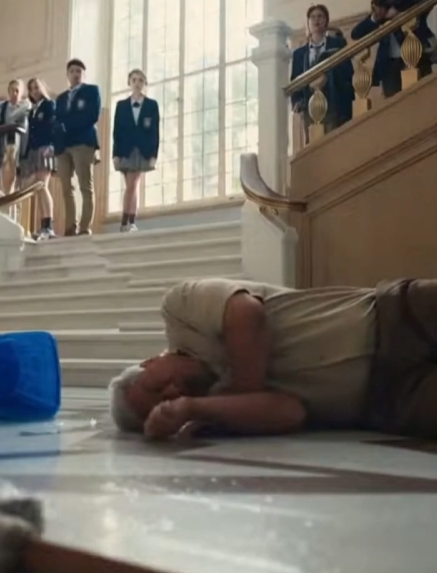
A janitor was fired for bleeding on a school hallway floor… But the kid who called his billionaire father had a secret that would destroy the entire empire.
The sound of a body hitting marble echoes different when you already know nobody’s going to help.
I was three lockers down when I heard it—that wet, sharp crack—and turned to find Elias on the floor at the bottom of the staircase. Sixty years old. Broken shoulder. Mop handle snapped beneath him like a joke.
Chase Montgomery stood at the top of the stairs, varsity jacket gleaming, smirking down at what he’d done.
Principal Vance burst out of the admin wing in four seconds flat. He saw the spreading puddle, he saw the Board of Trustees were arriving in twenty minutes, and he looked at Elias the way you look at spilled coffee before you wipe it up.
“You’re fired,” Vance said. “Gross negligence. Get out of my building.”
Elias didn’t argue. He tried to crawl toward the mop. He was apologizing for existing.
I thought about the bleachers. The bottle of pills. How Elias had sat next to me without a word, eaten his sandwich, talked about his garden until I put them away. He had saved my life without making it a thing. And now he was being dragged out like trash because he was inconvenient.
I reached into my blazer and pulled out my phone.
The contact was labeled THE ARCHITECT.
My father didn’t just have money. My father was the kind of money that moved senators. The library at Amesbury was named after his grandfather. The stadium after his brother. And technically, he owned the mortgage on Vance’s house—though Vance didn’t know that yet.
“I’m giving you one chance,” I said. “Help him up. Get him medical attention.”
Vance laughed and turned away. “Security.”
I pressed call.
It rang once. My father’s voice—the voice of tectonic plates—came through low and clipped. “Leo. This better be a literal emergency.”
“It is.” I made sure Vance could hear every syllable. “Dad, the Board is looking for a reason to restructure the administration, right? I’m watching the Principal illegally terminate a man he just let get assaulted. It’ll be a PR nightmare. The lawsuits alone will bankrupt the endowment.”
Vance stopped walking. His shoulders went rigid.
“Put him on speaker,” my father said.
I held the phone out like a weapon.
“Principal Vance. I am the Board. Here is what is going to happen. You will apologize. You will reinstate the employee with a raise. And then you will take instructions from my son until I fly in and decide whether you’re worth the legal fees to fire you.”
The hallway had gone churchyard quiet. Fifty students, phones raised. Chase at the top of the stairs, knuckles white on the railing.
Vance bent down and picked up the bucket. His manicured hands—usually reserved for expulsion slips and donor handshakes—dabbed at the soapy floor with a gray rag.
The King was on his knees.
I helped Elias to my Jeep and drove him toward the hospital. But before we reached the ER bay, a black sedan cut us off. Two men in dark suits stepped out.
My father’s private security.
“The Architect wants to ensure proper care,” the lead man, Kael, said. “We’ll take it from here.”
I stepped between him and Elias’s door. “He’s my friend.”
“He’s a liability,” Kael said. “Step aside.”
They loaded Elias into the sedan gently, like they were transporting something expensive and fragile. He looked at me through the window—terrified, but resigned—and then they drove him away to the VIP entrance.
I sat in my Jeep and screamed until my throat tore.
Then my father’s text arrived: Dinner. 8 PM. The Avery. Don’t be late.
The Avery was a private dining club where the waiters were trained to be deaf to every conversation. My father was already at the corner booth, back to the wall, when I arrived at 7:55.
“You caused a stir today,” he said, not looking up from his tablet.
“I did the right thing.”
He ordered the porterhouse for two. Rare. He described Vance as a “useful idiot.” He told me that Chase’s father was a Senator currently chairing the committee that regulated his offshore holdings, that an expulsion would cost him billions, and then he slid a folded document across the white tablecloth.
It was a settlement agreement. Signed by Elias.
Clause Four stated the injury occurred due to Elias’s own personal negligence.
“You bought his silence,” I said. “You stripped him of the truth.”
“I gave him three years’ salary,” my father said. “Dignity doesn’t pay the electric bill.” He leaned in. “You think you’re the hero of this story, Leo. But you lit a match in a room full of gasoline because you liked the way the flame looked. I’m the one who puts out fires before the house burns down.”
I crumpled the paper and threw it on the table.
That was when Chase sent the video.
It was me. In the locker room. Shirtless. Mid-panic attack. Rocking on a bench and muttering to myself, trying to come back down before class. He had filmed it weeks ago, hidden angle, and now it was going to every student at Amesbury with the caption: Psycho on the loose.
His follow-up message read: My dad says your dad fixed everything. But nobody fixes me. See you tomorrow.
My father had prioritized the Senator over my safety. He had left me exposed. Chase wasn’t expelled. He was emboldened.
I walked to Vance’s house that night.
I won’t rehearse every detail of what I found—the shredder, the ledgers, the confession about shifting scholarship funds into operating expenses to keep the floors polished for donors. But I will tell you what Vance told me while the paper confetti of stolen money rained down around him.
He told me about my mother.
Three years ago, she had found emails. Amesbury wasn’t just a school—it was a feeder program. They ran psychological profiles on every student. Stress tolerance, compliance, leverage points. My father sold the data to corporate headhunters and foreign political strategists. He wasn’t raising leaders. He was breeding assets.
My mother found out. She came to the school screaming. She threatened the Times.
My father needed two signatures to have her committed and bypass the 72-hour hold. He signed one. Vance signed the other—because my father had known about the embezzlement for years, had let Vance steal, and used that knowledge as a leash.
Vance had been the jailer. He was the reason my mother was staring at Alps instead of holding me.
When Vance swung the brass letter opener at my head and caught my forearm, when I heard the bone crack and hit the tile floor, I thought: of course. Of course it ended with me bleeding, just like Elias.
But then the sirens. Headlights across the kitchen window. Kael.
They zip-tied Vance. They drove me to a private jet.
“Your father thinks a semester in Switzerland would be beneficial,” Kael said, somewhere over the Atlantic.
Switzerland. The clinic. The same facility where my mother had been staring at the same view of a glacier for three years.
My father thought he was putting me in timeout. He didn’t realize he’d just put the courier in the same room as the package.
My mother was thinner. Her hair had gone gray. But the moment she heard my voice, the performance she’d maintained for the doctors—vacant, fragile, confused—dropped like a mask being pulled off.
She had been waiting.
She went to the easel in the corner of her room and dug something from inside a thick glob of blue oil paint with a palette knife. A micro-SD card wrapped in plastic. She had hidden it in her earring the night they brought her in.
The master key. The predictive algorithm. The bank transfers. The names of the Senators. The medical records of everyone committed to keep them quiet.
Three years, hidden in a painting.
“The supply truck comes at 4:00 AM,” she said. “East wing. Service road. It’s steep and it’s covered in snow, but it’s not a cliff.”
“I can’t leave you here.”
“You have to,” she said. She grabbed my shoulders and looked at me like she was memorizing every detail. “If you stay, they win. You have to run.”
I ran.
I hid in the laundry truck. An hour down the mountain, numb, broken arm screaming every hairpin turn. I crawled out in Zurich, traded my Rolex to a cab driver for a ride, and collapsed at the gate of the US Consulate.
“My name is Leo Blackwood,” I told the Marine. “I’m claiming whistleblower protection. Tell the FBI legal attaché I have the Architect’s blueprints.”
Three days later, I watched the raid on the Blackwood Estate on CNN. Helicopter footage. Federal agents carrying boxes. Computers. My father’s things.
Agent Miller handed me a secure cell phone. “He asked for you.”
My father’s voice hadn’t changed. It still sounded like tectonic plates. Still a little impressed, even in handcuffs.
“You burned the house down,” he said.
“I told you I wasn’t hungry for dinner.”
“The assets are frozen. The legacy is gone. You are penniless.”
“No,” I said, looking out at the Swiss skyline. “I bought my life back.”
“She was always too emotional,” he said. “Your mother. She never understood the necessity of control.”
“She understood love. That was the variable you couldn’t code into your algorithm.”
The silence on the line was long and flat.
“I did it for you,” he said finally. “To build a world you could rule.”
“I don’t want to rule the world, Dad,” I said. “I just want to live in it.”
“Then enjoy the poverty,” he spat.
I hung up.
One Year Later
The coffee shop was small. Rain on the windows, the smell of roasted beans and wet pavement. I liked the smell. It was real.
I wiped down the counter and carried two lattes to table four.
Elias was there.
He looked good. Weight back on him, the gray drained from his face. Flannel shirt, gardening magazine. A man at rest.
“How’s the shoulder?” I asked.
“Stiff,” he said. “But the class-action settlement check helps.” He smiled—a real smile, nothing afraid in it. “Your mom coming by?”
“Yeah. She has a gallery show next week.” I checked my watch. “‘Landscapes of Confinement.’ Heavy stuff. But she’s happy.”
The Blackwood Estate had been liquidated. The victims—hundreds of students and staff—had been compensated. The Blackwood Wing at Amesbury had been renamed. My father was serving twenty-five years federal. Chase had been expelled and was already forgotten. Vance was in a federal facility somewhere in Nevada, shredding nothing.
I was a barista in a Seattle coffee shop, taking night classes in social work, driving a rusted Toyota Corolla I bought with my wages.
“You happy, Leo?” Elias asked.
I looked at my apron. I looked at the rain on the glass.
“I’m real,” I said. “And I’m clean. First time in my life.”
The bell above the door chimed. My mother walked in shaking rain from her umbrella, face bright and untethered, waving like she was the happiest woman in the world.
I stood up to meet her.
Elias squeezed my hand once as I passed. “You picked up the bucket, kid.”
“Yeah,” I said. “I picked up the bucket.”
