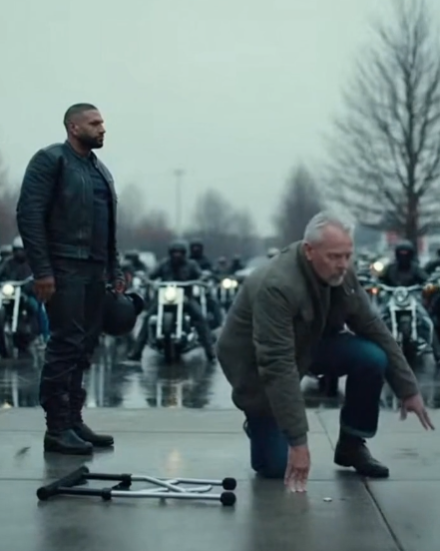
A nurse shoved a disabled war veteran to the ground outside the hospital where his dying wife lay… But she didn’t know he had two hundred biker brothers—and a recording.
The concrete was colder than Silas Vance expected. Not that he’d planned on landing on it.
He’d been standing outside Mercy General for fifteen minutes, gripping his crutches in the November wind, waiting for visiting hours. His wife Martha was on the fourth floor. She didn’t have many fourth floors left.
“You’re not allowed to stand here.”
The nurse’s name tag read BRENDA THORNE, HEAD FLOOR NURSE. She looked him up and down like he was something tracked in on someone’s boot—the faded field jacket, the skin-graft ointment smell, the shrapnel-stiffened way he held himself.
“My wife is in room 402,” Silas said, his lungs still carrying thirty years of burn-pit damage. “I’m just waiting.”
Brenda didn’t hear him. Or didn’t want to. She crossed her arms and leaned in. “You filthy people hang around the entrance trying to guilt-trip visitors. Not on my watch. Move, or I call security and have you trespassed.”
Silas turned to go. He was too tired for another fight. He’d been too tired for another fight since 1991.
That’s when she pushed him.
His back hit the pavement like a detonation—all the old shrapnel waking up at once. His crutches skittered across the concrete. He lay there looking at the gray November sky above the entrance of the hospital he’d once bled to protect.
“You beggar!” Brenda hissed, standing over him. “I told you to get out!”
People walked past. A few glanced. No one stopped.
Silas pulled himself up slowly, fingers shaking around cold metal. He didn’t shout. He just looked at her with eyes that had seen things she never would. “I’ve been shot,” he said quietly. “I’ve been blown up. But I’ve never been humiliated by someone wearing a uniform meant for healing.”
She laughed. “Nobody here cares who you are.”
She was right. She didn’t know who he was.
She didn’t know that in eight minutes, the parking lot of Mercy General would begin to shake.
It started as a vibration in the soles of his boots. Then a hum. Then a growl that built into a wall of sound that drowned out the city entirely.
The first bike rounded the corner—a black Road Glide, rider wearing a leather vest with three words arched across the back: IRON BROTHERHOOD – VETERANS MC.
Behind him came another. And another. Two by two, they poured into the hospital drive like a tide of chrome and leather, until nearly two hundred bikes had filled every inch of available asphalt. The riders were gray-bearded, scar-knuckled men whose faces said they had been places no tourist brochure mentioned.
Brenda’s expression moved from smug to pale in the span of a single breath.
The lead rider—Jax Miller, a man Silas had shared a foxhole with at twenty—pulled his bike directly onto the sidewalk. He kicked the stand down with a definitive clack. Removed his helmet. Looked at Silas on the ground, then slowly at Brenda.
“Silas,” Jax said, voice low as rolling thunder. “Why are you sitting on the floor, brother?”
“Had a little help getting down here,” Silas said.
Jax’s eyes moved to Brenda. He didn’t threaten. He didn’t raise his voice. He simply stood there—six-four of quiet, absolute intent—and waited.
Brenda touched her name tag like it was a shield. “He was obstructing the entrance. He fell. It was an accident.”
“An accident.” Jax looked back at the line of bikes. “Funny. We’ve got about fifty dash-cams and GoPros running in that line. Wonder what they saw.”
The blood left Brenda’s face completely.
The hospital COO—Arthur Sterling, a careful man in a charcoal suit—arrived in the lobby eleven minutes later. He had Brenda behind him and authority in his posture. He looked at the two hundred bikers filling his atrium and made the wrong calculation.
“This is a place of healing,” he announced. “Not a protest. I will have you all removed.”
Silas stood up. Slowly, painfully. He reached into the pocket of his field jacket and held up a battered smartphone.
He pressed play.
“Do you think just anyone can stand here? Look at you. Filthy. Smelly…”
Then the scrape of crutches on concrete. The heavy thud of a body. And Brenda’s voice again, triumphant: “You beggar! I told you to get out!”
The lobby piano played softly. No one else made a sound.
Sterling turned to Brenda. The authority drained from his face and was replaced by something more familiar: the expression of a man watching a lawsuit walk toward him in leather boots.
“Brenda,” he said, voice dropping an octave. “My office. Now.”
It wasn’t over. Not even close.
Sitting in the VIP suite Sterling had quietly authorized—tenth floor, city view, a chair that didn’t creak—Silas told Jax about the name he’d seen on the donor wall downstairs. Elias Thorne. The contractor who, twenty years ago, had collected disability backpay from fifty veterans for a housing project called Hero’s Village—then moved the money through a shell company and watched the project quietly die.
Silas had given every cent of his refinery accident settlement. Martha had spent the next two decades watching him work three jobs on a broken spine to keep the lights on.
Brenda Thorne hadn’t pushed a stranger. She’d pushed a witness.
Sterling came back that evening with a manila folder and a look on his face that said he’d already done the math on what it meant. The Hero’s Legacy Fund. The shell company. The donations that had bought Brenda a head nursing position she hadn’t earned and her father’s name on a wall he had no right to be on.
“The hospital’s legal team will offer you a settlement in the morning,” Sterling said, setting the folder down. “My father was a Vietnam Corpsman. He died of Agent Orange at fifty-three.” He looked at Martha sleeping. “Don’t sign anything until you’ve shown that to a good lawyer. One who likes the sound of a hundred Harleys.”
At 8:00 AM the next morning, Elias Thorne arrived at the hospital in a black sedan, Brenda beside him in a designer suit, dark glasses hiding whatever she felt.
In the second-floor conference room, his lawyers offered Silas a number with a lot of zeros and a non-disclosure clause. Elias sat at the head of the table, hands folded, not even looking up.
Silas tossed the folder onto the mahogany surface. It slid to a stop in front of Elias.
“The ‘Hero’s Legacy Fund’ didn’t go bankrupt,” Silas said, leaning forward until he could see his own reflection in Elias’s glasses. “You drained it. You bought this wing with stolen disability checks and put your daughter in a job she wasn’t qualified for. She didn’t push me yesterday because she hated a beggar. She pushed me because I was a reminder of where the money came from.”
“You’re a delusional old man,” Brenda said, voice cracking. “You should be grateful we’re offering you anything.”
Silas looked at her. “I might be an old man. But I’m an old man who’s been recording this meeting.”
The lawyer went pale.
Outside, the parking lot began to shake. Two hundred Harleys starting simultaneously—the sound of a debt coming due.
“The local news is in the lobby,” Silas said. “So is the District Attorney. Duster, the man who lost his leg in Fallujah? He became one hell of a paralegal. He’s been outside for three hours filing paperwork.”
Elias looked at the vibrating windows. Then at his daughter. For the first time, Silas saw fear in those dead, cold eyes. The ghosts he’d built his empire on had learned how to haunt.
Silas and Jax walked out and left the lawyers scrambling.
Martha died that afternoon, just as the sun broke through the clouds.
She asked if he’d won. He told her yes—that the village was going to get built, the real one, with porches and gardens. She smiled, squeezed his hand one last time, and let the breath go.
He sat with her for a long time. Jax, Duster, and Preacher came in silently and stood behind him. No empty words. Just presence.
By evening, the Thorne family’s assets had been frozen. The board had issued a formal written apology. Brenda’s nursing license was formally under review, with termination and board reporting to follow. Elias Thorne was facing racketeering charges that ensured his twilight years would be spent in a very different kind of institution.
The hospital announced the new veterans’ wing would be named the Martha Vance Center for Restorative Care.
When Silas walked out of Mercy General that night, leaning on Jax’s arm, the Brotherhood lined the driveway in two silent rows. Every man raised a hand as he passed.
The “Thorne” name on the donor wall had already been covered by a tarp.
Silas climbed into his truck. The engine caught on the second try. He looked at the empty passenger seat and could almost smell her—lilies and peppermint gum.
He pulled out of the lot, and two hundred Harleys came to life behind him, an escort of thunder carrying him toward the last light on the horizon.
The nurse had been wrong about one thing. People did care who he was.
He was Silas Vance. Husband. Soldier. Brother. And for the first time in decades, a man who didn’t have to carry the weight alone.
