A billionaire’s grandson filmed a poor classmate’s worn hoodie for 3 million laughs… But the boy’s grandfather owned the entire empire.
Leo Sterling had never touched a mop in his life. He’d never needed to. His sneakers cost more than most people’s rent, his hoodie had a three-hundred-dollar price tag, and his iPhone 15 Pro was practically a weapon — pointed, that morning, at a boy named Caleb Miller.
Caleb sat three rows ahead on Bus 402, staring out the window, jaw tight. He wore the same charcoal hoodie he’d worn every day that week. The cuffs were frayed. There was a careful patch on the left elbow.
Leo zoomed in. “Day five of the Grey Ghost saga, folks. The fabric is literally fusing with his skin. Should we start a GoFundMe? I think we raised twelve bucks.”
The laughter came easy. It always did.
What Leo didn’t notice was the rearview mirror. And the eyes watching him from it.
Arthur Vance was sixty-five years old, with hands that looked like topographical maps and a face that had earned every line. To the kids on Bus 402, he was just “the driver.” Background furniture. Part of the machine.
He wasn’t.
When Leo stood and shoved the camera into Caleb’s face — his hand reaching for the hood, ready for the “big reveal” — Arthur pumped the brakes.
The bus shuddered to a halt on the shoulder of the road. The air brakes hissed like a warning shot.
“Sit down, Mr. Sterling.”
Leo looked up, a smirk already forming. “What was that, old man? I think the bus is broken. Just like Caleb’s fashion sense.”
Arthur unbuckled his seatbelt. The click was a gunshot in the sudden silence. He stood, all six feet of him, and walked down the aisle.
“Put the phone away. You’re filming a boy who’s done nothing to you. You’re acting like a predator, and I don’t allow predators on my bus.”
Leo’s smirk sharpened. He looked around at his audience. They were watching. Good.
“You don’t allow? Man, do you know who I am? My dad is Richard Sterling. He owns Sterling Transport. He owns this bus. He owns you.”
Arthur stopped in front of him. He didn’t flinch. He didn’t raise his voice. He just looked at Leo the way a man looks at something he built badly and has decided to fix.
“Your father owns a lot of things,” Arthur said. “But he doesn’t own the truth. And the truth is, you’re a coward picking on a boy who’s twice the man you’ll ever be — for digital likes from people who don’t even like you.”
Leo’s face went crimson. He was already dialing.
“Yeah, Dad? One of your drivers is harassing me. I want him gone. Now.”
He looked at Arthur with a victor’s grin. “He’s on his way. He was already nearby. You better start packing your thermos, pops. You’re finished.”
Arthur folded his arms across his chest. “Good,” he said quietly. “I’ve been waiting for a reason to see Richard. It’s been far too long.”
The black Mercedes arrived in five minutes. Richard Sterling stepped out in a tailored navy suit, silver temples, aura of impatient power. He was a man accustomed to arriving and having problems disappear.
Leo was already at the bus steps, practically vibrating. “Dad! Finally. Fire him. Right now.”
Richard didn’t look at his son. He looked at the driver. His hand dropped to his side. The color left his face the way water leaves a tipped glass.
“Leo,” he said, his voice gone thin. “Get in the car.”
“What? Dad, you need to—”
“Get in the car. Now.“
The violence in Richard’s voice shoved Leo into silence. He blinked. He looked from his father to the driver and back again. Then he slunk toward the SUV, though he didn’t get in. He stood by the door and watched.
Richard boarded the bus. The doors hissed shut.
The students held their breath. They’d forgotten their phones.
“Hello, Richard,” Arthur said. Cold. The way you speak to someone you once loved.
“Pop.” Richard’s voice cracked on the single syllable. “What are you doing? Why are you driving a school bus? I told you ten years ago I’d take care of you. I thought you moved to Florida.”
A collective intake of breath moved through the bus like a wave. The “old, pathetic driver” was Richard Sterling’s father?
Arthur stepped closer. “You wanted to put me in a gilded cage so you didn’t have to look at the man who knows what a real day’s work looks like. I didn’t want your charity, Richard. I wanted a son. I ended up with a shark.”
“Don’t do this here,” Richard pleaded.
“You made it public the day you raised a boy who thinks money buys him the right to be cruel.” Arthur’s eyes moved to the back of the bus. To Caleb. Then back to Richard. “That boy back there works two jobs to keep his mother’s inhaler paid for. He wears the same hoodie every week because it’s the price of her breath. And your son filmed it. For laughs.”
Richard wiped his forehead. “I’ll talk to Leo. I’ll make him apologize.”
“You’ll do more than that.” Arthur reached into his jacket and produced a heavy brass key — the key to the original Sterling garage, the one he’d built from nothing in his own backyard forty years ago. He set it in Richard’s hand.
“The trust fund you built for Leo — it’s tied to the legacy shares I wrote into the original company bylaws. There’s a Character Clause, Richard. The one you never bothered to read. As of today, I’m invoking it.”
Richard went pale. “Pop, you can’t—”
“As of today, Leo Sterling is penniless. No car, no designer clothes, no phone. He’s going to learn what it means to be ‘the help.’ Starting Monday, he’s my apprentice. He’ll be cleaning this bus, scrubbing the floors, and riding the route with me every single day. If he misses once, he’s cut from the will entirely. And if you give him a single dime to bypass this, I’ll pull my remaining shares and collapse your merger.” Arthur held his son’s gaze. “Don’t think I won’t.”
Richard looked at his father. He knew better than anyone that Arthur Vance would burn the whole world down if he decided it was the right thing to do.
“Do what he says, Leo,” Richard called toward the SUV, his voice hollow.
“What?! Dad, no—”
Arthur was already walking back to his seat.
The 4:30 AM alarm wasn’t the gentle iPhone chime Leo had woken to his entire life. It was a mechanical shriek, a vintage wind-up Arthur had placed on the nightstand beside a pair of reinforced navy work pants.
Leo groaned. Reached for a screen that wasn’t there.
Arthur appeared in the doorway, already in his uniform. “Siri isn’t coming to work today. The bus leaves in forty minutes. If you’re not in the truck in ten, you’re walking. It’s four miles.”
Ten minutes later, Leo was in the passenger seat of a 1998 Ford F-150 that smelled of black coffee and old sawdust.
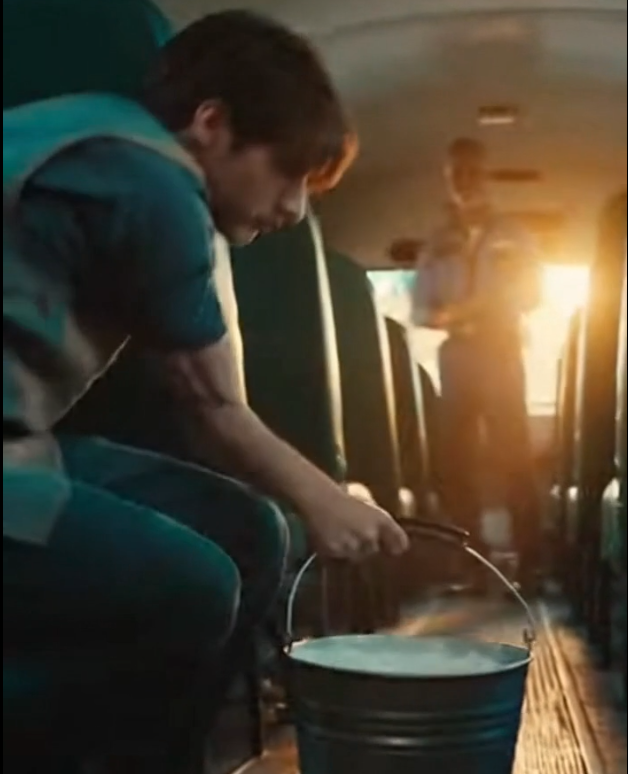
At the depot, Arthur handed him a plastic bucket of soapy water, a scrub brush, and a bottle of industrial degreaser.
“Bus 402, Bay 4. You have ninety minutes before the morning run. Every inch of the floor scrubbed. Gum removed from under the seats. The back row — your throne — clean enough to eat off. I find one sticky spot, you do it again tomorrow.”
Leo looked at the bucket. “There are professional cleaners for this.”
“There are,” Arthur agreed. “Today you’re the professional. Get to work.”
The next ninety minutes broke Leo in ways a gym never had. He knelt on ribbed metal, his nose burning with ammonia, scraping calcified gum that predated his own birth. His knuckles bled where they caught the seat frames. His back throbbed. His expensive-adjacent work pants turned grey with filthy water.
He was working his way toward the back when he found it. Wedged between the cushions of Caleb’s seat. A piece of paper.
He pulled it out. It wasn’t trash. It was a drawing — a detailed, breathtaking sketch of the city skyline as seen from the bus window. Rendered entirely in ballpoint pen on the back of a grocery receipt. And at the bottom, in small, neat letters: One day, I’ll be on the other side of the glass.
Leo stared at it. He had shoved his camera into this face and called his silence “boring.” He hadn’t realized that while he was performing for a digital void, Caleb was documenting the world with a talent Leo didn’t possess and never would.
He folded the drawing carefully and put it in his pocket.
The social death came on schedule.
When the bus pulled up to the Academy gates that first morning, Leo standing in the aisle in his stained uniform with bleeding knuckles, three girls from the cheer squad boarded and stopped mid-sentence.
“Is this a TikTok thing? Are you undercover?”
The flash of a phone camera hit him like a physical blow.
“Leo Sterling is a bus boy,” one of them announced. “This is going to go viral.”
It did. Three million views. He became a meme. A cautionary tale. His former second-in-command, Jax, took the back row throne and immediately began performing — dropping a chocolate milk carton on the floor Leo had just mopped, splitting it deliberately, spreading brown liquid across the metal ridges.
“You missed a spot, janitor. Don’t expect a tip.”
The students leaned in, phones ready, waiting for the old Leo to explode.
Leo looked at the mess. He felt the surge of rage. He caught Arthur’s eyes in the rearview mirror — not intervening, just watching. A steady, expectant gaze.
Leo reached into his bucket and wiped up the chocolate milk.
Caleb was the last one off the bus. He paused beside Leo, still on his knees.
“You shouldn’t let them do that,” Caleb said quietly.
“What am I supposed to do?” Leo asked. “I’m the one who taught them it was okay.”
“There’s a difference between being a servant and being a victim,” Caleb said. “A man only becomes a victim when he starts believing what people say about him.”
Then he walked off, backpack heavy on his shoulders.
A week in, Arthur told Leo the real problem.
A black sedan in the principal’s reserved spot. The Academy’s Board of Trustees. A closed-door meeting about “Student Conduct and Institutional Reputation.”
They weren’t coming for Leo. Leo was a Sterling. His father’s donations had built the new library. They were coming for Caleb — the “source of distraction.” No victim, no scandal. No scandal, no story.
“I can’t walk in there,” Arthur said. “It’ll look like a billionaire interfering. This has to come from inside. It has to come from a witness.”
He handed Leo a small, leather-bound ledger — the original logbook of Sterling Transport. “Caleb’s grandfather was my first driver. We were partners before we were an empire. Go in there. Don’t be a Sterling. Be a witness.”
Leo looked at his stained uniform. His bruised knuckles. His matted hair.
He walked up the limestone steps anyway.
He pushed past the security guards outside the oak boardroom doors — “I’m the Student Safety Monitor of Bus 402, I have a formal report” — and entered a room lined with twelve men and women in suits that cost more than Arthur’s bus.
Caleb sat small at the far end of the table. His mother Sarah beside him, inhaler in her trembling hand.
Richard Sterling was in the back corner. His face went white.
“I’m the reason we’re here,” Leo said, walking to the center of the room. He laid the ledger on the table. “You’re considering expelling Caleb Miller because his presence is ‘distracting.’ Because he’s a scholarship student whose life doesn’t fit your image.”
“We are considering the overall environment—” Principal Henderson started.
“The environment is a lie.” Leo’s voice rose. “I spent seventeen years in it, and it taught me I could film a boy’s poverty and call it a joke. If you expel Caleb, you’re confirming this school is a factory for people like I used to be.” He looked at the board. “I am the bully. I am the conduct violation. Expel me. I’m the one who brought shame to this name. Not him.”
Sarah Miller began to cry.
Richard stood. “Leo’s under stress. This has gone far enough.”
“It hasn’t gone far enough, Dad. You were going to let them erase a kid to sweep my mess under the rug.” Leo held his father’s gaze. “Stop protecting me with lies.”
He turned back to the board. His voice went flat and clear. “If Caleb Miller is expelled, I will tell three million people exactly why. I’ll tell them that Silver Oaks Academy punishes victims to protect donors. Let’s see what that does for enrollment.”
The board exchanged glances. In the world of the elite, the only force more powerful than money was the fear of being publicly unmasked.
“That won’t be necessary,” Henderson said tightly. “Caleb Miller’s scholarship will remain intact.”
Leo walked out without waiting for formal dismissal.
Caleb caught him in the hallway. “You just destroyed everything for yourself. Your friends, your dad — they’ll never forgive you.”
“I didn’t do it for them,” Leo said. “I did it for the kid who found a drawing on a grocery receipt and realized he was the one who was poor.”
A month passed. The viral fame moved on. Leo moved into Arthur’s guest room — cedar and old paper, three miles from the depot. He woke at 4:15 AM without an alarm. He wore navy work pants faded at the knees. He drank black coffee and didn’t remember liking sugar.
He learned the pit work. He learned the grease traps and the frayed belts and the logic of a machine that did not care about your last name. He enrolled in night school to finish his credits. He tutored with Caleb on Thursdays, math textbooks spread across Sarah Miller’s small table, a plate of lasagna waiting by the stove.
Richard came to the depot on a Tuesday afternoon, his suit slightly rumpled, his silver temples looking more like ash. He was stepping down. The board had offered a buyout. The company was gone.
“I’ve spent ten years protecting a chair,” Richard said. “I lost my father. I nearly lost my son.” He reached into his pocket and produced a gold watch — the one Leo had coveted since he was ten. He placed it in Leo’s greasy palm. “Time is the only currency you can’t earn back once you’ve spent it badly. Don’t waste yours being important. Just be useful.”
He turned and walked back to the Mercedes.
Leo watched him go. He felt grief. He also felt the solid, unmovable ground under his feet.
Six weeks after the hearing, Arthur let Leo take the wheel on the afternoon Activity Run.
Arthur sat in the jump seat beside him, arms crossed, eyes like a hawk. “Watch the turn on 5th. She’s a long girl. Swing wide or you’ll clip the curb.”
Leo took the turn perfectly. The rear tires cleared by a fraction of an inch.
“Good,” Arthur grunted.
The bus stopped at the library. Caleb stepped on with a stack of books, saw Leo in the driver’s seat, and broke into a slow grin.
“Moving up in the world, Sterling?”
“Just trying to keep the wheels turning, Miller.”
“My mom left a plate in the fridge for you. Said to come by if you’re working late.”
“I’ll be there.”
As the city scrolled past the windows in the long, gold light of late afternoon, Leo looked into the rearview mirror. He didn’t see an audience. He saw a community. People heading home to their ordinary, essential lives.
He saw himself, too. Grease under his fingernails. A quiet weight in his eyes that hadn’t been there before.
At 12th and Main, Caleb stepped off and gave a two-finger salute. “See you Monday.”
“Monday,” Leo said.
He watched Caleb walk toward the brick apartment building — unhurried, certain, carrying the weight of his life like it was his to carry and no one else’s.
Leo put the bus in gear and drove the final leg back to the depot. The only sounds were the low hum of the heater and the occasional rattle of the windows.
Arthur put a heavy hand on Leo’s shoulder. One firm, calloused pat that said everything.
“You’re doing okay, kid.”
“Thanks, Grandpa.”
Leo pulled into the bay and shut off the ignition. He sat for a moment with his hands still on the wheel, feeling the engine’s warmth fade.
He had lost his inheritance, his social throne, his father’s version of love, and the easy comfort of a life without weight. In their place he had a drawer of faded work pants, a watch he hadn’t earned yet, a bedroom smelling of cedar, a standing invitation to lasagna, and the ability — finally, genuinely — to look at another human being and actually see them.
The Character Clause had been fulfilled. The empire had fallen. The man had been built.
Leo locked the depot gate behind him, the brass key heavy and real in his hand, and walked toward the small bungalow where the light was already on.
He didn’t look back at the throne.
He knew exactly where he was.
