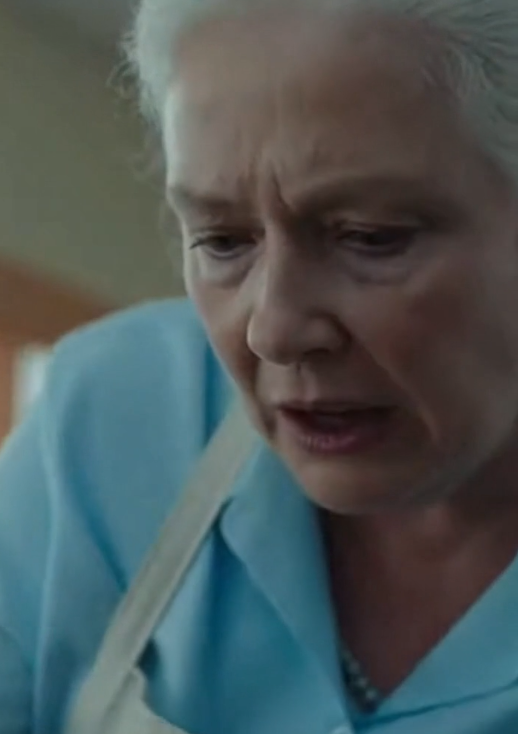
A man in a $3,000 suit slapped a 68-year-old waitress over three drops of coffee… But she turned out to be the one person the most dangerous crime family in New Jersey was terrified of.
I’ve poured ten thousand cups of coffee at Sal’s Highway Stop. I’ve mopped floors, scrubbed burns off the grill, and smiled through gritted teeth at men who treated me like part of the furniture. My name is Martha. I’m sixty-eight years old, my knees are shot, and every single dollar I earn goes into a jar I’ve labeled “Davey’s Smile.”
Davey is my grandson. Seven years old, jaw so misaligned he can barely eat, barely speak, barely look at another kid without covering his mouth. The surgery costs more than I’ve earned in the last three years combined. But I’m still standing. Still punching in at five in the morning.
That’s the thing about people like me. We’re harder to break than we look.
It was a Tuesday, the kind of gray New Jersey morning where the sky looks like a dirty dishcloth and your bones ache before you’ve even tied your shoes.
I was training Sarah, a nineteen-year-old with a bouncing ponytail and more enthusiasm than a golden retriever. “Hold the tray from the center,” I told her. “Let your shoulder carry the weight. Treat your body right, or it’ll break on you.”
“I don’t know how you do eight hours of this,” she whispered.
“You keep moving,” I said. “Rust sets in when you stop.”
At ten-thirty, the door chimed and two people walked in like they were visiting a museum of poor people.
The man was mid-forties, hair gelled into a perfect wave, charcoal suit so tailored he looked like he’d been shrink-wrapped. The woman wore cream silk and boots that had never touched a cracked sidewalk. She set a black Birkin bag on the table. Glossy leather, gold lock. Fifteen thousand dollars, at least.
I’d seen her type before. I’d cleaned up after her type for forty years.
“Two black coffees. Quickly,” the man said without looking at me. “And wipe the table again. I can see the film.”
“Of course,” I said, already moving.
At the coffee station, my hand was shaking. Cold weather always brought out my tremors — a gift from my father’s side. I took a breath, steadied myself, and walked back to their table.
I poured the man’s cup. Perfect.
I moved to the woman’s side. And then — a bolt of lightning from my lower back straight down to my knee. My leg buckled half an inch. The heavy pot jerked.
Three drops of coffee arced through the air.
They landed on the pebbled leather strap of the Birkin.
Three drops. Smaller than dimes.
The woman screamed like I’d stabbed her. “DON’T TOUCH IT! Do you know what this is?! Togo leather! Fifteen thousand dollars! You’ve ruined it!”
“I’m so sorry, ma’am — it won’t stain if we act fast—”
The man stood up. He was a head taller than me, his eyes cold and flat. “You stupid, clumsy old woman,” he hissed. Then louder: “You’re trash. A drain. You probably don’t even know what fifteen thousand dollars looks like.”
“I am a human being,” I said, keeping my voice steady. “And I apologized.”
He laughed. Then his arm moved.
SLAP.
The sound hit the room like a gunshot. My head snapped sideways. My taped-together glasses flew across the floor. I stumbled back into the edge of a table, the air knocked from my lungs. My cheek felt branded.
I stood there, half-blind, refusing to cry.
The room was dead silent. Old Pete, a regular who’d known me twenty years, stared at his scrambled eggs. The construction workers studied their boots. Sal didn’t come out of the kitchen.
I waited for someone. Anyone.
Then a chair scraped.
In the far corner — the shadow booth — a man rose. He’d been there since I opened my shift, quiet, nursing black coffee. As he stepped into the light, I saw the back of his jacket.
A skull with a scythe. IRON REAPERS MC arched above it. Below: PRESIDENT.
Jack.
He walked toward me with the slow, deliberate rhythm of a man who’d already decided how the next five minutes would go. He crouched at the floor near my feet, picked up my glasses, and cleaned the lenses with the hem of his shirt. Handed them back.
“Are you alright, Ghost?” he said quietly.
The whole diner exhaled.
I hadn’t been called that in thirty years.
Julian tried for a smirk as Jack turned toward him. It didn’t land.
“She’s sixty-eight years old,” Jack said. “She’s worked this floor since before you knew how to tie your shoes.”
Julian’s throat moved as he swallowed. “Stay back. I’ll call the police.”
Jack crossed the room in four steps and placed one hand on Julian’s shoulder. The expensive fabric bunched.
“You’re not calling anyone,” Jack said. “And you’re not leaving. Not until we settle the bill for the lesson you just gave.”
What followed was two weeks of war.
The DiMatos — the family Julian worked for as their “Clean Man,” the one who handled the shell companies and the offshore accounts — decided that Julian’s forced payout from their slush fund had created a paper trail they couldn’t afford. Vincent DiMato, the youngest brother and the family’s quiet enforcer, sent people to my trailer.
Thirty bikers on my gravel driveway disagreed with his plan.
Then Julian got desperate. He called Child Protective Services. Filed an anonymous tip claiming I was using Davey as a shield in a gang dispute. Two agents in polyester suits showed up at the Reapers’ clubhouse with an emergency removal order.
I’ve survived a lot in sixty-eight years. Nothing has ever come close to handing my grandson to a stranger while he cried and reached for my apron.
But here’s what Julian Vane didn’t know.
He didn’t know that forty years ago, I was called the Ghost because I could see the numbers moving through the air before they landed. He didn’t know that I was the woman who walked out of a police raid in 1974 with the entire DiMato family ledger hidden under a baby blanket. He didn’t know that the account numbers were still living in my memory, clean and clear as the day I first memorized them.
He didn’t know any of that. Because to him, I was just a clumsy old waitress in a diner off the highway.
That was his mistake.
I sat in the Iron Reapers’ back office with a pen and a scrap of paper and I wrote from memory. Every shell company. Every offshore account. Every transfer Julian had been siphoning into a private Cayman trust since 2018. Three million dollars. The password was his wife’s maiden name.
I slid the paper across the desk to Jack. “Take this to Detective Miller. Tell him it’s the grocery list I promised his mother. Tell him if he wants to bring down the DiMatos, he moves tonight.”
“This is a suicide note for their empire,” Jack said.
“Good,” I told him. “Get my grandson back.”
At midnight, thirty Harleys rolled up the DiMato estate driveway.
Vincent stood on his porch with a glass of scotch and a bored expression that didn’t quite reach his eyes.
I climbed off the back of Jack’s bike. I wasn’t wearing my apron. I was wearing the old leather jacket from when I was twenty-two — the one without patches.
“Julian’s been stealing from you,” I said to Vincent, cutting straight through the silence. “Blue Horizon account. Cayman trust. Three million, give or take. The Federal Task Force is raiding his office right now with a ledger I wrote from memory.”
Julian, standing beside Vincent, went from smug to white in under a second. “She’s lying — she’s a senile old woman—”
“Account ends in 7-7-4-2,” I said, watching Julian’s face collapse. “Password is your wife’s maiden name.”
Vincent looked at Julian for a long moment. Then he turned to the nearest guard. “Call the judge. Tell him the tip on the Miller boy was fabricated by a disgruntled employee. Return the child to his grandmother. Tonight.”
“Vince, you can’t—”
“Get him out of my sight.”
Two men grabbed Julian by the arms. He disappeared into the darkness behind the estate. I never asked what happened next. I didn’t need to know.
Vincent walked to the gate and met my eyes. “My father used to say the Ghost was the smartest person in any room.”
“I just wanted to be a grandmother,” I said. “You should have stayed out of the diner.”
Two weeks later, I sat in a hospital waiting room drinking the worst coffee I’d ever tasted — thin, bland, completely loveless — and I loved every sip.
The recovery wing doors opened. A nurse wheeled out a small boy with a bandage wrapped around his jaw and eyes bright as new pennies.
Davey saw me and his whole face opened up.
“Grandma.” The word came out clear. Still tender, still healing — but clear. Aligned. The surgery had worked.
I walked over on my aching knees and kissed his forehead. “Hey, soldier. Ready to go home?”
“Can we get ice cream?”
“We can get anything you want, baby.”
Outside, Jack leaned against his Harley, smoking. He didn’t say anything. He just looked at Davey, then at me, and nodded once.
The fifteen thousand dollars was gone — every cent paid to the hospital. Julian Vane was facing federal racketeering charges. The DiMatos were too busy surviving an FBI audit to think about a waitress in a diner.
And Davey, for the first time in his seven years on this earth, could smile without it hurting.
I’m Martha. Sixty-eight years old. Bad knees, good memory, and the best cup of coffee in Jersey. Come in sometime.
Just watch where you drop things.
