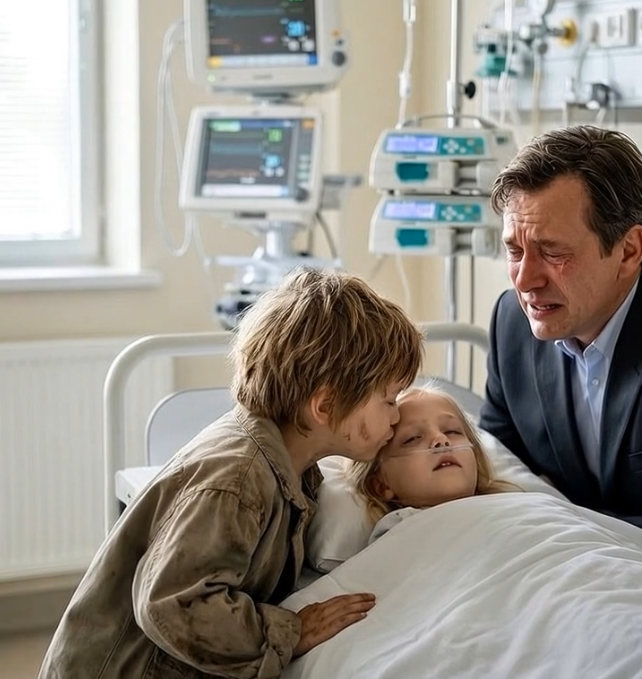
A billionaire’s daughter lay comatose for 3 years… But a ragged street boy appeared from nowhere and woke her up.
The heart monitor had been beeping for three years, two months, and eleven days. Ethan Walker knew the exact count because he had never stopped counting.
In the world of finance, his name moved markets. His signature had launched companies and buried rivals. Senators returned his calls. But inside Room 512 of Seattle Grace Medical Center, none of that meant a single thing.
His daughter Olivia lay on the bed, pale and still. She had been six when the accident happened. She was nine now. The same small hands. The same dark lashes fanned against white cheeks. Three years without a word, a squeeze, a sound.
That morning, Dr. Patel asked him to step into the hallway and told him what he had been dreading for months. The brain scans were definitive. Her vital functions were declining. Life support was no longer medicine — it was delay.
Ethan demanded more time. He begged. He threw the kind of fury that had once made subordinates quit on the spot.
The charts just stared back at him.
By afternoon, he was hollow. He walked back to Room 512 with a decision that felt like swallowing glass. His hand found the door handle. Cold metal. Still world.
“Don’t go in there to say goodbye.”
He spun around.
A boy stood in the middle of the hallway. Ten years old, maybe. Clothes dusty and worn through at the knees. Sneakers split at the toe. But his eyes — still, certain, impossibly calm — belonged to someone far older.
“Who are you?” Ethan’s voice came out rough.
“My name is Gabriel,” the boy said. “She isn’t gone. She’s just lost. I can bring her back.”
Every logical circuit in Ethan’s mind fired at once. Call security. This is a hospital. This child has no business here. But grief had eaten through logic months ago, and what remained underneath was raw and animal and desperate.
He held the door open.
Gabriel walked in without hurrying. He stopped at the edge of the bed and looked at Olivia the way someone looks at a familiar face — recognition, not curiosity. He turned to Ethan.
“Do you believe it’s possible?”
Ethan’s knees hit the floor before he made a conscious choice to kneel. “Yes. Please.”
Gabriel placed one small hand on Olivia’s forehead. He closed his eyes.
The air changed. There was no other word for it. The antiseptic smell faded and something warmer replaced it — the way a room smells just after rain. A faint glow seemed to gather at the boy’s palm, soft and without source. The heart monitor, steady for three years, jumped a beat. Then another.
Olivia’s fingers twitched.
Ethan gripped the bed rail. He was shaking everywhere. Then the light faded and Gabriel stepped back, looking suddenly exhausted in the way children never should.
“That’s enough for today,” he said quietly. “She heard the call. Tomorrow she will wake.”
Before Ethan could speak, the boy was gone.
That night Ethan did not sleep. He sat in the chair beside Olivia’s bed with his hands folded and his eyes on her face and he made every deal he had ever made in reverse — promising things instead of demanding them, offering instead of extracting.
Dawn came pale and slow. Gabriel arrived with it.
He said nothing this time. He simply placed his hand on Olivia’s forehead again and closed his eyes. The light returned — brighter, warmer, filling the room like the first real morning after a long winter.
The machines went wild. Alarms fired. Two nurses burst through the door and then stopped, confused by what the monitors were showing.
Then Olivia moved.
A small shift of the shoulder. A turn of the head. Lashes fluttering.
“Daddy…”
The word was hoarse from three years of silence. It was the most beautiful sound Ethan had ever heard in his life. He collapsed against the bed rail, one hand finding hers, sobbing in a way he hadn’t allowed himself since the night of the accident.
Dr. Patel stood in the doorway looking at the readouts with an expression that had no medical category.
By the time Ethan looked up, Gabriel was slipping toward the door.
“Wait.” Ethan rose and crossed the room in two strides. He knelt in front of the boy — a billionaire on both knees in a hospital corridor — and looked him in the eye. “You saved her. I’ll give you anything. A home. School. A future. Whatever you need, it’s yours.”
“I don’t need anything,” Gabriel said, and he smiled — small and complete and without want. “Just make sure she’s happy.”
Then he walked out through the double doors.
Ethan stood up and looked down the hallway. Empty.
He found the head of hospital security within the hour. They pulled the corridor footage from both days. The cameras showed Ethan standing alone in the hall, talking to no one. Two days of footage. Not a single frame contained a child.
No entry record. No visitor log. No face on any lens in the building.
The medical team ran every test twice. Olivia’s recovery was complete — no neurological damage, no muscle atrophy consistent with three years of non-use, no explanation that fit any known framework. Dr. Patel used the word “impossible” twice in one sentence and then stopped talking.
Within a week, Olivia was sitting up. Within two, she was walking the corridor with a physical therapist, pointing at the ceiling tiles and asking questions about everything.
One afternoon she grew quiet. She looked at her father with the particular focus children reserve for things they consider very important.
“The boy from my dream came, didn’t he?”
Ethan’s breath stopped. “What boy?”
“The one who helped me find my way back home. His name was Gabriel Hayes.”
Ethan had never heard a last name. He had never told Olivia anything about a boy.
That night, after she was asleep, he opened his laptop and typed three words into the search bar.
Gabriel Hayes Seattle.
The first result was a news archive. A small article, dated three years ago. He recognized the date immediately — it lived in his body the way all catastrophic dates do.
“10-Year-Old Boy Dies in Multi-Car Crash on I-90 — Family Survives.”
He read it slowly. His car had hydroplaned in the storm, triggering a chain collision involving four vehicles. A family in a compact sedan had been struck. The parents and older sister had survived with injuries.
Their youngest son had not.
Gabriel Hayes. Age 10. Survived by his parents and sister. Described by his teacher as a boy with “the kind of quiet you trust immediately.”
There was a school photo. Soft smile. Eyes that were still and certain and impossibly calm.
The same eyes.
Ethan sat for a long time without moving. The cursor blinked in the search bar. Outside, Seattle glittered wet and indifferent.
He had caused the crash. The storm, the speed, the split-second loss of control — it had been his car that started the chain. He had walked away. This boy had not.
And yet Gabriel Hayes had come back.
Not with accusation. Not with the rage that Ethan had spent three years half-expecting from the universe. He had come back to a hospital hallway to save the daughter of the man responsible for his death, and he had asked for nothing, and he had smiled, and he had left.
Ethan closed the laptop. He walked to Olivia’s room and stood in the doorway for a long time, watching her breathe in the dark.
He thought about everything he had built — the portfolio, the holdings, the leverage, the reach. He thought about how none of it had been able to save one small girl in a hospital bed. He thought about a ten-year-old boy in worn sneakers who had walked in off the street and done what no amount of money could buy.
He pulled out his phone and called his attorney at an hour that would have been unreasonable any other day.
“The Hayes family,” he said when the call connected. “Gabriel Hayes — the I-90 accident, three years ago. Find them. Whatever they need for the rest of their lives — medical bills, housing, education, anything — I want it handled. Anonymously. Tonight if possible.”
He hung up. He sat beside Olivia’s bed. He took her hand.
In the morning she woke up smiling, and when she saw her father’s face she reached up and patted his cheek with her small palm the way she used to when she was six.
“You look better, Daddy,” she said. “You look like you came back too.”
Ethan Walker, who had moved markets and bent rooms full of powerful people to his will, could not speak for a full minute.
He just held her hand and let the morning come in through the window, and for the first time in three years, two months, and eleven days, the sound of the heart monitor wasn’t a reminder of what he had lost.
It was proof of what had been given back.
