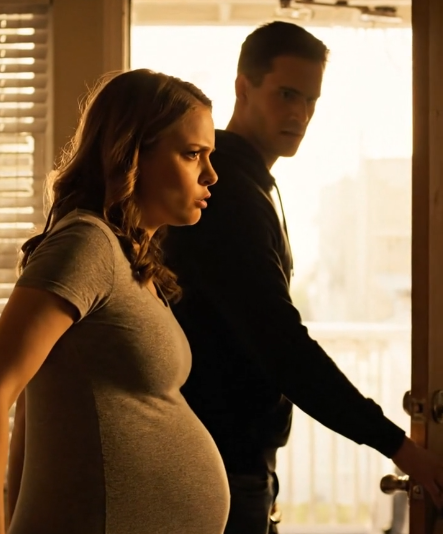
She was nine months pregnant when her husband said “Get out”… But the $200 million inheritance she hadn’t told him about changed everything.
The last thing Tyler Morgan said to me before he walked out was that he was tired of carrying me. He didn’t look at my face when he said it. He just grabbed his keys off the counter, and I stood there nine months pregnant, gripping the edge of the kitchen sink while the first wave of labor pain began curling through my lower back.
“Tyler.” My voice came out smaller than I wanted it to. “I think I’m going into labor.”
He paused at the door, hand already on the knob. “That’s not my problem right now.” And he left.
The door didn’t even slam. That was somehow worse.
I stood in the kitchen for three full minutes after the sound of his car disappeared down the street. The apartment smelled like the coffee he’d made for himself and didn’t offer me. The sink was still running. I turned it off, picked up my hospital bag, and drove myself to Riverside General.
Three days before Tyler left, I had been sitting at that same kitchen table eating cereal when my phone rang with a Denver area code. A man named Harold Fletcher introduced himself as the estate attorney for my maternal grandfather, Gerald Whitmore, who had passed away six days earlier.
I had met my grandfather exactly four times in my life. He was a quiet, self-made man who had built a real estate and investment empire over fifty years and apparently spent most of them feeling guilty about a falling-out with my mother that I was never fully told about.
“Ms. Whitmore,” Harold said carefully, “your grandfather named you as his sole beneficiary. The estate is valued at approximately two hundred and eleven million dollars.”
I set down my spoon and stared at the wall.
“He wanted you to have it regardless of whether you knew him well,” Harold continued. “He said, and I’m quoting from the letter he left, ‘She deserved better than what our family gave her.'”
I slid off the chair and sat on the cold tile floor because my legs stopped working. Harold kept talking. He explained there were properties in Denver and Scottsdale, a diverse investment portfolio managed out of New York, shares in four mid-sized corporations, and several trust accounts already structured and waiting for my signature. The process would take roughly two weeks to finalize and had to remain confidential until the documents were signed.
I said I understood. I sat on the kitchen floor for another twenty minutes after we hung up.
I decided I would tell Tyler after the baby came. We were already tense, and I didn’t want the money to become another source of conflict during what should have been a joyful time. I told myself he was stressed about finances and that becoming a father was rattling him. I made excuses the way I had been making them for eight months.
I was wrong about all of it, and the night he walked out, I finally knew it.
Paige was at the hospital before I was fully admitted. My younger sister had driven from Austin without stopping, and she walked into the triage room still wearing her work blazer, her eyes wide and bright with the particular fury she reserved for Tyler Morgan.
She didn’t say anything about him. She just took my hand and didn’t let go.
A nurse named Rosario came in to check my progress and leaned close when she adjusted the monitor. “Right now it’s you and your baby that matter,” she said quietly. “Just focus on that.”
I focused on that.
At 5:47 in the morning, Mason Tyler Whitmore was born. He weighed seven pounds and nine ounces and had a full head of dark hair and both of his father’s ears, which I decided to forgive him for immediately. When they placed him on my chest, something locked into place inside me that I hadn’t known was loose.
Paige cried. I didn’t. I just looked at my son and understood, clearly and without drama, that I was done apologizing for my own survival.
Three days after Mason was born, I was sitting up in the hospital bed nursing him when my phone buzzed. Harold Fletcher: The transfer is finalized. You may sign at your convenience.
I typed back: Come to the hospital today.
He arrived at two in the afternoon in a neat gray suit and an expression of practiced calm that estate attorneys apparently develop over years of delivering life-changing news to people in vulnerable moments. He spread the documents across my bedside tray table and walked me through each one.
Four residential properties. Two commercial holdings. Investment accounts totaling just over ninety-four million. Corporate shares. Three established trusts, one of which he had already begun structuring in Mason’s name at my grandfather’s instruction. “He set this up six months ago,” Harold said, nodding at that trust. “He knew about the baby.”
My hands didn’t shake when I signed. I had expected them to. Instead they were steady in a way the rest of me had not been in months.
When Harold left, I held Mason against my shoulder and looked out the hospital window at the late afternoon sun cutting across the parking lot. I thought about the night Tyler had looked at me over the pile of newborn onesies I was folding and said in a flat, bored voice, I’m tired of carrying you. I had folded the onesie in my hands and said nothing because I didn’t know what to say.
Now I had two hundred and eleven million things to say. I chose not to say any of them.
I went back to the apartment nine days after Mason was born. I had called ahead because I wasn’t cruel, and also because I wanted to observe what Tyler did with warning.
He was on the couch when I came in. He looked at Mason for exactly two seconds before glancing back at his phone. “Figured you’d stay at Paige’s,” he said.
“I came for our things.”
He laughed through his nose, the way he did when he thought I was being naive. He got up, crossed his arms, and stood between me and the bedroom hallway. “You can’t just walk in here like that. I pay the rent.”
“I know,” I said. “You won’t need to much longer.”
Something in my voice made him go still. I carried Mason to the bedroom, set his car seat on the floor, and began pulling my things off the closet shelf. Tyler appeared in the doorway, watching. I heard him trying to construct a sentence and not quite managing it.
I took the manila folder Harold had prepared for me from my bag and set it on top of the dresser without a word. It contained a single document: the cover page of the estate transfer, with the total figure printed clearly in the summary line.
Tyler picked it up.
I watched his face go through five distinct expressions in about four seconds. Confusion, then calculation, then the specific pale shock of someone who has just understood that the hand they folded was the winning one.
“Is this real,” he said. It wasn’t quite a question.
“It’s finalized.”
He sat down on the edge of the bed. “You knew. Before that night.”
“Yes.”
He was quiet for a moment. Then: “I was stressed, Claire. I didn’t mean it. We can fix this.”
I thought about the kitchen floor. The running sink. Driving myself to the hospital. Rosario telling me to focus on my baby while my husband was somewhere not caring about either of us.
“It wasn’t stress,” I told him. I kept my voice gentle because I wasn’t angry anymore. Anger requires hope, and I had run out of hope for Tyler Morgan weeks ago. “It was honesty. You showed me exactly what you thought of me when you believed there would be no consequences.”
He followed me to the front door. He stood in the frame while I buckled Mason into his car seat in the hallway, and I could feel him trying to find the sentence that would turn this around.
“You’re really leaving,” he said finally.
I straightened up and looked at him for what I knew would be the last real time. “You left first,” I said, and walked to the elevator.
I stayed at Paige’s for three weeks. The guest room was small, the crib was borrowed, and Mason woke up twice a night and sometimes three times, and I slept better than I had in two years.
I bought a house in Scottsdale in early March. Four bedrooms, a kitchen with big east-facing windows, a backyard with mature shade trees and room enough for a swing set and a garden and whatever else Mason might one day ask for. I hired two financial advisors through Harold’s firm and spent six weeks going through the portfolio carefully, restructuring what needed restructuring, and setting aside a portion that I had been thinking about for a long time.
Tyler used to roll his eyes when I talked about it. I had brought it up twice, once early in our marriage and once when I was five months pregnant and feeling idealistic about the future. A support center, I’d told him. For pregnant women who’d been abandoned. Women who didn’t have a Paige, or a Harold, or two hundred million dollars in an estate they didn’t know about. Women who had no one.
“Charity doesn’t make money,” he’d said both times, the second time with less patience than the first.
I didn’t need it to make money.
Rising Hope opened its doors on a Tuesday in June, in a renovated building off a main corridor in Phoenix. We offered legal consultations, short-term housing referrals, job placement assistance, counseling services, and a resource library that Paige helped me build and that she was now running as the center’s first director. We had eleven staff members on opening day and a waiting list of women who had already reached out.
I stood outside on the sidewalk holding Mason on my hip while a photographer from the local paper positioned us against the building’s new sign. Mason grabbed at my collar and tried to eat it. I let him.
Later that afternoon, one of the counselors, a woman named Dana who had come to us from a nonprofit background, stopped me in the hallway. “There’s a woman in my office,” she said quietly, “who drove here from Flagstaff this morning. Thirty-four weeks pregnant. Her husband dropped her at a gas station two days ago and hasn’t answered the phone since.”
I looked at Dana. “Does she have somewhere to sleep tonight?”
“Not yet.”
“She does now,” I said. “Call the residential coordinator.”
Dana nodded and went back to her office. Mason blew a bubble against my shoulder.
I had thought, in the weeks after Tyler left, that what I felt was grief. It looked like grief from the outside and it sat in the chest like grief. But somewhere between the hospital and the signed documents and the Scottsdale backyard, I’d understood that it wasn’t grief. It was the particular exhaustion of having worked very hard to hold together something that had never been structurally sound, and the equally particular relief of finally stopping.
Tyler sent nine emails between February and May. He left four voicemails. In April, he drove to my house and stood outside the gate for about twenty minutes. I watched him on the security camera feed from my kitchen while Mason napped. He looked smaller than I remembered. Not physically, just in the way of people who have recently understood something they can’t unknow.
I didn’t open the gate. I watched until he got back in his car and drove away, and then I went and started dinner.
The divorce was finalized in July. My attorney, a sharp woman named Kira Desmond who came recommended by Harold’s firm, made the process fast and clean. I didn’t ask for anything. Tyler had nothing I wanted. But the court ordered child support on Mason’s behalf, and Kira had pushed for an amount that was meaningful without being punitive, because the point wasn’t to punish him. The point was for Mason to know, as he grew up, that both of his parents had been held accountable for him.
Tyler signed the papers at a conference table in Kira’s office. His hands shook slightly. He looked at me once, directly, with an expression I’d never seen on him before, and I recognized it eventually as genuine shame. Not the performed regret from his voicemails. The real thing, the kind that arrives too late to be useful.
I signed my copy, shook Kira’s hand, and went to pick up Mason from Paige’s house.
In November, I returned to Riverside General Hospital. Not as a patient. I had been in conversations with the hospital foundation for three months, and we had finalized an agreement: a donation that would fund twelve new NICU incubators, a full-time postpartum mental health coordinator, and a dedicated room on the maternity floor where new mothers without support systems could receive extended counseling before discharge.
The director of nursing walked me through the ward. Mason was with me, thirteen months old and newly walking, and he lurched ahead of me down the hallway with the particular focused determination of someone who has very recently discovered locomotion.
A nurse appeared at the end of the hall and stopped when she saw me. It was Rosario.
She looked at Mason first, then at me. “You look stronger,” she said.
I smiled. Mason grabbed her pant leg and she reached down automatically and caught his hand.
“I am stronger,” I told her. “Because I learned what I’ll never accept again.”
She nodded, with the quiet understanding of someone who has sat with women at their lowest and watched them leave and occasionally gotten to see what came after. She crouched down to Mason’s level and said something to him in a soft voice that made him laugh, a sound like water over rocks.
I thought about what Tyler had believed when he walked out of that apartment. He had believed I was powerless. He had believed I needed him more than he needed me, and that this was a permanent condition, and that therefore nothing he did to me would cost him anything significant.
He was wrong about the money. But even if there had been no money, he would have been wrong about the rest of it. Because what he had never understood, and what I had spent two years forgetting and then one year remembering, was that the things he dismissed in me were not weaknesses. The empathy he called naive, the care he called excessive, the dreams he called impractical. Those were not things to apologize for.
They were what I was building with.
On Mason’s first birthday, I had a small party in the Scottsdale backyard. Paige brought her boyfriend and her best friend from work. Harold and his wife came and drank lemonade in the shade. Two of the counselors from Rising Hope brought their kids. Mason sat in the grass and methodically destroyed a small cake with both hands while everyone laughed.
I sat in a lawn chair with a glass of iced tea and watched my son be happy.
I thought about my grandfather, a man I had barely known, sitting in a lawyer’s office in Denver and writing a letter he would never see delivered. She deserved better than what our family gave her. I thought about what it must have cost him to admit that, at the end of everything. I hoped the admission had given him some peace.
It had given me a beginning.
Mason looked up from the ruins of his cake, saw me watching him, and broke into the enormous, uncomplicated grin of someone who has no idea how much went into this backyard, this party, this afternoon. He raised one frosting-covered hand in my direction as if flagging me down.
I got up and went to him.
Some people come into your life to show you what love looks like. Some come to show you what it doesn’t. Tyler Morgan had walked out of a door believing he was leaving me with nothing. What he had actually done was leave me with the only thing that had ever mattered: myself, and the son I had driven alone to a hospital to bring into the world, and every door that opened from that night forward.
The bravest thing I ever did was not fight for the marriage. It was stop.
And when I stopped, I finally had room to build something worth keeping.
