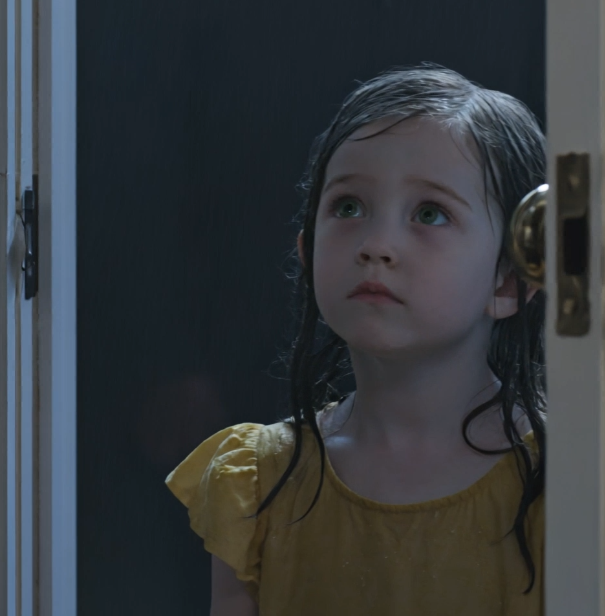
The storm had been going for three hours when Martin heard the knock. Not a knock, exactly — more a single, soft tap, the kind a small fist might make. He told himself it was a branch. He told himself it was the pipes. He poured another finger of whiskey and did not move from his chair. Then it came again.
He opened the door and the world stopped.
She was standing in the rain, soaking and still, her dark hair flat against her pale cheeks, her dress — that yellow dress, the one with the white daisies, the one he had chosen himself from the rack at Morrow’s department store — hanging wet and heavy from her small shoulders. She was eight years old. She was exactly eight years old, the same as she had been the last time he’d seen her. Six years ago. The night she died.“You left me.”
Martin grabbed the doorframe. His knuckles went white. The whiskey glass slipped from his other hand and exploded on the porch boards, and he didn’t hear it. He couldn’t hear anything except those three words and the thunder groaning somewhere far away over the hills. You left me. Her voice was the same — that small, clear voice that used to call to him from the hallway in the mornings, asking for pancakes, asking him to come see a drawing, asking why the sky was blue. He had loved that voice. He had loved it so much it had become a kind of pain.
“Lily,” he whispered. He hadn’t said her name out loud in six years. It felt like swallowing glass.
She didn’t blink. The rain moved around her in thin silver threads and she stood perfectly still in the middle of it, her eyes the precise shade of grey-green he had spent years trying to forget. He had packed away all the photographs. He had sold the house. He had moved three states north, changed his number, cut off everyone who had known him before. None of it had worked, of course — grief doesn’t care about geography — but he had tried. God, he had tried.
“Come inside,” he said, because what else do you say to a dead child standing in a storm?· · ·
She sat at his kitchen table and dripped onto the floor and said nothing. He put a towel around her shoulders and she let him, though she didn’t reach up to hold it. Her eyes moved around the room — taking in the bare walls, the single cup beside the sink, the calendar still turned to October of the previous year — and her expression was not angry or sad or frightened. It was something worse. It was knowing.
“How are you here?” Martin asked. His voice came out barely above a murmur.“You left me.”
“I didn’t—” He stopped. He sat down across from her. “I didn’t mean to.” The words sounded hollow even to him. They were hollow. He had been saying them to himself for six years, turning them over in the dark like smooth stones, and they had never once held any weight. I didn’t mean to was what you said when you forgot someone’s birthday. It was not sufficient for what he had done.
The night came back in pieces, the way it always did — never in full, never clean, always in jagged fragments that cut on their way up. The lake house. The argument with Claire, Lily’s mother, which had stretched into a screaming thing neither of them recognised as themselves. The two bottles of wine. His decision — his decision — to put Lily in the car and drive her to his mother’s for the night, to get her away from the fighting, he’d told himself. He’d told himself it was for her. He’d told himself that right up until the moment the wet guardrail gave way on County Road 7 and the car went over.
He had survived. A broken arm, three cracked ribs, a gash across his forehead that left a scar he still couldn’t look at in mirrors. He had climbed out of the wreck and stood in the shallows of the creek and looked at the water and known — known before anyone told him — that the current had taken her.
They found her body two days downstream.
He had never told the police about the wine. He had never told Claire. He had given a statement about the rain and the guardrail and the terrible accident, and every word was true except for the truth at the centre of it, the truth he had swallowed whole and carried ever since: that he had no business driving that night, that he had known it, that he had buckled her into that car anyway because his pride was too large to let him stay in that house and admit that the argument was lost.
“Lily,” he said now, to this impossible child at his table. “I am so sorry.” He felt tears on his face and didn’t wipe them away. “I am so sorry. I was drunk. I knew I was drunk. I put you in the car anyway. It was my fault. All of it. And I have been running from that every day since, and I—”
He broke. He put his face in his hands and he broke completely, the way he had never allowed himself to break — not at the funeral, not in the years after, not once, because breaking meant admitting it was real and admitting it was real meant admitting what he had done. He wept until he had no breath left and the kitchen was very quiet around him except for the rain.· · ·
When he lifted his head, she was standing beside him.
She placed one small, cold hand against his cheek. He flinched at the temperature of it — it was the cold of deep water, of December creeks — but he didn’t pull away. He looked at her face and something in it had shifted. The knowing was still there, but beneath it, or behind it, something that might — if he let himself believe — have been release.“You left me.”
“I know,” he said. “I know I did.”“Say it out loud.”
He understood what she meant. Not to her — not just to her. To the world. To the record. To the people who had spent six years believing it was only rain and a bad guardrail and terrible luck.
“I will,” he whispered. “I’ll tell them everything.”
She held his gaze for a long moment. Then she lowered her hand.
He blinked — one slow blink — and she was gone. The chair across from him was empty. The towel lay folded on the table, perfectly dry, as though it had never been used. The floor had no puddle. The front door stood closed and locked, the way it had been all evening.· · ·
Martin sat for a long time after that. Then he got up and found a piece of paper and sat back down and began to write. Not a note — he wasn’t going anywhere. A letter. Addressed to the county sheriff’s department. To Claire. To the truth, which he had buried six feet deep inside himself and called grief, when all along it had simply been guilt wearing grief’s clothing.
He wrote for an hour. He didn’t leave anything out.
When he was done, he sealed the envelope and set it on the table and looked at the empty chair across from him. The storm had stopped. Through the kitchen window, the first grey light of morning was beginning to separate the sky from the hills — pale and cold and entirely without comfort, but present. Undeniable.
He thought of Lily’s hand against his cheek. The impossible cold of it. He thought of how, in all the years he had dreamed of her — and he had dreamed of her constantly — she had always been underwater, always unreachable, always turning away. He wondered if that would change now. He suspected that was the point.
Some doors, once closed in cowardice, can only be opened again by the people we failed. And sometimes — if we are very unlucky, or perhaps very lucky — they come back to make us open them.
Martin picked up the envelope and held it in both hands, as carefully as he had once lifted a sleeping child from the back seat of a car on nights that were nothing like that night — ordinary nights, safe nights, nights he had thrown away without knowing their worth.
He held it until the sun came up.
Then he put on his coat and walked out into the cold morning to face what he had done.
