The Westfield Galleria on a Saturday afternoon was its own kind of organism — heaving, breathing, consuming. Nadia Okafor kept one hand looped through the strap of her bag and let the other trail behind her, feeling the small, warm fingers of her son, Marcus, curled inside her palm. He was seven. He smelled like the grape juice he’d spilled on his shirt at breakfast and still wore, despite her protests, because he loved that shirt, Mom, the one with the rocket.
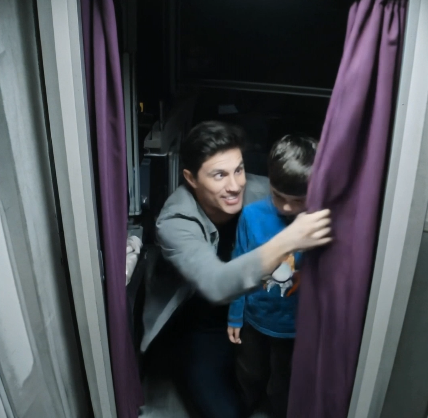
They moved through the Saturday current — past the pretzel stand that Marcus always slowed for, past the photo booth with its purple curtain, past the fountain where coins lay scattered like fallen stars on the turquoise tile. She was searching for the shoe store. Just sneakers. In and out. That was the plan.
Her phone buzzed. One glance — a work email, subject line blaring. Her thumb hovered. Just a second. She stopped walking, angled the screen, squinted.
Eleven seconds. Maybe twelve.
When she looked up, her hand held nothing.
· · ·
Part Two — The Realization
The first thing she did was laugh — a short, embarrassed sound — because surely he had ducked into the pretzel line again. Marcus. She turned. The pretzel stand had a father with a stroller, a teenage girl, a woman in a yellow coat. No rocket shirt.
Marcus. Louder now. A few heads turned. She spun in a circle, and the mall swam around her — a blurred carousel of storefronts and strangers and noise. The loudspeaker announced a sale. Someone laughed somewhere, bright and careless. Her heartbeat spiked, hard and fast, like a fist knocking at a locked door.
“Marcus!” The name tore out of her — raw, animal, wrong in her own mouth.
She ran to the fountain. She ran back. She grabbed the arm of a teenager — “Did you see a little boy? Blue shirt, rocket on the front, he’s seven, brown skin, he was just—” The teenager shook her head, stepped back, eyes wide. Nadia was already moving. The crowd didn’t part for her. It swallowed her like water swallows a stone.
She called Marcus’s name until her voice cracked and people stared and a security guard — heavyset, young, startled — jogged toward her. She told him. She watched his expression shift from confusion to something solemn and efficient, and that shift destroyed her, because it meant this was real, this was happening, this was the thing you never think will happen to you until the eleven seconds are already over.
· · ·
Part Three — The Hunt
The mall’s security office was a beige room behind a door marked STAFF. A woman named Pauline pulled up the CCTV grid — sixteen feeds at once, a mosaic of frozen moments. Nadia pressed her knuckles to her mouth and stared at the screens. Her legs trembled. She would not sit down. Sitting down felt like giving up.
Pauline rewound Feed 7: the concourse outside the pretzel stand. There was Nadia, stopped, head bent to her phone. And there was Marcus — small, vivid, the rocket on his chest even visible in the grainy footage — pulling free of her loosened hand with the easy confidence of a child who has never had reason to be afraid. He turned toward the photo booth with the purple curtain. A man was standing near it. Tall. Grey jacket. Cap pulled low.
The man crouched to Marcus’s level. His mouth moved.
Marcus nodded.
And then the purple curtain closed around both of them.
Nadia’s cry was soundless — a grief too large for her throat. The guard was already on his radio. Code Adam. Code Adam. North concourse photo booth, grey male, small child, blue shirt— The words blurred into static. Nadia was already running back through the door.
The photo booth stood where it always had — cheerful, absurd, painted with cartoon stars. The purple curtain hung still. She ripped it open.
Empty. A back panel, slightly ajar. A service corridor beyond it, dim and humming with ventilation.
She went in.
· · ·
Part Four — The Corridor
The service corridor ran parallel to the storefronts, a grey artery hidden inside the mall’s bright body. Fluorescent tubes buzzed overhead, one of them flickering in a slow, maddening rhythm. Crates. A pallet jack. A fire door at the far end, propped open with a rubber wedge — and beside it, a small white sneaker on its side.
Marcus’s. The velcro was still undone; she’d been meaning to teach him double-knots.
She burst through the fire door into the parking structure — concrete and diesel and the low moan of a passing car. Columns. Shadows between columns. And then, forty feet away, the man in the grey jacket, holding Marcus’s wrist, walking fast toward a dark blue sedan.
Marcus was crying now. She could hear it — small, hiccuping sobs — and the sound filled her with a rage so clean and absolute it burned away everything else.
“Marcus! MARCUS!”
The man’s head snapped around. For one frozen second, their eyes met across the concrete expanse. His face was ordinary — forgettable, almost. That was the worst part. He looked like no one. He looked like a father.
· · ·
Part Five — The Confrontation
He ran. He yanked Marcus forward, half-dragging him, and Nadia ran too — faster than she had ever run, faster than she knew she could. Her bag flew off her shoulder. Her heart hammered a single word with every stride: Marcus Marcus Marcus.
The man fumbled for his keys, hit the fob. The car blinked to life. He hauled the rear door open, and Marcus screamed — a full-throated, piercing scream that echoed between the concrete pillars and reached the parking attendant at the booth on Level 2, who stepped out and saw, and immediately called 911.
Nadia hit the man from behind. She was not a large woman. She was a mother. She drove her shoulder into his spine and they went down together, skidding on the oil-stained floor. She didn’t think about what to do next. Her hands found his collar, his jacket, anything, and she held on with every ounce of herself. He was stronger, and he thrashed, and she absorbed each blow and held tighter, screaming for her son, screaming for help, screaming just to keep screaming because silence felt like death.
Marcus stood three feet away, frozen between fleeing and helping, and then he did the only thing he could think of: he threw himself onto the man’s legs, wrapping his small arms around them, and held.
Two mall security guards came through the fire door at a sprint. A moment later, a police cruiser fishtailed into the parking lane, blue lights strobing cold and violent against the concrete walls. The man stopped fighting.
He went still.
And then Marcus was in her arms.
· · ·
Aftermath
She sat on the curb outside the parking structure with Marcus crushed against her chest, both of them shaking. A paramedic draped a foil blanket over her shoulders, and she didn’t feel it. She could only feel him — his ribs expanding and contracting, the wet heat of his tears against her neck, the rocket on his shirt pressing into her palm. She pressed back. Hard. As if she could fuse them.
“I found you,” she kept saying, lips in his hair. “I found you. I found you.”
A detective would later tell her that the man — a name she would learn and then spend years trying to forget — had done this before. That there was a pattern, a methodology, a preferred profile: children near distracted parents in busy places. That eleven seconds was all the time he had ever needed.
She never told the detective that she already knew exactly how long eleven seconds was. She would know for the rest of her life. She would feel those eleven seconds every morning when she took Marcus’s hand — tighter now, always tighter — as they walked into the world together, and she would never, not once, look at her phone.
