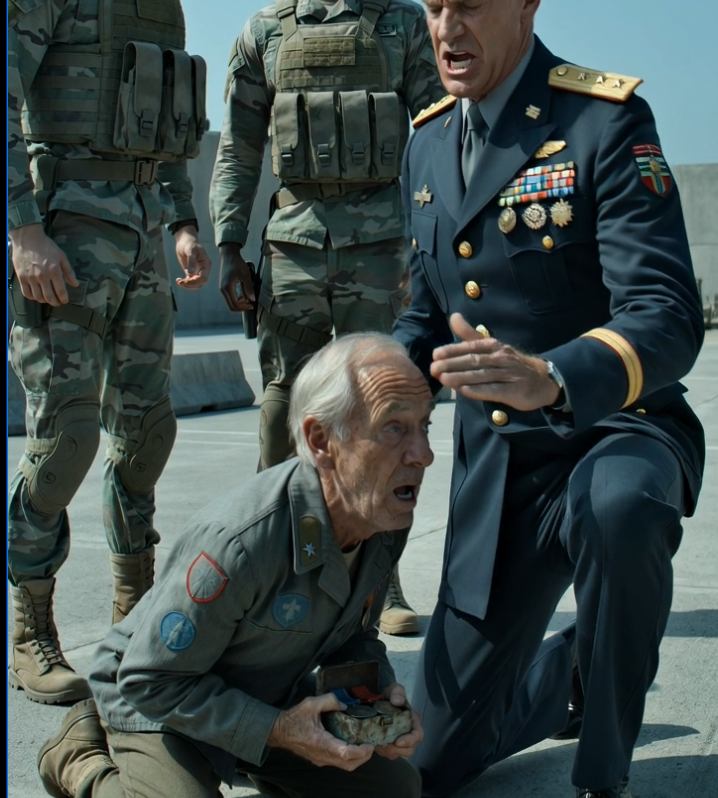
The shouting started before anyone in that corridor had a chance to think.
Five soldiers. One old man. And a moment that would change every single person in that hallway forever.
The fluorescent lights buzzed overhead like something angry, casting a cold, merciless glow across the gray corridor of Fort Bragg’s administrative wing. It was the kind of light that made everyone look sick. Made everything feel wrong.
He had wandered in from the side entrance — nobody was quite sure how. He looked like something the outside world had chewed up and spat out. An old man, maybe seventy, maybe older. His gray hair was matted and wild, his beard tangled with dirt. His jacket — once military green, now faded to almost nothing — hung off his bony shoulders like a ghost of something it used to be. His boots were cracked. His hands shook.
He was just standing there, near the water fountain, clutching a small metal box to his chest like it was the last thing he owned.
Because it was.
Corporal Danny Reeves spotted him first.
Twenty-four years old. Broad-shouldered. The kind of guy who had never once in his life questioned whether he was the most important person in a room.
“Hey.” His voice bounced off the walls. “Hey, old man.”
The veteran turned slowly. His eyes were pale blue, the color of a sky that hadn’t seen sun in a long time. He said nothing.
Reeves walked toward him, and four others followed — young, uniformed, with the energy of men who had never seen real war but wore the costume of it proudly.
“You can’t be in here,” Reeves said. “This is a restricted facility. Who let you in?”
The old man opened his mouth. Closed it again.
“I just needed to—” he started.
“You just needed to leave.” Reeves stepped close enough that the old man had to lean back. “You don’t belong here, old man.”
And then he shoved him.
Not enough to knock him down. Just enough to remind him of the order of things. Just enough to send a message: You are nothing. You are less than nothing.
The veteran’s shoulder hit the wall hard. He grunted. His grip on the box slipped.
The box hit the floor.
The lid popped open.
And the medals spilled out.
They scattered across the cold tile like fallen stars — bronze, silver, ribbons faded but still holding their color, each one a tiny monument to something enormous. A Purple Heart. A Bronze Star. Others that even the soldiers, had they bothered to look, might have recognized.
But they didn’t bother to look.
One of the other soldiers — barely nineteen, trying to impress — stepped forward and kicked the box. Not hard. Just enough.
Just enough to be cruel.
The old man made a sound that wasn’t quite a word. Something between a cry and a breath. He sank to his knees on the hard floor, his trembling hands moving across the tile, gathering each medal with the care of a man handling something sacred.
Because to him, they were.
“Please,” he whispered. His voice was barely there. “Please… those are all I have left.”
Nobody moved to help him.
Reeves crossed his arms. Someone laughed — a short, sharp sound that died quickly, uncomfortable even to the person who made it.
The old man kept reaching. Keep gathering. His knuckles were white. His eyes were wet.
And then —
“Stand down.”
The voice came from the far end of the corridor like a thunderclap.
Not loud, exactly. But the kind of voice that doesn’t need to be loud. The kind of voice that was built for exactly this — for cutting through noise, through arrogance, through the smallness of men who forgot what they were supposed to be.
“That is an order.”
Every soldier in the hallway went rigid.
Brigadier General Marcus Cole moved through the corridor like a force of nature wearing a uniform. He was fifty-eight, with iron-gray hair cropped close, and the kind of face that had seen enough of the world that nothing surprised him anymore.
Except this.
This surprised him.
He stopped at the edge of the scattered medals, looked down at them, and something happened to his face that none of the young soldiers had ever seen happen to a general before.
He went pale.
He dropped to one knee on the cold floor beside the old man — this decorated, powerful, unshakeable man — and he picked up one of the medals with both hands. Carefully. The way you’d pick up something that could break.
He stared at it for a long moment.
Then he looked at the old man’s face — really looked, for the first time — and his breath caught in his throat.
The soldiers watched, confused, the arrogance draining out of them one second at a time.
General Cole rose slowly to his feet. He turned to face the men who, thirty seconds ago, had been so certain of themselves.
The silence in the corridor was absolute.
“Do you have any idea,” the General said, his voice low and controlled and terrifying in its quiet, “who this man is?”
Nobody answered.
Nobody breathed.
Cole looked at each of them in turn — Reeves last, and longest.
“This is Sergeant William Hayes.”
The name landed in the corridor like a stone dropped into still water.
“Sergeant William Hayes received the Medal of Honor in 1971 for actions during the Battle of Quảng Trị. He entered enemy territory alone — alone — to pull eleven wounded men to safety under direct fire. Eleven men who would have died without him.”
Cole’s jaw tightened.
“He was shot three times during that extraction. He didn’t stop.”
One of the younger soldiers made a small sound. It might have been a word. It didn’t matter.
“Among the men he carried out that day—” Cole paused, and something crossed his face, something vast and personal and old— “was a twenty-two year old second lieutenant who’d taken a round to the chest and was bleeding out in the mud.”
He let the silence stretch.
“That lieutenant was my father.”
The corridor felt like it had been sealed shut. Like the air had stopped moving entirely.
Reeves looked like he’d been struck. His arms, so confidently crossed just minutes before, hung at his sides now. His face had gone the color of the walls.
General Cole turned back to the veteran — this small, shaking, dirty, magnificent man still on his knees on the floor.
He bent down. Picked up the last medal. Placed it gently into the old man’s hands. And then, with the full weight of his rank and his years and his gratitude, he straightened and raised his hand in a slow, formal salute.
“Sergeant Hayes,” he said. “On behalf of every man and woman in this building, and on behalf of my father who lived a full life because of you — thank you.”
William Hayes looked up at him.
His pale blue eyes, those eyes that had seen things no one in that corridor could imagine, filled with tears.
Not tears of shame. Not tears of pain.
The other kind.
The kind that comes when someone has been invisible for so long that being seen — truly seen — feels like being brought back from somewhere very far away.
He nodded. He couldn’t speak. He didn’t need to.
Cole turned to his soldiers one final time. There was no anger in his face anymore. Only something heavier.
“Pick up his medals,” he said quietly. “Every single one. And then you’re going to sit with this man, and you’re going to listen to him.”
He looked at Reeves.
“Because the least you can do — the absolute least — is hear the story of the man who gave you the freedom to stand in this hallway and act like you earned it.”
Nobody said a word.
Reeves knelt down first.
And one by one, in the cold fluorescent light of a corridor that would never quite feel the same again, five young soldiers gathered the scattered medals of a man who had given everything — and been given nothing in return.
Until today.
Some heroes don’t wear their medals anymore.
Some of them carry them in a box.
Just to remember that once, a very long time ago, they mattered.
