The scream cut through the morning air like a knife.
“Stay away from that filthy beggar!”
People on the sidewalk turned. A few stopped. Most just walked faster, the way city people do when something uncomfortable bleeds into their carefully managed day.
But nobody moved like the boy did.
Marcus Hale was not a man who tolerated disobedience. Not in his boardroom. Not in his home. And certainly not on the corner of West 4th and Brennan, where he had made the catastrophic mistake of taking his eight-year-old son, Eli, to walk to school instead of sending him in the car.
It was supposed to be a good morning. A rare one.
It lasted approximately four minutes.
Eli had spotted the old man the moment they turned the corner.
He was sitting against the wall of a closed laundromat, half in shadow, half in the thin November light. His coat was the color of old newsprint. His shoes — if you could still call them that — were split open at the toe, and his feet were cracked and gray with the cold, exposed to the world as if even his own clothes had given up on him.
Most people stepped around him. One woman actually crossed the street.
But Eli stopped walking.
He felt something that children feel before adults train it out of them — a raw, wordless pull toward suffering. Like a compass needle swinging north.
“Dad,” he said quietly. “That man’s feet are bleeding.”
Marcus didn’t even look up from his phone. “Keep walking, Eli.”
“Dad—”
“I said keep walking.”
But Eli was already drifting toward the old man, reaching into his backpack for the small water bottle he carried every single day, the one with the blue cap that his mother had packed for him every morning before she got sick, and still packed for him now out of pure habit, even from the hospital bed.
That’s when Marcus looked up.
That’s when his hand shot out and grabbed his son’s arm.
“Stay away from that filthy beggar!”
The words were ugly. They knew it as soon as they landed. Even Marcus, for one split second, heard how they sounded in the open air.
But he didn’t take them back.
He never took things back. That was the whole problem.
Eli’s eyes went wide — not with fear, exactly, but with something sharper. A kind of clarity. The look a child gets when they see their parent be wrong, truly wrong, and they understand it completely, maybe for the first time.
He yanked his arm free.
It surprised Marcus. His son was eight years old and small for his age, and he had never once in his life physically defied him. But the boy twisted hard, pulled loose, and ran — not away, but toward the old man.
“Eli!” Marcus’s voice cracked across the street.
People were watching now. A woman with a stroller had stopped. Two teenagers leaned against a wall with their phones half-raised. A delivery man slowed his cart.
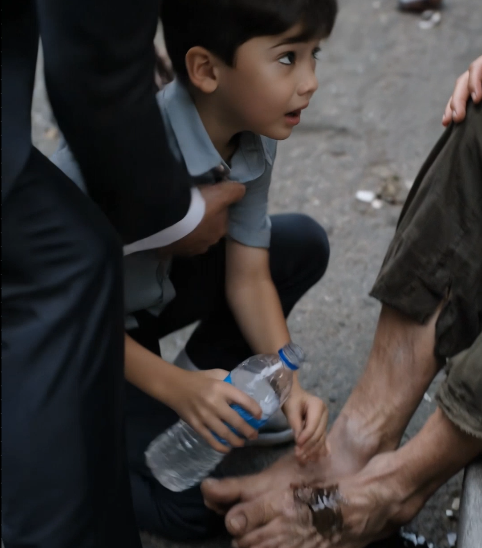
Eli dropped to his knees on the cold concrete in front of the old man. He unscrewed the blue cap from his water bottle with both hands. And then, slowly, deliberately, he began to pour the water over the old man’s cracked and bleeding feet, using his own small fingers to try to wipe them clean.
The old man looked down at the child as if he were dreaming.
Marcus stormed forward.
His jaw was tight. His face was doing the thing it always did when he was about to say something he would never apologize for — jaw muscles flexing, eyes going cold and flat, the boardroom face that had ended careers and silenced rooms.
He grabbed Eli by the shoulder and hauled him upright.
“That’s enough.“
“Dad, he’s hurt—”
“He means nothing to us!”
Eli stared up at him. There were tears on the boy’s face now, but his eyes weren’t defeated. They were burning. He looked, in that moment, almost unbearably like his mother.
Marcus opened his mouth to speak again.
And then the old man moved.
It was a slow movement. The kind that costs something — every inch of it earned against stiff joints and cold bones and years of sleeping on concrete and eating almost nothing and being walked past by a thousand people who looked right through you.
The old man lifted his head.
His face was weathered like old leather, mapped with lines that each had a story. His eyes were pale — a grayish blue, the color of winter sky — and they were full of tears he hadn’t shed yet.
On his wrist, where his coat sleeve had fallen back from the effort of moving, there was a mark.
A birthmark.
Dark reddish-brown, irregular at the edges, shaped roughly like a crescent moon.
Small. Distinctive. Unmistakable.
Exactly like the one on Marcus Hale’s left wrist.
The one Marcus had carried since birth.
The one he had asked the doctor about as a teenager and been told was hereditary.
Hereditary.
The old man’s eyes found Marcus.
Not Eli. Marcus.
They moved over his face the way a person reads something they memorized long ago — slowly, hungrily, as if checking that all the words are still there.
His voice, when it came, was barely above a whisper. Worn thin as paper. But every syllable was precise.
“Son… is that really you?”
The world stopped.
Not metaphorically. Not cinematically. It actually stopped — the delivery cart stopped rolling, the woman with the stroller froze, even the wind seemed to pause between buildings as if it too needed a moment.
Marcus could not speak.
His mouth was open. The boardroom face was gone — completely, instantly, as if it had never existed. What was underneath it was something rawer and younger and terrified. Something that had never appeared in any meeting room or courtroom or charity gala.
He looked like a little boy.
His eyes dropped to the old man’s wrist. To the mark. Back up to the pale gray-blue eyes that were — God, they were his eyes. How had he never seen it? How had he never—
His knees almost buckled.
Eli looked up at his father. Then down at the old man. Then back at his father. His small face was cycling through confusion and wonder and the beginnings of something he didn’t have a word for yet.
“Dad?” he whispered. “Do you… know him?”
Marcus couldn’t answer.
Because he was doing the math that he had spent thirty-six years refusing to do — every silence at the dinner table, every locked door, every answer that was really a non-answer. Your grandfather moved away. Your grandfather was complicated. We don’t talk about your grandfather.
We don’t talk about your grandfather.
The water from Eli’s bottle was still running off the edge of the curb, tracing a thin clear line along the gutter toward the drain.
The old man’s eyes hadn’t left Marcus’s face. They were patient, those eyes. Patient the way only a person who has waited a very long time can be patient. Patient the way hope becomes when it has survived things it had no right to survive.
One tear broke loose and ran down the side of the old man’s face.
He didn’t wipe it.
“I looked for you,” he whispered. “I looked for a long time.”
Marcus’s throat was working. His whole body was rigid, every defense he had ever built stacked up and braced — and crumbling, brick by brick, in real time, on a public sidewalk on a Tuesday morning while his eight-year-old son watched.
And Eli — small, tender, impossibly perceptive Eli, who had knelt in the cold to wash a stranger’s feet while his father screamed — reached out and took the old man’s marked wrist in both of his hands.
Gently. The same way he’d held the water bottle.
He looked up at Marcus with those burning eyes.
“Dad,” he said, very quietly. “I think you should sit down.”
Marcus Hale — wealthy, controlled, untouchable Marcus Hale — lowered himself to the curb.
And the three of them stayed there, in the thin November light, while the city moved around them like a river around three stones.
Some things, once broken open, cannot be closed again.
And sometimes, it takes a child eight years old to show a grown man where he left his heart.
