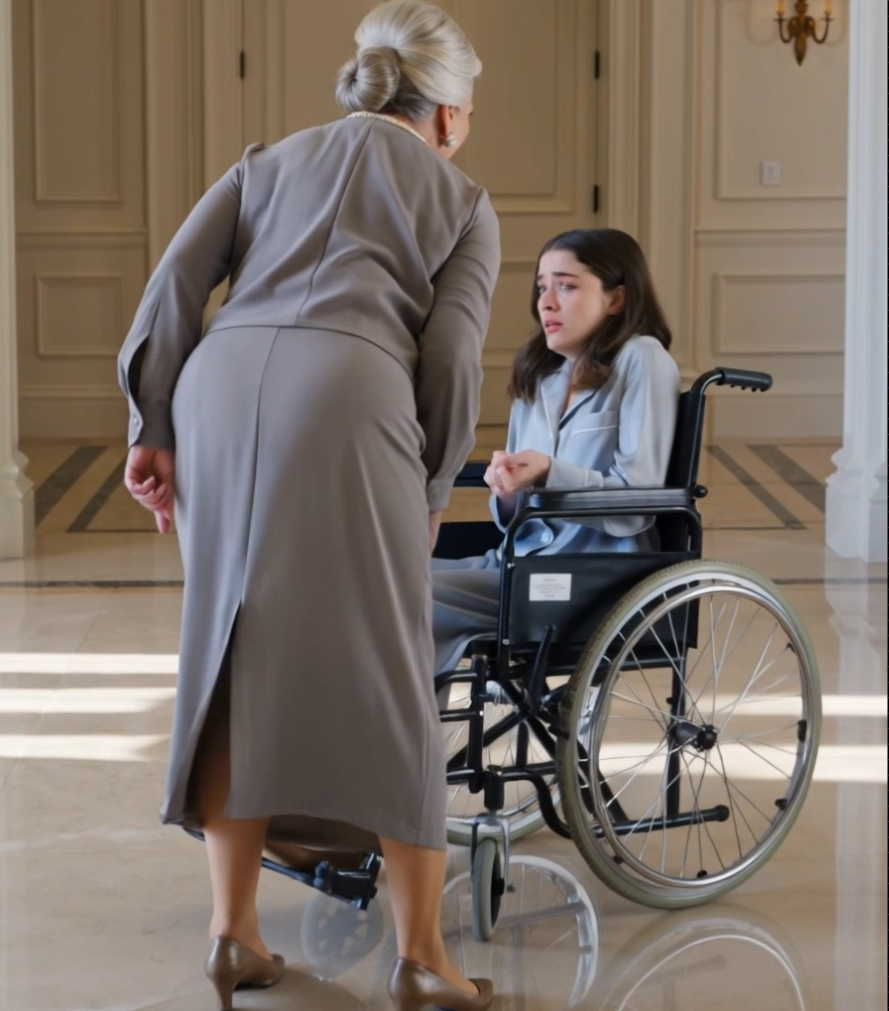
The slap cracked through the grand hall like a gunshot.
It happened before anyone could breathe. Before anyone could think. One second the morning light was pouring through the tall arched windows, painting golden stripes across the polished marble floor — and the next, the sound of skin against skin split the silence wide open.
Vivienne sat in her wheelchair, one hand pressed to her cheek, eyes wide with shock. The sting radiated through her face, but it was the words that hit harder.
“You ruined my son’s life.”
Margaret Harlow stood over her, elegant in cream silk, pearls at her throat, chest heaving with rage. She had the posture of a woman who had never once been told no. Her blue eyes burned cold and furious.
“You will never be part of this family.”
Vivienne’s fingers curled slowly around the armrests of her chair.
She didn’t scream. She didn’t collapse. She simply looked up at the woman who had despised her from the very first day — the day her son, Elliot, had walked through the front door of this mansion holding Vivienne’s hand, introducing her not as a girlfriend, not as a date, but as his wife.
Two weeks married. Six months after the accident that had taken the use of Vivienne’s legs.
Margaret had smiled that day. The cold, practiced smile of a woman already sharpening her knives.
That had been four months ago.
And now, finally, the knives were out in the open.
“She trapped you with her lies!”
Margaret’s voice ricocheted off the high ceilings, off the marble columns, off every pristine surface of the home she had spent thirty years curating. Her pointed finger aimed at the wheelchair like it was evidence of a crime.
“You were engaged to Sophia. You had a future. And then this woman—” she spat the word “—this woman appears out of nowhere with her sob story, her tragedy, her helplessness, and suddenly my son forgets everything he was supposed to be!”
Vivienne closed her eyes for just a moment.
She had heard variations of this speech before. In clipped whispers at dinner tables. In loaded silences during family gatherings. In the way Margaret never once used her name — always this woman, always her, always spoken like an accusation.
But she had never heard it screamed.
And she had never been struck.
“Mother. Stop.“
Elliot’s voice came from the doorway.
He crossed the marble floor in long, fast strides, his jaw tight, his eyes dark with something Vivienne had only seen in him once before — on the night of the accident, when he had found her in that hospital corridor, broken and terrified and completely alone.
He dropped to one knee beside her wheelchair.
His hands found hers — trembling, cold — and he held them the way you hold something precious. The way you hold something you are afraid of losing again.
“Are you okay?” he whispered.
Vivienne looked at him. She wanted to say yes. She wanted to be strong, controlled, dignified. She had promised herself she would never cry in front of Margaret Harlow.
But the tears came anyway.
They slid down her cheeks silently, tracking over the reddened skin where the slap had landed, and she hated herself for them — even though they were the most honest thing in the room.
“Get up,” Margaret said, her voice dropping to something colder, more dangerous. “Don’t kneel to her. Elliot. Look at me.”
He didn’t look at her.
“I said look at me.“
“I heard you the first time,” he said quietly. “And I’m choosing not to.”
The silence that followed was extraordinary. In thirty-four years, Elliot Harlow had never spoken to his mother that way. Not once. And from the way Margaret’s face shifted — the way the fury cracked just slightly at the edges, revealing something raw underneath — she knew it too.
“She manipulated you,” she said, but her voice had lost half its certainty. “You felt sorry for her. After the accident, you felt responsible, and she used that—”
“You don’t know anything about what happened after that accident.”
“I know enough.”
“No.” He finally stood. He turned to face his mother fully, squaring his shoulders. “You know the story you decided was true. You never asked. You never wanted to know.”
Margaret’s chin lifted. “Then tell me. Tell me why you threw away everything for a woman you’d known for four months. Tell me why you married her in secret, without telling your family, without giving any of us a chance—”
“Because I was afraid you’d do exactly this.”
The room went quiet.
Outside, a bird called once and fell silent. Somewhere deep in the house, a clock ticked.
Vivienne’s hands were still trembling. She could feel the heartbeat in her cheek where Margaret had struck her. But beneath the pain, beneath the exhaustion of four months of silent endurance, something else was stirring.
She reached into the pocket of her cardigan.
Her fingers closed around a small envelope — ivory, slightly worn at the corners from how many times she had taken it out and put it back. She had carried it with her for weeks, telling herself she would never use it. Telling herself it didn’t matter.
Telling herself the truth didn’t need defending.
But some truths, she was learning, had to be spoken out loud. Or they got buried.
“Then why,” she said softly.
Both Elliot and his mother turned to look at her.
Her voice was unsteady, threaded through with tears, but she held their gaze. She held it the way you hold onto a rope over open water — because there is nothing else.
“Then why did your son sign these hospital papers to save me after the accident?”
She held up the envelope.
The room didn’t move.
“I was unconscious for eleven days,” Vivienne continued, her voice barely above a whisper. “I had no family. No emergency contact. The doctors needed consent for the surgery — the one that kept me alive, not the one that failed to save my spine.” She paused. “They needed someone to sign. And Elliot had only known me for six weeks.”
She looked at Margaret directly now. Steadily. Through the tears.
“He signed those papers. He sat in that hospital for eleven days — I have the visitor logs, they’re in there too — while I was unconscious and had no idea he existed. He didn’t do it for gratitude. He didn’t do it because I asked him.” Her voice broke, just slightly, before she steadied it again. “He did it because he said he couldn’t walk away. That’s the man you raised, Mrs. Harlow. That’s the man you’re accusing me of trapping.”
The envelope sat between them like a small, devastating fact.
Margaret Harlow — who had commanded boardrooms, silenced critics, and bent the world to her expectations for six decades — did not move.
Her hand was still half-raised from where she had been pointing. Her mouth was slightly open. And in her eyes — those cold, certain, unbreachable eyes — something was happening that Vivienne had never expected to see.
Doubt.
Real, fracturing, irreversible doubt.
“Elliot,” Margaret said. The word came out strange. Smaller than usual.
He didn’t answer right away. He was looking at Vivienne — at the envelope, at her face, at the tears still drying on her cheek — with an expression she couldn’t quite read. Something between grief and awe. Something that looked almost like he was seeing her fully for the very first time.
“I never told her,” he said quietly, more to himself than anyone. “I never told you I kept those.”
Vivienne shook her head. “I found them in your desk. Six weeks ago.” Her voice cracked. “I’ve been carrying them ever since, trying to decide if I’d ever have to use them.”
The clock in the hallway kept ticking.
Margaret’s hand dropped slowly to her side.
And then — in a house built for impressions, for power, for the flawless performance of a perfect family — something happened that no marble floor or vaulted ceiling had ever witnessed before.
Margaret Harlow sat down on the bottom step of her grand staircase, pressed both hands over her mouth, and wept.
Not from cruelty. Not from rage.
From the unbearable, shattering weight of being wrong.
Vivienne watched her.
She didn’t feel triumph. She had never wanted this. She had only ever wanted to be seen — as a woman, as a wife, as a human being worthy of the same grace that everyone else in this family had always been given without question.
Elliot’s hand came to rest on her shoulder. Warm. Steady.
She reached up and covered it with her own.
Outside the tall windows, the morning light kept pouring in — indifferent and golden and endlessly patient — the way the truth always is, before it finally arrives.
