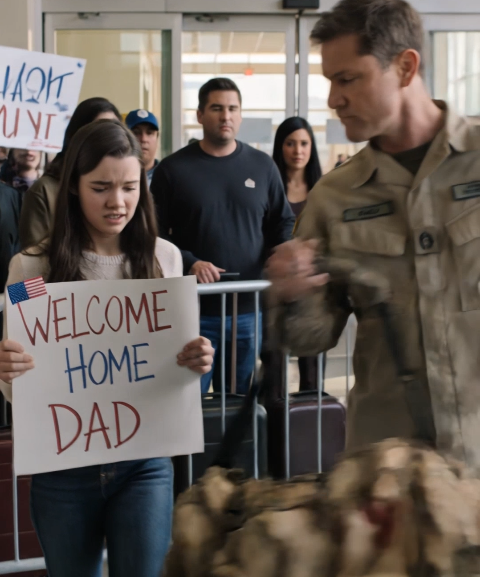
The airport was loud the way airports always are — announcements bouncing off tile, wheels rattling over grout lines, a hundred conversations bleeding into one low roar.
Maya didn’t hear any of it.
She stood at the arrivals barrier, her handmade sign pressed against her chest, the red and blue marker letters facing outward: WELCOME HOME DAD. A small American flag was taped to the corner, slightly crooked, the way all the best things are when you make them yourself at midnight because you can’t sleep from the excitement.
She’d been standing there for forty minutes.
Brandon had shown up eleven minutes ago.
“You didn’t have to bring that thing,” Brandon said, nodding at the sign with the particular contempt that nineteen-year-olds reserve for anything sincere. “It’s embarrassing.”
Maya kept her eyes on the arrivals doors. “Please don’t start.”
“I’m just saying. He’s been gone two years. You act like he’s some kind of hero—”
“Please.” Her voice dropped to a warning. “Don’t.”
She felt him shift beside her. Felt the temperature change the way you feel a storm before the rain hits.
“You always do this,” Brandon said. “You make everything into some big emotional—”
“I said don’t.“
What happened next took less than a second.
His hand came across her face so fast she didn’t even see it — she only heard it, a sharp crack that silenced the three feet of world around them. The metal barrier caught her as she stumbled into it, cold and unyielding. Her shoulder screamed. Her cheek burned like an open flame.
But her hands held the sign.
She didn’t drop the sign.
The world went strange and slow.
Somewhere behind her, a woman gasped. A child stopped crying mid-sob — even it understood, instinctively, that something had shifted. Maya blinked through the heat rising in her face and looked up, and what she saw frightened her in a new way: people with their phones raised, faces frozen in that particular modern horror of witnessing something real.
Brandon hadn’t moved. He stood there, jaw tight, the way people do when they’ve done something they won’t apologize for.
Maya straightened slowly.
She didn’t cry. She was past that now — past crying over Brandon, past pretending things between them had just “gotten complicated.” You don’t cry when you’ve already known the truth for months and chosen the easier story instead.
She turned back toward the doors.
Because her dad was coming through those doors.
And she was going to be standing there when he did.
The automatic doors slid open.
Travelers spilled out in clusters — couples reuniting, businessmen wheeling luggage, families folding into each other the way families do after distance. Maya scanned every face, the way she’d been doing for forty minutes, the way she’d been doing in her sleep for two years.
And then she saw him.
He wasn’t hard to spot. He never had been.
The desert uniform was worn in the way that only real use wears fabric — faded at the shoulders, creased in places no iron had touched. His boots hit the tile with the particular weight of someone who had walked on ground that mattered. The deployment bag hung from one shoulder like it was nothing, though she knew it was everything — everything he’d lived with for twenty-two months in places she could only partially imagine.
He was scanning. Eyes moving fast and practiced across the crowd, the way they always did — she’d almost forgotten that habit, how he was never fully in a room until he’d checked every corner of it.
Then he saw the sign.
A smile broke across his face — brief, real, the kind that comes before you can stop it. It was the smile she remembered from before. From pickup after soccer practice and Sunday morning pancakes and the night he sat outside her bedroom door and talked to her through the wood when she was too sad to open it.
Then the smile disappeared.
Because he saw her face.
Maya watched his eyes change.
She’d been raised by this man. She knew every register of his expression — pride, exhaustion, humor, grief. But this was something she’d only seen once before, years ago, when someone had threatened her outside her school and he’d arrived six minutes after she called him.
That look wasn’t anger.
Anger is loud. Anger is urgent and uncontrolled.
What crossed his face was quieter than anger, and far more serious.
He was already moving.
The bag dropped from his shoulder mid-step — a heavy thud against the floor that she felt in her chest — and then his arms were around her, both of them, fully, the way he used to hold her when she was small enough to be carried. She pressed her face into the rough fabric of his uniform. He smelled like travel and something she couldn’t name — like distance, like time, like every day he’d been somewhere she couldn’t reach him.
She still didn’t cry.
She held the sign out to one side and pressed the other fist against his back, fingers gripping uniform the way she’d gripped the barrier, and she breathed.
Just breathed.
He pulled back after a long moment.
His hands came to her shoulders, and he looked at her the way doctors look at things they need to assess — but gentler, with a fury underneath it so controlled it was almost peaceful.
His thumb grazed her cheekbone, barely touching.
She didn’t flinch. She just watched his face.
He turned.
Brandon hadn’t left. He was still standing three feet back, arms crossed, working himself into the posture of someone who had reasons. Maya had seen that posture too many times. She knew what came next — the explanations, the context, the you don’t understand how she is.
Her father looked at him for exactly two seconds.
He didn’t raise his voice.
He said, very quietly: “You’re leaving. Now.”
Three words.
Not a request.
Not even really a sentence — more like a door closing.
Brandon looked at the boots. Looked at the uniform. Looked at the bag on the floor like it was evidence of something he’d miscalculated. His arms uncrossed slowly. His chin dropped half an inch.
He left.
He walked out of frame and didn’t look back, and Maya watched him go with the strange calm of someone whose world had just quietly rearranged itself into something more honest.
Her father turned back to her.
He reached out and touched the small flag taped to the corner of her sign — just one finger, adjusting it slightly, straightening it the way he used to straighten her collar before school pictures. The gesture was so ordinary she almost came apart at it.
He picked up his bag.
She looked at the sign in her hands — the red and blue letters, the crooked flag, the hours she’d spent making something he’d only see for thirty seconds — and she didn’t feel embarrassed about any of it.
He looked at her sideways, the way he did when he was trying not to make a moment too big.
“Hungry?”
One word. Like they’d picked up mid-conversation. Like he hadn’t been gone twenty-two months, like her face wasn’t still warm, like the whole morning hadn’t just split in two directions — one frightening, one finally safe.
She laughed. Actually laughed.
“Starving,” she said.
They walked toward the exit together, and the crowd around them slowly remembered how to move — strangers resuming their conversations, wheels rattling forward again, the low roar of the airport refilling the space.
Nobody followed.
Nobody stopped them.
Just a father and his daughter walking out of an arrivals hall into whatever came next — the sign still in her hands, the flag still taped to the corner, slightly crooked.
The way the best things always are.
