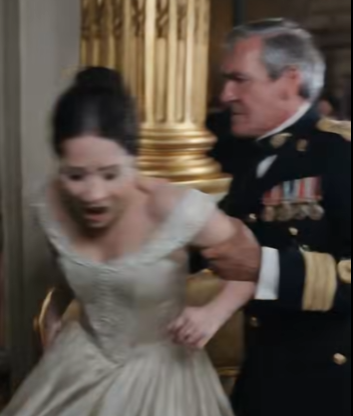
She hit the chairs before anyone understood what they’d just witnessed.
One second she was standing at the pillar — composed, beautiful, a young woman in a pale blue ballgown doing nothing more dangerous than existing — and the next she was crashing through gilded chairs in a sound that cut straight through the orchestra, through the clinking crystal, through four hundred years of carefully maintained civility.
The chandelier kept burning above it all, indifferent and magnificent.
The music stopped.
The ballroom was the kind of room that made people behave differently — ceilings thirty feet high, molding that took craftsmen a year to carve, floors polished to a mirror finish that reflected every gown and every medal and every careful smile. The Hartwell Foundation Gala happened once a year, and an invitation was a particular kind of currency.
Tonight, three hundred guests in silk and military dress and custom tailoring stood holding champagne flutes and watched something happen that rooms like this were specifically designed to prevent.
General Arthur Caldwell stood in the center of it all, his face the color of old brick, his chest heaving beneath six rows of decorations earned across four decades of distinguished service.
His hand was still extended from the shove.
The young woman’s name was Lena Vasquez. She was twenty-six years old, a junior foreign policy attaché, and she had been invited to this gala by people considerably more powerful than herself as a gesture of professional recognition.
She pulled herself up from the floor now with shaking arms, one hand going immediately to her right shoulder — the shoulder that had caught a chair on the way down. Her hair had come half-loose. A thin scratch ran along her collarbone, just visible above the neckline of her gown.
She was breathing hard. But her eyes were steady.
She looked at the General.
And she did not look afraid.
The room had erupted in the way that only genuinely shocked rooms do — not the performative outrage of crowds that expected drama, but the raw, unscripted noise of people who cannot believe what their eyes have just processed.
Phones were everywhere. That was the thing about formal events in the current century — underneath all the silk and protocol and carefully rehearsed deference, everyone had a rectangle of glass in their evening bag or breast pocket. They came out now like a reflex, automatic as breathing. Hundreds of small screens turning the chaos into content before the chaos had even finished happening.
Someone was crying near the back. A woman in green chiffon, hand pressed to her mouth.
A man in black tie grabbed his companion’s arm without realizing he’d done it.
“Stop!” someone shouted from the left side of the room. “What are you doing?!“
General Caldwell turned toward the voice. His face was incandescent.
“Stay out of this,” he said. The command voice — the voice that had moved battalions, that had ended careers, that had operated at volumes ranging from whisper to thunderclap with equal authority.
The room didn’t listen.
For a moment he seemed genuinely stunned by that. By the refusal of the room to arrange itself according to his will, the way rooms had always arranged themselves. He turned in a slow half-circle, looking at the phones, looking at the faces — the horror, the judgment, the recording of all of it in real time — and something moved across his expression that might have been the first edge of comprehension.
He yelled for silence anyway.
Nobody gave it.
The young officer had been standing twelve feet away when it happened.
His name was Captain James Okafor, and he was twenty-nine years old, and he had exactly the kind of training that produces one very specific response to witnessing an act of violence: he moved toward it.
He positioned himself between Lena and the General with the economy of someone who has rehearsed intervention so many times it has become instinct. He didn’t touch anyone. He didn’t raise his voice. He stood with his shoulders squared and his hands visible and his eyes fixed on the General’s face.
“Sir,” he said. Quiet. Firm. The single word doing the work of a sentence much longer and considerably less polite.
The General looked at him the way generals look at captains who have miscalculated their moment.
“Move,” Caldwell said.
“I won’t, sir.”
The air between them was thin and electric — the specific tension of two people from the same world, operating under the same codes, arriving at a moment where those codes had broken down into something rawer and older and harder to navigate.
It felt, somehow, like a duel. Like something out of another century dressed in the clothes of this one.
Nobody breathed.
Then the double doors exploded open.
Event security — four of them, in black, moving with the practiced efficiency of people paid specifically for moments like this — spread across the room in seconds. They were professionals. They read the scene the way professionals do, assembling the picture from fragments: the overturned chairs, the woman with her hand on her shoulder, the General’s posture, the Captain standing between them, the three hundred phones still rolling.
One of them spoke quietly into an earpiece.
Another moved toward the General with the careful approach you use with someone who has authority and adrenaline and no clear plan.
“Sir, I’m going to need you to come with us.”
General Caldwell looked at the security officer. Looked at the Captain. Looked at Lena. Looked at the phones.
The crimson had faded from his face, leaving something worse — a gray, sunken quality, the color of a man watching something irreversible complete its arc.
Lena had moved back to her feet fully now. She was standing straight — deliberately, visibly straight, in the way that requires specific effort when your shoulder is screaming and your hands are trembling and three hundred people are watching you decide who you are.
A woman in red moved to her side — a friend, or someone who had just decided to become one. She put a hand gently on Lena’s arm. Lena nodded once, the smallest acknowledgment of kindness.
She didn’t leave. She didn’t look away from the General.
He was being guided toward the door now, security on both sides, his medals catching the chandelier light with every step, each decoration a small bright irony.
At the threshold, he stopped.
He turned.
And for just a moment, standing in the wreckage of the most consequential minute of his decorated life, General Arthur Caldwell looked at Lena Vasquez across the ballroom.
His expression shifted into something none of the three hundred witnesses could fully read.
Not remorse, exactly. Something more complicated. Something that might have required context none of them had.
They got it two hours later.
The phones had done their work by then — the footage spreading outward in the particular velocity of things that confirm what people already feel about power and violence and beautiful rooms and who gets protected inside them.
But it was a journalist in the corner — a small, sharp-eyed woman who had covered three continents and knew how to find the seam in a story — who pulled the thread.
She found the document.
Filed eighteen months ago. Sealed. A formal internal complaint — harassment, intimidation, career interference — submitted by a junior attaché named Lena Vasquez against a senior officer who had tried, systematically and patiently and through every available bureaucratic mechanism, to end her career before it began.
The complaint had been reviewed.
And buried.
By the office of General Arthur Caldwell’s closest ally.
Caldwell hadn’t come tonight to confront a stranger.
He’d come because he’d learned, three hours before the gala, that the buried document had been found. That it was going to be published. That Lena Vasquez — the young woman he’d spent eighteen months trying to quietly erase — was going to be in this room, tonight, surrounded by exactly the people whose opinion he’d spent a lifetime cultivating.
He hadn’t planned what he did at the pillar.
Rage rarely comes with a plan.
Captain Okafor found Lena later, in a side corridor, sitting on a velvet bench with her shoes off and her shoulder wrapped in a cold compress someone had found.
He sat down beside her without asking permission.
“You knew he’d be here tonight,” he said.
It wasn’t a question.
Lena looked at the far wall for a moment. Then she looked at her phone — at the footage of herself standing straight in a ruined ballgown while a general’s career ended in real time on three hundred screens.
“I knew,” she said quietly.
Okafor absorbed that. “You could have stayed home.”
She was quiet for a long moment.
“So could he,” she said.
Outside the ballroom, the chandelier was still burning — thirty feet above a floor scattered with overturned chairs and dropped programs and the particular debris of an evening that had become something no one would forget.
And somewhere in a black car moving through the city, a man with forty years of medals sat in the dark and understood, for the first time, what it felt like to be on the wrong side of a room that wouldn’t look away.
