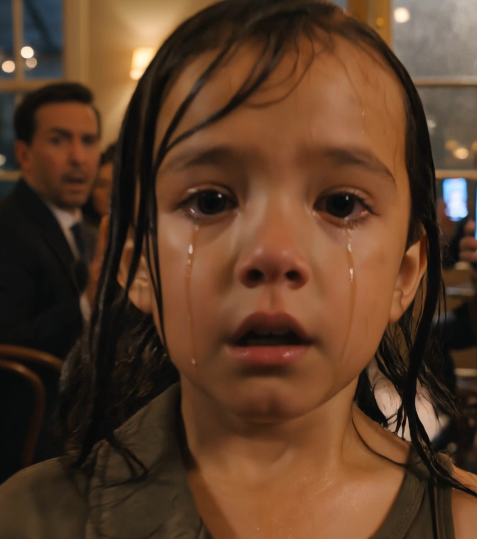
The door didn’t open.
It slammed open — glass and rain and cold air and a small body stumbling through it all at once, like the storm outside had finally decided to throw something at the warmth and see what happened.
Every cup in the room stopped moving.
Every sentence died mid-word.
And in the silence that followed — the specific, total silence of a crowded place that has collectively forgotten to breathe — a seven-year-old girl stood in a puddle of her own making and looked at the faces of strangers who were already reaching for their phones.
The café was called Lumen, and on a rainy Thursday evening it was exactly what a certain kind of person needed — golden light pooling on marble tables, the smell of espresso and warm pastry, soft music that cost someone a lot of money to make sound effortless. The kind of place where the chairs were comfortable enough that people stayed two hours longer than they planned and left feeling like the city wasn’t so bad after all.
Forty-three people were inside when the door slammed open.
In the first second, every one of them turned.
The girl was small — small even for seven, the kind of small that comes from not having quite enough of the things that make children grow. Her coat was a man’s coat, tan and torn at both pockets, hanging so far past her knees it nearly dragged. Her hair was dark and soaked flat against her face. Her shoes — mismatched, one a sneaker and one something rubber — had left wet prints all the way from the door.
Her face was the thing that stopped people.
Not the dirt on her cheeks, not the tears mixing with rainwater, not the trembling lip or the enormous eyes scanning the room with an expression that existed somewhere between desperation and something older and more exhausted.
It was the way she looked at all of them.
Like she’d been looking for something for a very long time, and she wasn’t sure if she’d found it yet, and she was almost too tired to keep hoping either way.
A young woman at the front table — mid-twenties, first date energy, a glass of wine she’d barely touched — covered her mouth with both hands.
The man across from her forgot she existed.
Then the girl opened her mouth.
And the room, which had already gone silent, somehow went more silent — the kind of silence that has texture, that you can feel pressing against your eardrums.
Her voice was small. Fragile in the way that makes something more powerful, not less — the way a single candle in a very dark room does more work than it has any right to.
“Mommy, can you hear me?”
That was all. Four words and a melody. Simple enough that a child could have written it, which was exactly what had happened.
But the way she sang it —
The way she sang it was not simple at all.
Phones rose everywhere. Not unkindly — or at least not consciously unkindly. Just the reflex of a generation that has learned to reach for documentation when encountering something it doesn’t know how to hold in its bare hands.
The girl didn’t seem to notice them. Or if she did, she’d decided they didn’t matter.
She kept singing.
“Can you see me standing here?”
Her voice cracked on the last word — just slightly, just enough. A woman near the window made a sound like she’d been touched somewhere she hadn’t expected.
“I’ve been waiting in the rain so long, I forgot what dry feels like.”
That wasn’t the official lyric — there were no official lyrics, because this song had never been written down anywhere, had never been recorded, had never existed outside of one person’s voice and one child’s memory.
But nobody in the café knew that yet.
The barista — a young man named Theo who had worked at Lumen for two years and had seen most things — had stepped out from behind the counter. Not approaching. Just stepping out, hands loose at his sides, watching.
Later he would say that the thing that got him wasn’t the voice, though the voice was extraordinary.
It was the posture.
The way the girl stood with her shoulders slightly forward and her chin slightly up, like something in her had decided that if she was going to do this, she was going to do it properly. Like someone had once taught her that you stand up straight when you sing, that you give it everything, that the song deserves your best even when you have very little left to give.
Someone had taught her that.
The question was who.
The song continued. The girl’s eyes had closed now — not in performance, but in the private way of someone going somewhere else while their body stays in the room. Somewhere warm and specific, where the person she was singing to could actually hear her.
“I kept the song you sang to me. I keep it right here, right here. So when the dark gets too dark to see, I just sing and you feel near.”
A teenage boy near the back — leather jacket, headphones around his neck, the studied disaffection of someone who has decided not to care about things — was crying.
He wasn’t the only one.
The first-date woman had given up entirely on composure. Her companion had given up watching her give up and was simply crying himself.
Three different people were narrating softly into their phones in three different languages.
The girl’s voice cracked again. And again. And she kept going.
Nobody moved to stop her. Nobody moved to help her, either — not yet, because the room was suspended in something and everyone could feel it and no one wanted to be the one who broke it before it finished doing whatever it was doing.
The rain hit the windows. The golden light held steady. The small girl in the enormous coat stood in her puddle and sang a song that nobody in the room had ever heard before.
Except one person.
The woman near the window had been sitting alone.
She was somewhere in her mid-forties, elegant in the unshowy way of someone who stopped trying to be impressive years ago and settled into simply being themselves. A white blouse. Dark hair shot through with silver. A cup of tea she had let go cold.
She had come here, as she came every Thursday evening, because Thursday evenings were the hardest. Had been the hardest for two years. Because Thursday was the day of the week it had happened — the accident, the ice on the road, the call she had received standing in a grocery store holding a bag of apples, the apples falling, the whole subsequent structure of her life falling with them.
Her daughter had been five years old.
And her daughter had made up that song.
Sitting at a piano she could barely reach, picking out notes with two fingers, singing in her high, earnest, completely tuneless voice: Mommy, can you hear me?
They had sung it together, eventually. Dozens of times. Hundreds. In the car, in the bath, at bedtime, in the kitchen while making pancakes on Saturday mornings.
I kept the song you sang to me. I keep it right here, right here.
It wasn’t a song that existed anywhere.
It wasn’t a song that anyone else could possibly know.
The woman was standing before she’d decided to stand.
Her chair scraped back. Her cup hit the saucer wrong. Both hands went to the table to steady herself as something moved through her — a wave, enormous and physical, the kind that starts behind the sternum and moves outward until it has nowhere left to go.
The girl was still singing.
“So when the dark gets too dark to see—”
The woman’s voice came out before she could stop it. Barely a whisper. Barely a sound at all.
“That’s my daughter’s song.”
The room heard it anyway.
The gasps were involuntary — the sharp collective intake of forty-three people arriving simultaneously at the edge of something they couldn’t yet see past.
Phones swung toward the woman. Swung back to the girl. The girl’s eyes opened.
She stopped singing.
In the golden, rain-blurred silence, the small girl in the oversized coat and the woman with the cold cup of tea looked at each other across the crowded room.
And somewhere between those two faces — between the child who had learned the song and the mother who had lost the child who sang it — the question that mattered most hung in the trembling air, and nobody breathed, and the rain kept falling, and everyone waited for an answer they didn’t yet have words for.
